

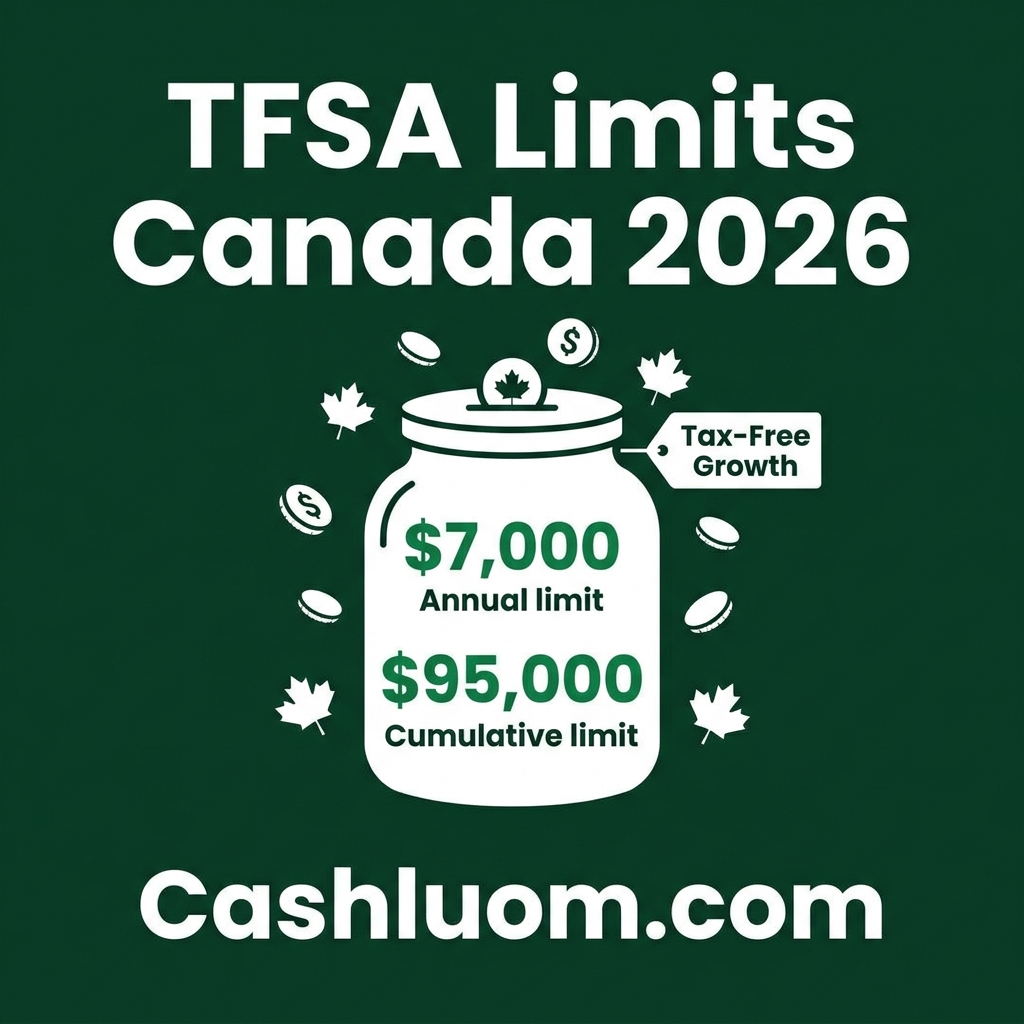
The Tax-Free Savings Account is arguably the best general-purpose investment account in the Canadian tax system. Unlike the RRSP (where you pay tax on withdrawal), every dollar that grows inside a TFSA comes out tax-free: no questions asked. Whether you're saving for a car, an emergency fund, or retirement, the TFSA works for any goal because it has no restrictions on when or why you withdraw. Here's everything you need to know about the 2026 limits, your cumulative room, and how to maximize it.
2026 TFSA Contribution Limit
Annual Limit: $7,000 | Cumulative Room (since 2009): $102,000
Withdrawals from a TFSA add back to your contribution room, but only in the following calendar year. Over-contributing to a TFSA triggers a 1% per month penalty on the excess amount. Check your exact room at CRA My Account.
TFSA Annual Limits: Full History Since 2009
Your total cumulative TFSA room is the sum of every year's annual limit since you turned 18 and became a Canadian resident: minus any contributions you've already made, plus any withdrawals made in prior years. Here's the complete annual limit history:
| Year | Annual Limit | Cumulative Total (From 2009) |
|---|---|---|
| 2009 | $5,000 | $5,000 |
| 2010 | $5,000 | $10,000 |
| 2011 | $5,000 | $15,000 |
| 2012 | $5,000 | $20,000 |
| 2013 | $5,500 | $25,500 |
| 2014 | $5,500 | $31,000 |
| 2015 | $10,000 | $41,000 |
| 2016 | $5,500 | $46,500 |
| 2017 | $5,500 | $52,000 |
| 2018 | $5,500 | $57,500 |
| 2019 | $6,000 | $63,500 |
| 2020 | $6,000 | $69,500 |
| 2021 | $6,000 | $75,500 |
| 2022 | $6,000 | $81,500 |
| 2023 | $6,500 | $88,000 |
| 2024 | $7,000 | $95,000 |
| 2025 | $7,000 | $102,000 |
| 2026 | $7,000 | $102,000 (as of Jan 1, 2026) |
⚠️ 2026 TFSA limit confirmed at $7,000. Cumulative total assumes resident from 2009 and age 18+ throughout. Source: CRA — TFSA Contribution Room.
TFSA vs RRSP: Which is Better for You?
The classic Canadian financial planning question. The short answer: it depends on whether you'll be in a higher or lower tax bracket at withdrawal. But for most people, the TFSA wins on flexibility:
| Feature | TFSA | RRSP |
|---|---|---|
| Tax deduction on contribution | No | Yes ✅ |
| Growth inside account | Tax-free ✅ | Tax-deferred |
| Tax on withdrawal | None ✅ | Taxed as income |
| Withdrawal room restored | Yes — next calendar year ✅ | No — room is gone permanently |
| Affects income-tested benefits | No ✅ | Yes — withdrawals add to income |
| Mandatory withdrawal age | None ✅ | Must convert to RRIF by age 71 |
| Best for | Medium-term savings, high flexibility, retirement if low income expected | Tax deferral if high income now, expect lower income in retirement |
What Can You Hold in a TFSA?
A TFSA is not just a savings account. The "savings account" in the name is misleading: it's actually a tax-sheltered investment account that can hold almost anything:
- High-interest savings accounts: interest earned inside is completely tax-free
- GICs (Guaranteed Investment Certificates): safe, fixed-return instruments with no tax on gains
- Stocks and ETFs. Canadian and US equities, with no capital gains tax on growth inside the account
- Bonds and bond ETFs: interest income sheltered from tax
- Mutual funds: managed funds of any type eligible within a registered account
- REITs and dividend-paying stocks: dividends earned inside a TFSA are tax-free (note: US dividends subject to 15% withholding even in TFSA)
📊 Chart Suggestion: "Growth chart showing $102,000 max-contributed TFSA growing at 7% annually over 20 years vs same amount in a taxable account at 30% effective rate. Title: 'Tax-Free vs Taxable: The TFSA Advantage Over 20 Years'"
Frequently Asked Questions
What is the TFSA contribution limit for 2026?
The 2026 TFSA annual contribution limit is $7,000: unchanged from 2024 and 2025. If you've never contributed to a TFSA and have been a Canadian resident since 2009 (and were 18+ throughout), your cumulative room as of January 1, 2026 is $102,000. Check your exact personal room at CRA My Account, as it reflects your actual contribution history.
What happens if I over-contribute to my TFSA?
Over-contributing triggers a 1% per month penalty tax on the excess amount: applied until the excess is withdrawn. The CRA tracks TFSA contributions and will send an assessment letter if you've over-contributed. The fix is simple: withdraw the excess immediately. The penalty is typically 1–2 months of 1% on the excess before the CRA processes the correction.
If I withdraw from my TFSA, can I put the money back?
Yes, but not immediately in the same year. TFSA withdrawals are added back to your contribution room on January 1 of the following year. So if you withdraw $20,000 in June 2026, you get that $20,000 of room back on January 1, 2027. Contributing it back before the year ends would be an over-contribution and trigger the penalty.
Do TFSA withdrawals affect my OAS or GIS in retirement?
No. TFSA withdrawals don't count as income for any purpose: including means-tested government benefits like Old Age Security (OAS), the Guaranteed Income Supplement (GIS), provincial social assistance, or the GST/HST credit. This is a key advantage over RRSP withdrawals, which do count as income and can trigger OAS clawbacks for higher-income retirees.
Can newcomers to Canada contribute to a TFSA?
Yes, from the year you become a Canadian resident (or turn 18, if older). You accumulate TFSA room for each calendar year you're a resident and 18+. Years spent as a non-resident don't generate room. Non-residents can keep their existing TFSA open, but cannot make new contributions: over-contribution as a non-resident is subject to 1% per month penalty tax.
Should I put my emergency fund in a TFSA?
Yes: a high-interest savings account inside a TFSA is one of the best places for an emergency fund. The interest is tax-free (unlike a regular savings account), you can withdraw any time with no penalty, and withdrawals restore your room the following year. Use a "TFSA HISA" (high-interest savings account within a TFSA) at a bank offering 4–5% in 2026 for maximum return on your emergency cushion.
Final Thoughts
The TFSA is one of the most flexible and powerful wealth-building tools in Canada. With $102,000 in cumulative room available for 2026 and $7,000 more added every year, Canadians who consistently maximize their TFSA from an early age accumulate substantial tax-free wealth over time. The key rules: don't over-contribute, understand the US withholding tax quirk, and hold your most growth-oriented investments inside the account. Use our Compound Interest Calculator to see what consistent TFSA contributions could be worth at retirement, and compare TFSA vs RRSP strategy in our RRSP vs TFSA Guide for 2026.
Sources & Citations: Content verified against official guidelines from the IRS (US), HMRC (UK), and ATO (AU). Information is reviewed for accuracy prior to publication.
Free Calculator
Compound Interest Calculator
Visualize the power of compounding on your savings and investments. Enter your starting balance, monthly contributions, and expected interest rate to see your wealth grow over time. Features a detailed year-by-year breakdown and a comparison between your contributions and the total interest earned over the decades.
Comments are coming soon. Have feedback? Contact us.