
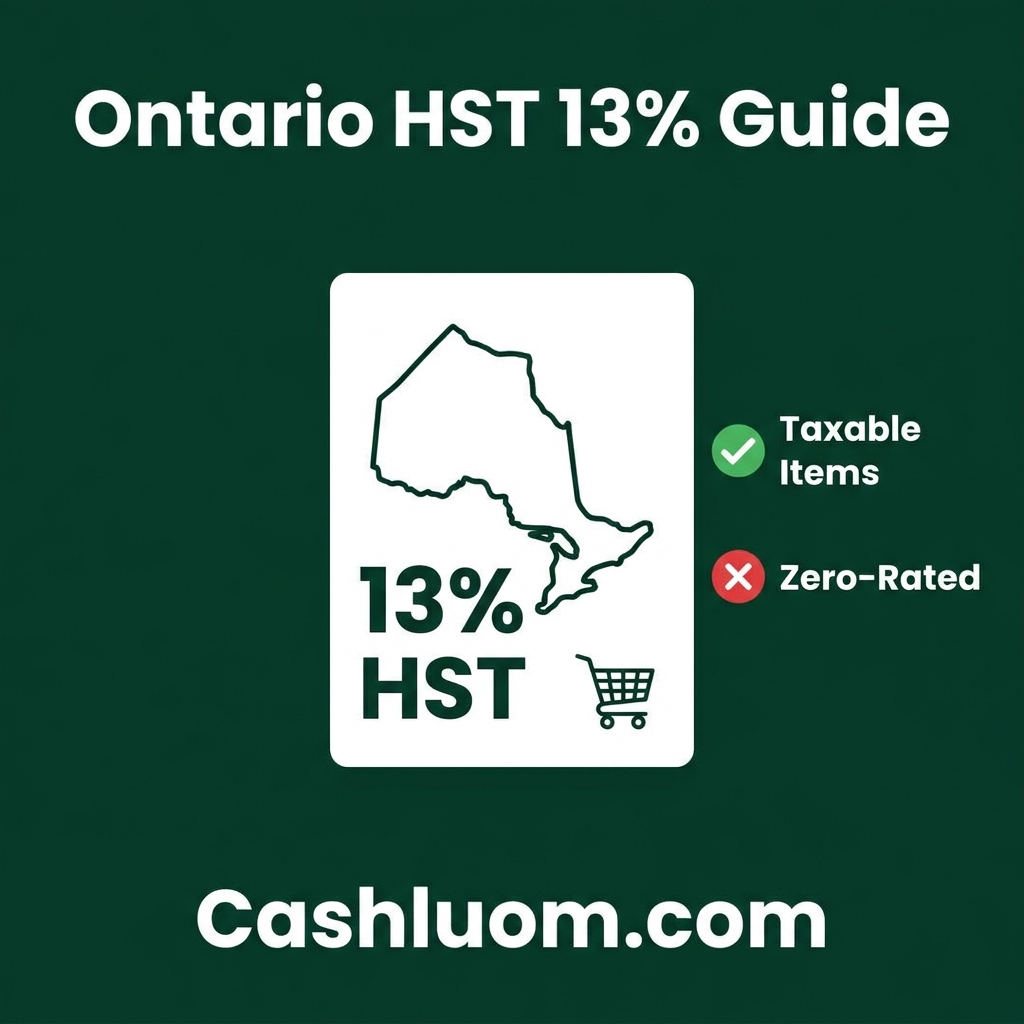
You're standing at an Ontario grocery checkout. Your cart has chips, fruit, granola bars, and bottled water. Some items get taxed. Some don't. Some get taxed at the lower federal rate only. The rules aren't obvious, and most Ontario residents don't fully know which side of the line their regular purchases fall on. This guide breaks down Ontario's 13% HST: what's taxable, what's exempt, and how the system actually works so you stop guessing at the register.
Ontario HST Breakdown
13% HST = 5% Federal GST + 8% Ontario Provincial Tax
Ontario harmonized its provincial retail sales tax with the federal GST on July 1, 2010 to create the HST. The two components are collected together but flow separately to Ottawa and Queen's Park.
Three Categories: Taxable, Zero-Rated, and Exempt
Ontario's HST system has three distinct categories for goods and services, and confusing them is expensive. The key distinction between zero-rated and exempt matters most to businesses claiming Input Tax Credits (ITCs).
| Category | HST Charged? | Can Business Claim ITCs? | Examples |
|---|---|---|---|
| Taxable (13%) | Yes — 13% | Yes | Restaurant meals, electronics, clothing over $30, alcohol, gas |
| Zero-Rated (0%) | No — but still a "taxable supply" | Yes | Basic groceries, prescription drugs, medical devices, exports |
| Exempt | No | No | Residential rent, daycare, most health services, financial services |
What's Zero-Rated in Ontario?
Zero-rated goods and services pay no HST at point of sale. These are designed to reduce the tax burden on necessities. According to CRA's GST/HST Guide (RC4022), the main zero-rated categories include:
- Basic groceries: most unprocessed or lightly processed food (produce, meat, eggs, dairy, bread, canned goods)
- Prescription drugs: medications dispensed under a prescription
- Medical devices: hearing aids, wheelchairs, eyeglasses (not contact lens cleaner though)
- Agricultural products: crops, livestock for human consumption
- Feminine hygiene products: added to zero-rated list in 2015
- Exports: goods or services sold to non-residents outside Canada
- International travel: flights to destinations outside Canada
Taxable vs Zero-Rated: The Grocery Grey Zone
Grocery taxation is where most confusion happens. The CRA uses a "food as sustenance" test: the more processed or snack-like a food is, the more likely it's taxable. Here's how common items actually break down:
| Item | HST Status | Reason |
|---|---|---|
| Fresh fruit and vegetables | Zero-rated ✅ | Basic grocery — unprocessed food |
| Canned soup | Zero-rated ✅ | Basic grocery — shelf-stable food |
| Bread and flour | Zero-rated ✅ | Basic grocery — staple food product |
| Milk, cheese, eggs | Zero-rated ✅ | Basic grocery — dairy and staples |
| Chips and popcorn (packaged) | Taxable 13% ❌ | Snack food — excluded from basic groceries |
| Chocolate bars and candy | Taxable 13% ❌ | Confectionery — explicitly taxable |
| Soft drinks and juice drinks | Taxable 13% ❌ | Beverages — carbonated and mixed drinks excluded |
| Ice cream (per unit) | Taxable 13% ❌ | Single-serving dessert — taxable |
| Granola bars (boxes) | Zero-rated ✅ | Qualifying "food" — sold in multi-pack |
| Bottled water (plain) | Zero-rated ✅ | Plain water — basic grocery exemption |
| Energy drinks | Taxable 13% ❌ | Carbonated beverages — taxable category |
| Restaurant meal (sit-down) | Taxable 13% ❌ | Prepared food and service — fully taxable |
| Coffee (café-made) | Taxable 13% ❌ | Prepared beverage — taxable if heated |
| Coffee beans or ground coffee | Zero-rated ✅ | Unprocessed grocery item — zero-rated |
⚠️ Data as of May 2026. Individual product categorization can depend on labelling and serving size. Verify at CRA RC4022 Guide.
What's Exempt from Ontario HST?
Exempt supplies don't charge HST to the end consumer, and businesses providing exempt services generally cannot claim ITCs on their related expenses. Major exempt categories in Ontario include:
- Long-term residential rent: leases over one month, most apartment rentals
- Childcare services: licensed daycare for children under 14
- Most health services: physicians, dentists, physiotherapy (regulated health professionals)
- Educational services: courses leading to a recognized degree or diploma
- Financial services: banking, insurance premiums, investment services
- Used residential housing: resale of a house by an individual (not the builder)
- Legal aid: services provided under provincial legal aid programs
Clothing: The $30 Rule
Ontario has a specific rule for children's clothing. Items designed for children aged 14 and under, priced under $30 per item, are exempt from the 8% Ontario provincial portion of the HST, though the 5% federal GST still applies. This is different from most items that either carry the full 13% or are completely zero-rated.
| Clothing Item | Tax Rate in Ontario | Notes |
|---|---|---|
| Adult clothing (any price) | 13% HST | Fully taxable |
| Children's clothing under $30 | 5% GST only | Exempt from 8% provincial portion |
| Children's clothing $30 and over | 13% HST | Full HST applies once at or above threshold |
| Children's footwear under $30 | 5% GST only | Same as clothing — provincial exemption applies |
| Diapers and training pants | Zero-rated | Zero-rated as a basic necessity |
📊 Chart Suggestion: "Pie chart showing Ontario HST revenue split by category. Taxable 13%, Zero-Rated 0%, Exempt. Title: 'What Ontario HST Actually Covers (2026)'"
Frequently Asked Questions
Is there HST on groceries in Ontario?
Most basic grocery items: produce, dairy, meat, bread, canned goods: are zero-rated and carry no HST. However, snack foods (chips, candy, chocolate), carbonated drinks, and restaurant meals are taxable at the full 13%. The CRA's "snack food" rule means packaging and serving size matter: a box of granola bars may be zero-rated while an individual granola bar could be taxable.
Is rent subject to HST in Ontario?
Long-term residential rent (leases over one month) is HST-exempt in Ontario. You don't pay HST on your monthly apartment rental. Short-term accommodation (Airbnb, hotels) is taxable at 13% HST and may also be subject to the Ontario Transient Accommodation Tax.
Are services taxable under Ontario HST?
Most services are taxable at 13% HST: including haircuts, plumbers, accountants, lawyers (except legal aid), marketing services, and tech support. The key exemptions are regulated health services (physicians, physiotherapy, dental), most educational services, and most financial services. When in doubt, check if the service provider is registered for HST: if they are and they're charging you, it's taxable.
Is there HST on used cars in Ontario?
Yes. Private vehicle sales are subject to Ontario's Retail Sales Tax (8%), not HST. Dealership sales are subject to the full 13% HST. So a car bought from a dealer includes HST, while one bought privately triggers the provincial RST instead: both rates are identical (8%) but collected differently. The 5% GST does not apply to most private vehicle sales.
What is the Ontario new housing rebate?
New homes in Ontario may qualify for the GST/HST New Housing Rebate if the purchase price is under $450,000. The rebate can return up to $24,000 of the HST paid on a new build. For homes priced between $350,000 and $450,000, a partial rebate applies on a sliding scale. Homes over $450,000 do not qualify for the federal rebate, but Ontario's provincial new housing rebate may still apply.
Do I need to register for HST as a freelancer in Ontario?
You must register for HST once your worldwide taxable revenues exceed $30,000 in any single calendar quarter, or over four consecutive calendar quarters. Voluntarily registering before this threshold lets you claim ITCs on business expenses immediately. Once registered, you're responsible for collecting 13% HST on all taxable services you provide to Ontario clients.
Final Thoughts
Ontario's 13% HST covers a wide range of goods and services, but the exemptions for basic groceries, prescription drugs, residential rent, and healthcare services protect the necessities most households rely on. Understanding which side of the taxable/zero-rated/exempt line your purchases fall on helps you shop smarter, manage your business's ITC claims accurately, and avoid surprises on your HST return. Use our Ontario HST Calculator for quick calculations, and read our guide on HST for small business in Canada if you're registered or approaching the registration threshold.
Sources & Citations
Free Calculator
Canada HST Calculator
The definitive tool for Canadian sales tax. Instantly add or remove HST, GST, and PST from any amount. Pre-configured with verified 2026 rates for all 13 provinces and territories, including Ontario (13%), British Columbia (12%), Quebec (14.975%), and Alberta (5%). Essential for Canadian freelancers and small businesses.
Comments are coming soon. Have feedback? Contact us.