

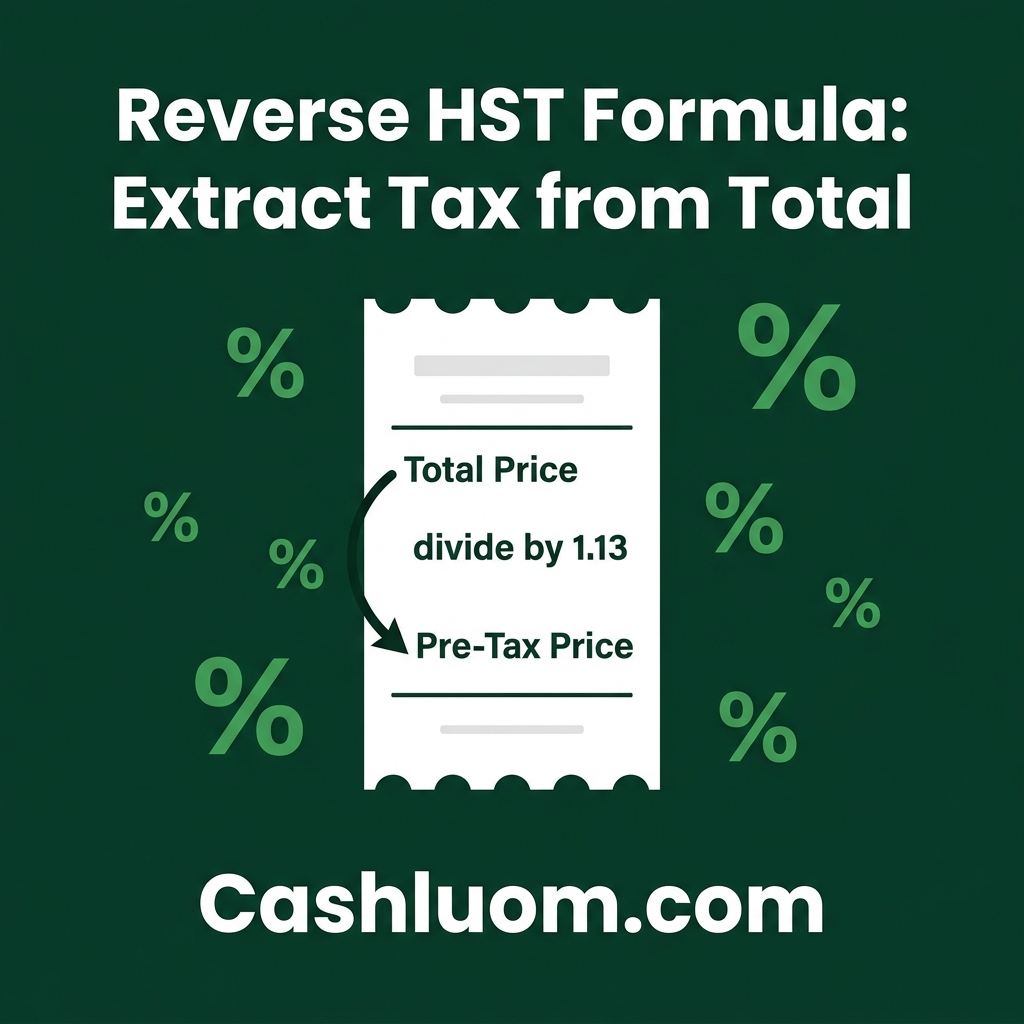
You just paid $226 for something and need to know how much HST is buried in that total for your expense report. Or you're a freelancer reconciling last quarter's invoices and your accounting software shows only totals, but you need the pre-tax breakdown for your HST remittance. Whatever the situation, the reverse HST formula is one of the most useful tools in Canadian business finance. And the good news? It's a single division calculation.
The Reverse HST Formula
Pre-tax Amount = Total Price ÷ (1 + HST Rate)
Then: HST Amount = Total Price − Pre-tax Amount. Apply the rate as a decimal: 13% = 0.13, so divisor = 1.13. For 15%: divisor = 1.15.
Why Division. Not Subtraction?
The most common mistake is trying to back out HST by subtracting 13% of the total. That gives the wrong answer every time. The HST was calculated on the pre-tax price, not on the inflated total. So subtracting 13% of the higher number always over-removes the tax.
Proof: Item costs $100 before tax. 13% HST = $13. Total = $113. Subtract 13% of $113 = $14.69: leaves $98.31, not $100. Correct method: $113 ÷ 1.13 = $100.00 exactly.
Divisors for Every Canadian Province (2026)
| Province | Tax Type | Combined Rate | Divisor | Formula ($113 Total) |
|---|---|---|---|---|
| Ontario | HST | 13% | 1.13 | $113 ÷ 1.13 = $100.00 |
| Nova Scotia | HST | 15% | 1.15 | $115 ÷ 1.15 = $100.00 |
| New Brunswick | HST | 15% | 1.15 | $115 ÷ 1.15 = $100.00 |
| Newfoundland | HST | 15% | 1.15 | $115 ÷ 1.15 = $100.00 |
| PEI | HST | 15% | 1.15 | $115 ÷ 1.15 = $100.00 |
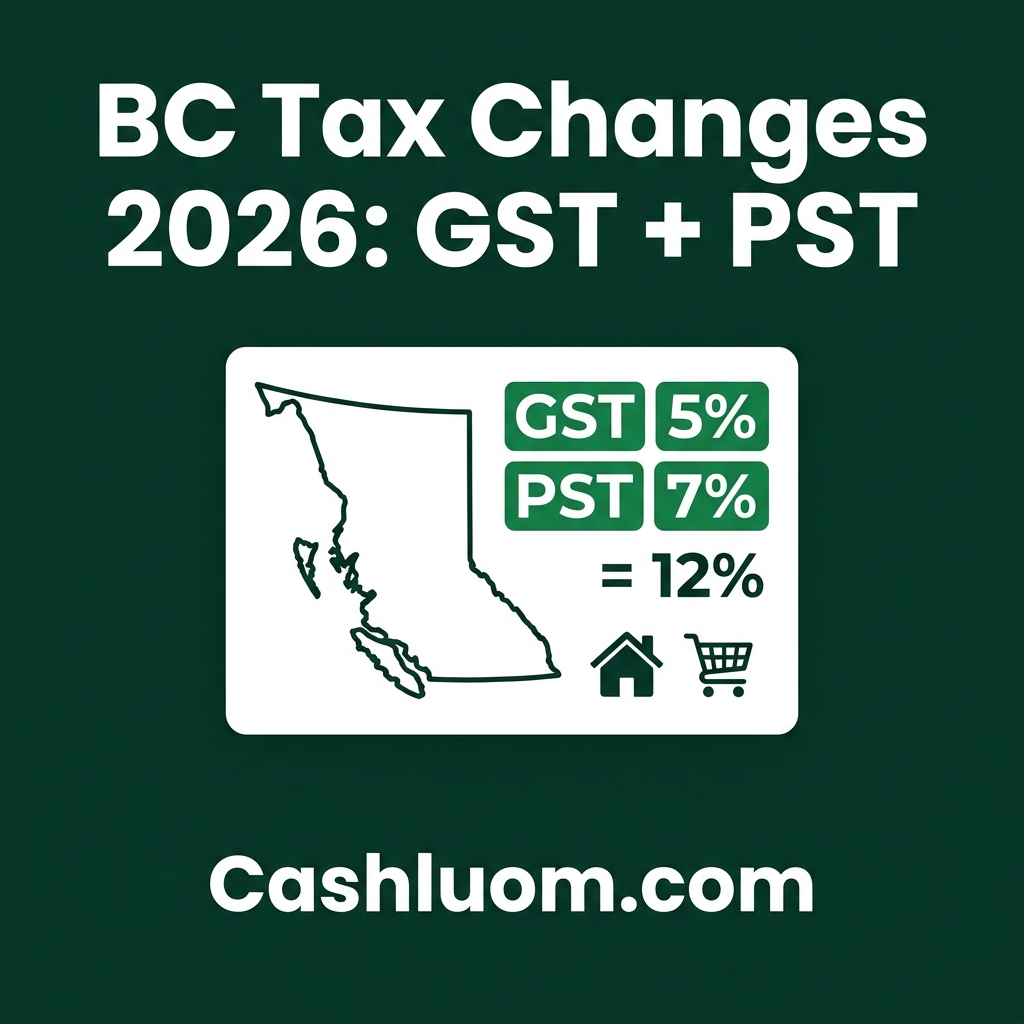
| BC | GST + PST | 12% | 1.12 | $112 ÷ 1.12 = $100.00 |
| Alberta | GST only | 5% | 1.05 | $105 ÷ 1.05 = $100.00 |
| Quebec | GST + QST | 14.975% | 1.14975 | $114.98 ÷ 1.14975 = $100.00 |
| Saskatchewan | GST + PST | 11% | 1.11 | $111 ÷ 1.11 = $100.00 |
| Manitoba | GST + RST | 12% | 1.12 | $112 ÷ 1.12 = $100.00 |
⚠️ Data as of May 2026. Verify at CRA.gc.ca.
Step-by-Step Worked Examples
Example 1: Ontario Restaurant Invoice ($226 Total)
- Total paid: $226.00
- Ontario HST: 13% → divisor = 1.13
- Pre-tax: $226.00 ÷ 1.13 = $200.00
- HST component: $226.00 − $200.00 = $26.00
Example 2: Nova Scotia Contractor Invoice ($3,450 Total)
- Total invoiced: $3,450.00
- Nova Scotia HST: 15% → divisor = 1.15
- Pre-tax: $3,450.00 ÷ 1.15 = $3,000.00
- HST component: $3,450.00 − $3,000.00 = $450.00
Example 3: Alberta Business Expense ($525 Total)
- Total paid: $525.00
- Alberta GST only: 5% → divisor = 1.05
- Pre-tax: $525.00 ÷ 1.05 = $500.00
- GST component: $525.00 − $500.00 = $25.00
Business Use: Claiming Input Tax Credits (ITCs)
For registered Canadian businesses, knowing the exact HST component in each purchase is essential for claiming Input Tax Credits (ITCs) on your HST return. You report the HST collected on sales, subtract the HST paid on business expenses, and remit (or claim back) the difference from the CRA.
| Purchase | Total Paid | Province | Rate | HST (ITC Claimable) | Pre-tax |
|---|---|---|---|---|---|
| Office supplies | $564.50 | Ontario | 13% | $64.96 | $499.54 |
| Equipment repair | $1,120.00 | BC | 12% | $120.00 | $1,000.00 |
| Software subscription | $345.00 | NL | 15% | $45.00 | $300.00 |
| Professional services | $2,100.00 | Alberta | 5% | $100.00 | $2,000.00 |
According to CRA guidelines on ITCs, you need a valid tax invoice to support any ITC claim over $30. For purchases over $150, the supplier's GST/HST registration number must appear on the receipt. Keep digital or physical copies for at least six years.
📊 Chart Suggestion: "Horizontal bar chart showing HST/GST/combined sales tax rates across all Canadian provinces and territories. Title: 'Canadian Sales Tax Rates by Province: 5% to 15% (2026)'"
Frequently Asked Questions
What is the reverse HST formula for Ontario?
For Ontario's 13% HST: Pre-tax amount = Total ÷ 1.13. HST amount = Total − (Total ÷ 1.13). Example: $339 total ÷ 1.13 = $300 pre-tax; HST = $39. This is the CRA-accepted method for expense reporting and ITC claims.
Why can't I subtract 13% from the total to get pre-tax?
Because HST is calculated on the original price, not the inflated total. Subtracting 13% of the total over-removes the tax. The division method is always mathematically exact. For a $113 total: $113 × 0.13 = $14.69 (wrong); $113 ÷ 1.13 = $100 exactly (correct).
How do I reverse GST and PST separately in BC?
For a combined reverse: pre-tax = total ÷ 1.12, GST = pre-tax × 0.05, PST = pre-tax × 0.07. Note that some services in BC are PST-exempt: verify item-specific rules at gov.bc.ca/pst.
What divisor do I use for 15% HST in Atlantic Canada?
Use 1.15 as your divisor. This applies to Nova Scotia, New Brunswick, Newfoundland and Labrador, and Prince Edward Island: all harmonized at 15% HST in 2026. Pre-tax = total ÷ 1.15; HST = total − pre-tax.
Do I need receipts to claim ITCs for HST paid on purchases?
Yes. CRA requires documentation: supplier name, date, total, and GST/HST registration number. For purchases over $30, a receipt is needed. For purchases over $150, a full tax invoice is required. Digital receipts are accepted as long as they're legible, and records must be kept for six years.
Is there a spreadsheet formula I can use for bulk reverse HST?
Yes. In Excel or Google Sheets, if your total is in cell A1 and HST rate is 13%: Pre-tax = =A1/1.13; HST amount = =A1-(A1/1.13). You can replace 1.13 with 1.15, 1.05, or 1.14975 depending on province. This is perfect for reconciling hundreds of receipts at once.
Final Thoughts
Dividing by (1 + rate) is the only correct way to extract HST from a total price. Whether you're filing an HST return, submitting expense reports, or reconciling a year of receipts, this formula gives you an exact, CRA-compliant answer every time. For instant calculations on any amount, use the free Reverse HST Calculator. For more worked examples by province, see our guide on how to back out HST from a total price.
Sources & Citations
Free Calculator
Reverse HST Calculator Canada
Quickly find the pre-tax price for any Canadian transaction. This dedicated reverse calculator handles GST, HST, and PST for every province. Simply enter the final total and select your province (like Ontario 13% or NS 15%) to see the tax breakdown. Perfectly suited for bookkeeping and filing business expense claims.

Comments are coming soon. Have feedback? Contact us.