

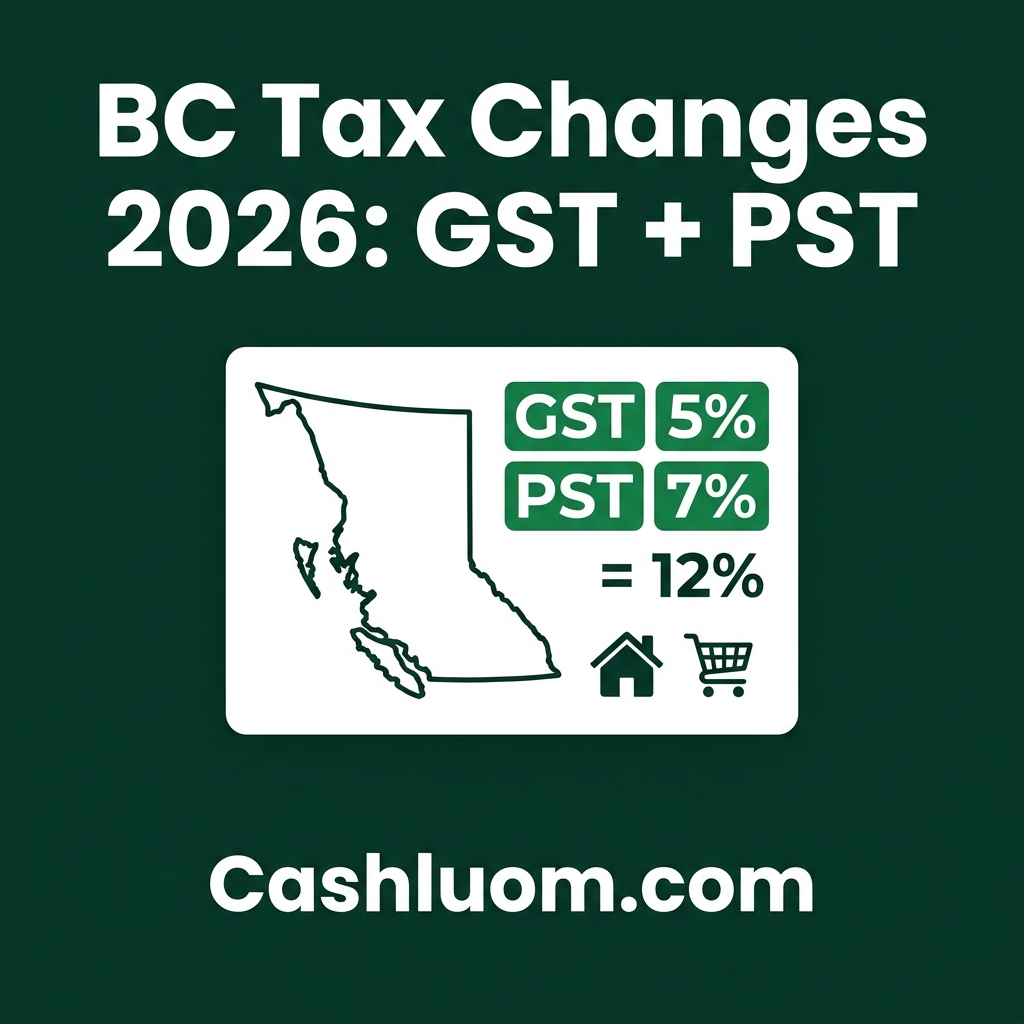
BC has a unique tax setup that trips up newcomers and even longtime residents. While Ontario and Atlantic Canada simplified things with a single harmonized tax, British Columbia rejected the HST in a 2011 referendum and went back to a split system. So in BC, you're dealing with two separate sales taxes, two different sets of rules for what's taxable, and two separate registration and remittance processes if you're a business owner. Here's everything you need to know about BC's GST and PST for 2026.
BC's Two-Tax Sales Tax System
Total BC Tax = 5% GST + 7% PST = 12% combined
The GST is administered by the federal CRA. The PST is administered by the BC Ministry of Finance. They have different exemption rules, different registration thresholds, and different remittance schedules.
GST in BC: The Federal Layer
The federal 5% Goods and Services Tax (GST) applies in BC exactly as it does in every other Canadian province. It covers most goods and services with the same exemptions: basic groceries, prescription drugs, exports, and most health services are zero-rated nationally. Once your taxable revenues exceed $30,000, you must register for GST with the CRA.
Unlike Ontario, where the 13% HST goes to one place and gets split internally, BC businesses remit GST to Ottawa separately from PST. This creates a compliance overhead but also means that GST Input Tax Credits (ITCs) are unaffected by any changes to BC's PST rules.
BC PST in 2026: What's New and What Changed
BC's Provincial Sales Tax (PST) rate remains at 7% in 2026. The PST applies specifically to the sale or lease of tangible personal property and specified services in BC. Unlike GST, not all services are automatically PST-taxable — PST is goods-first, service-second. Key 2026 developments include:
- Software and SaaS: BC clarified that downloaded software and software-as-a-service (SaaS) used in BC is subject to 7% PST: this affects BC businesses using US-based software subscriptions
- Carbon tax abolished: The federal consumer carbon tax was abolished effective April 1, 2025. BC's provincial carbon pricing aligned with this change. As of 2026, no federal consumer carbon levy applies to BC fuel purchases.
- Marketplace rules: Online platform operators selling taxable goods to BC customers must collect PST if they meet the registration threshold
What's Taxable Under BC PST? (Key Differences from GST)
This is where BC's system gets genuinely complicated. An item can be zero-rated for GST (no federal tax) but still fully subject to BC PST (7%). Or vice versa. Here's a comparison of key items:
| Item/Service | GST (Federal 5%) | BC PST (7%) | Total in BC |
|---|---|---|---|
| Basic groceries (fresh fruit, veg, dairy) | Zero-rated (0%) | Exempt (0%) | 0% |
| Restaurant meal | 5% GST | Exempt (0%) | 5% only |
| New vehicle purchase | 5% GST | 7% PST + possible luxury tax | 12%+ |
| Clothing (adult) | 5% GST | 7% PST | 12% |
| Children's clothing | 5% GST | Exempt (0%) | 5% only |
| Software (SaaS, downloads) | 5% GST | 7% PST | 12% |
| Professional services (legal, accounting) | 5% GST | Exempt (0%) | 5% only |
| Haircut and personal services | 5% GST | Exempt (0%) | 5% only |
| Furniture and appliances | 5% GST | 7% PST | 12% |
| Gasoline and fuel | 5% GST | 0% PST | 5% only (federal carbon tax abolished April 2025) |
| Accommodation (hotel, Airbnb) | 5% GST | 8% MRDT or PST | 13%+ |
⚠️ Data as of May 2026. Accommodation subject to MRDT (Municipal and Regional District Tax) of up to 3% in addition. Verify specifics at gov.bc.ca/pst.
BC PST Registration for Businesses
Unlike GST, which has a $30,000 revenue threshold before mandatory registration, BC PST requires registration as soon as you make any retail sale of taxable goods in BC. There's no minimum revenue exemption. If you sell taxable physical goods to BC customers from the very first dollar, you must register for PST with the BC Ministry of Finance.
| Tax | Registration Threshold | Remittance Frequency | Administered By |
|---|---|---|---|
| GST (Federal) | $30,000 taxable revenue | Monthly, quarterly, or annually | CRA |
| BC PST | Any retail sale of taxable goods | Monthly or quarterly | BC Ministry of Finance |
📊 Chart Suggestion: "Side-by-side bar chart comparing BC's two-tax system (GST 5% + PST 7%) against Ontario HST (13%) and Quebec combined (14.975%). Title: 'BC vs Ontario vs Quebec: How Sales Tax Stacks Up (2026)'"
Frequently Asked Questions
Why does BC have two taxes instead of one HST?
BC adopted HST in 2010 but voters rejected it in a 2011 referendum, citing concerns about the tax burden shifting to services that were previously PST-exempt. BC officially returned to the separate GST + PST system in April 2013. Unlike Ontario and Atlantic provinces, BC never re-harmonized, which is why you see two separate line items on BC receipts.
Do restaurants in BC charge PST?
No. Restaurant meals are PST-exempt in BC: only the 5% federal GST applies to dining out. This is different from many other provinces. However, if you're buying a bottle of liquor from a restaurant or liquor store, PST applies at 10% (a higher PST rate specific to liquor). The combined rate for liquor is 5% GST + 10% PST = 15%.
Is there PST on services in BC?
Generally no. Most professional services (legal, accounting, consulting, IT services) are PST-exempt in BC: only GST applies at 5%. However, services that modify or repair tangible personal property (e.g., car repairs, appliance servicing) are PST-taxable. Software and SaaS subscriptions used in BC are PST-taxable as of 2021 clarifications.
How much is the PST on a new car in BC?
The base PST rate on vehicles in BC is 7%, but a luxury surcharge applies for pricier vehicles: 10% PST on cars $125,000–$149,999, and 15% PST on cars $150,000+. Plus the 5% GST applies on top. For a $50,000 car: 5% GST ($2,500) + 7% PST ($3,500) = $6,000 in combined tax. Private sales pay PST on the greater of the purchase price or the Depreciated Value from the vehicle schedule.
How do I register for BC PST as a business?
Register online through the BC Ministry of Finance eTaxBC portal. You'll need your business number, business information, and expected PST revenue. Registration is free. Once registered, you must collect 7% PST on all taxable sales to BC customers and file returns monthly or quarterly depending on your sales volume. First-time filers can contact the BC PST Helpline at 1-877-388-4440.
Can BC businesses claim PST back on business purchases?
Unlike GST (where businesses claim ITCs), BC PST has limited refund mechanisms: there's no general ITC-style system for PST. However, specific exemptions exist for goods purchased for resale, manufacturing inputs, and certain business use cases. These are called PST exemptions, not credits. Businesses must apply for specific exemptions at the time of purchase using a "Certificate of Exemption" form.
Final Thoughts
BC's two-tax system is more complex than a single HST, but it also creates meaningful exemptions that HST provinces don't offer, particularly for restaurant meals, most professional services, and personal services like haircuts. For businesses selling into BC, the dual registration requirement is real overhead, especially with the 2021 extension to out-of-province and online sellers. Use our BC Sales Tax Calculator for quick calculations, and read our comprehensive BC Tax Guide 2026 for a full breakdown of provincial income tax brackets and the renter's tax credit.
Sources & Citations
Free Calculator
BC GST + PST Calculator
Calculate the combined impact of GST (5%) and PST (7%) on your British Columbia purchases. This tool handles both adding tax to a net price and removing it from a gross total. Stay on top of your BC sales tax calculations with 2026 verified rates. Essential for shoppers and small business accounting in BC.
Comments are coming soon. Have feedback? Contact us.