

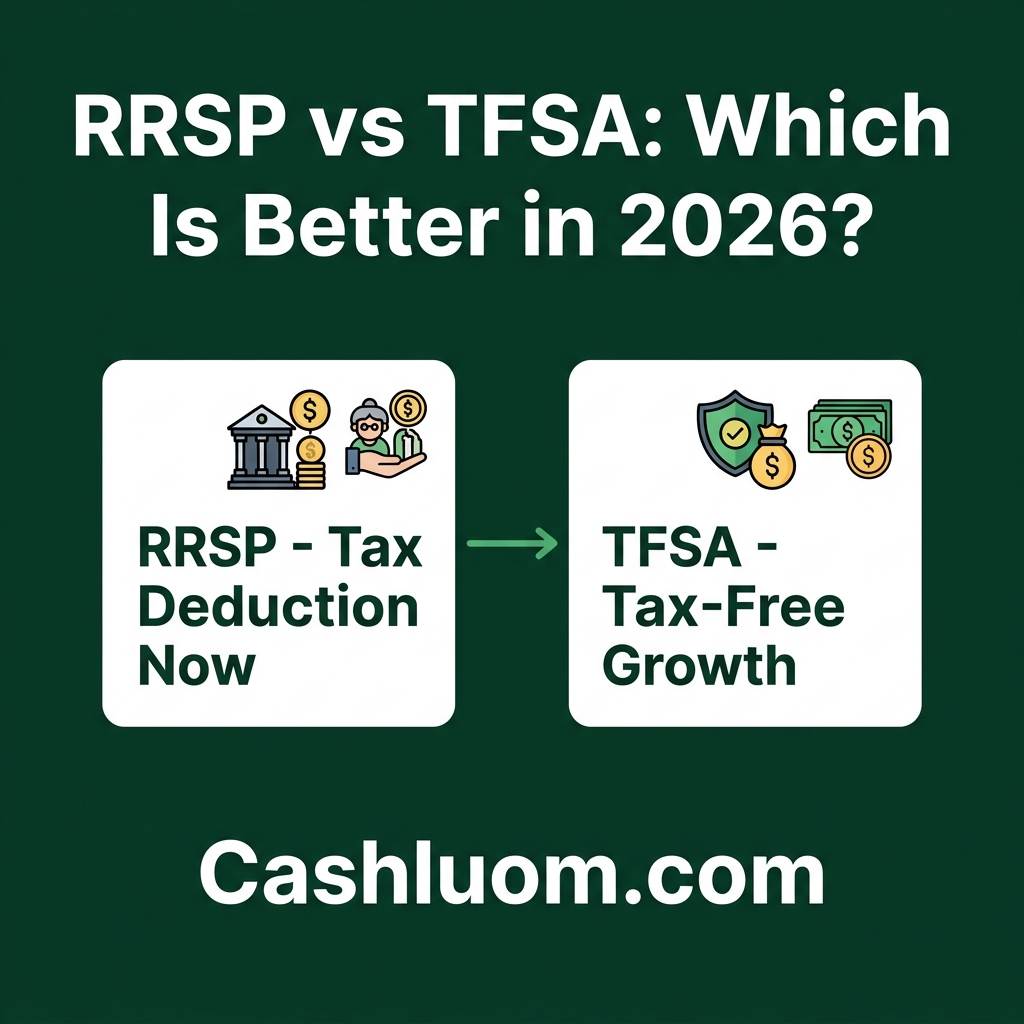
The RRSP vs TFSA decision is arguably the most important tax question for working Canadians, and the most commonly misunderstood. Both are powerful tax-sheltered accounts, but they work in opposite ways. The RRSP is a tax-deferred account: you get a deduction today but pay tax on withdrawals. The TFSA is tax-exempt: no deduction today, but withdrawals are forever tax-free. The right choice depends on your current marginal rate, expected retirement income, and financial goals. This guide gives you the complete framework and the numbers to make the right decision.
2026 Contribution Limits
RRSP: 18% of earned income (max $32,490) | TFSA: $7,000/year | Cumulative TFSA room: $102,000 (since 2009)
RRSP room accumulates based on prior-year earned income. TFSA room accumulates at a flat rate for all Canadians 18+. Both types of unused room carry forward indefinitely.
RRSP vs TFSA: Head-to-Head Comparison
| Feature | RRSP | TFSA |
|---|---|---|
| Contribution deduction | Yes — deducted from taxable income | No deduction |
| Growth inside account | Tax-sheltered (deferred) | Tax-free |
| Withdrawals taxed | Yes — added to income at marginal rate | No — completely tax-free |
| 2026 contribution limit | 18% of 2025 earned income, max $32,490 | $7,000 |
| Age limit | Must convert to RRIF by Dec 31 of year you turn 71 | No age limit — can contribute forever |
| Withdrawal room restored | No — once withdrawn, room is permanently lost | Yes — withdrawn amounts restore as room on Jan 1 of following year |
| Effect on government benefits | Withdrawals increase income — can claw back OAS/GIS | Withdrawals don't increase income — no claw back |
| Over-contribution penalty | 1%/month on excess over $2,000 grace | 1%/month on excess (no grace amount) |
| Spousal contribution | Yes — contribute to spouse's RRSP (still your deduction) | No spousal TFSA (each person contributes to their own) |
⚠️ 2026 figures. RRSP max contribution room verified on your CRA My Account Notice of Assessment. TFSA cumulative room as of 2026 = $102,000 if eligible since 2009. Source: CRA — RRSPs and CRA — TFSA.
Which Is Better? The Marginal Rate Rule
The mathematically optimal choice depends on comparing your contribution marginal rate (rate when contributing) vs your withdrawal marginal rate (rate when withdrawing at retirement):
| Scenario | Better Choice | Why |
|---|---|---|
| Contribution rate > Withdrawal rate (higher bracket now, lower at retirement) | RRSP wins | Deduction saves tax at higher rate; withdrawal taxed at lower rate = net tax gain |
| Contribution rate = Withdrawal rate | Mathematically equivalent | Same net result — TFSA has flexibility advantage (no mandatory conversion, no OAS impact) |
| Contribution rate < Withdrawal rate (lower bracket now, higher at retirement) | TFSA wins | RRSP locks in at lower deduction value; withdrawal taxed at higher rate = net tax loss |
| Income near OAS clawback zone in retirement ($90K+) | TFSA wins | TFSA withdrawals don't count as income — no OAS claw back risk |
| GIS recipient or low-income in retirement | TFSA wins | RRSP withdrawals reduce GIS entitlement; TFSA withdrawals don't affect GIS |
When to Use Both: The Optimal Strategy for Most Canadians
For most working Canadians with income between $60,000 and $150,000, the optimal strategy is to use both in a coordinated way:
- Contribute to RRSP to reduce income to the next bracket threshold: getting the deduction at your current high marginal rate
- Use the tax refund generated by the RRSP deduction to fund your TFSA
- In retirement, draw from RRIF (RRSP converted) to fill lower brackets, and supplement with TFSA withdrawals to avoid OAS claw back
Example: at $120,000 salary (Ontario), your top dollars are taxed at 37.91% combined. An $8,000 RRSP contribution saves ~$3,033 in tax. Take that $3,033 refund and contribute it to your TFSA: effectively sheltering $11,033 of income while only "costing" you $8,000 in net cash.
Frequently Asked Questions
What is the TFSA contribution limit for 2026?
The 2026 TFSA annual contribution room is $7,000, consistent with the limits since 2023. The cumulative TFSA room for someone eligible since 2009 (when TFSA was introduced) is $102,000 by January 1, 2026. Room accumulates regardless of income: every Canadian resident aged 18+ who has a valid SIN accrues the same annual room. Any unused room from previous years carries forward indefinitely. Check your room on CRA My Account to confirm your exact available room.
What is the RRSP contribution limit for 2026?
The 2026 RRSP limit is 18% of your 2025 earned income, up to a maximum of $32,490. "Earned income" includes employment income, self-employment income, and rental income (minus rental expenses). It does not include investment income, dividends, or capital gains. Your actual available room is shown on your most recent CRA Notice of Assessment and includes any unused room from previous years, minus any pension adjustment from an employer-sponsored pension plan.
Should I contribute to RRSP or TFSA first in 2026?
Prioritize RRSP first if: you're in a 30%+ marginal rate and expect a lower rate at retirement. Prioritize TFSA first if: you're in a low marginal rate (under 25%), you're near retirement (so RRSP deduction years are limited), you need the withdrawal flexibility, or you're close to the OAS claw back threshold in retirement ($90,000+ income). For most working Canadians earning $70,000–$130,000, contributing to RRSP up to the bracket threshold and investing the tax refund in TFSA provides the best combined outcome.
Can I have both an RRSP and TFSA at the same time?
Yes: absolutely. Most financial planners recommend using both. They serve complementary purposes: RRSP for high-income years when the deduction has maximum value; TFSA for flexible, tax-free savings at any income level. There is no rule against contributing to both in the same year, and having both provides maximum flexibility in retirement income planning (drawing from RRSP/RRIF to fill lower brackets while drawing TFSA amounts without affecting government benefits).
What happens to my RRSP when I turn 71?
By December 31 of the year you turn 71, you must convert your RRSP to either a RRIF (Registered Retirement Income Fund) or an annuity. You can no longer hold or contribute to an RRSP after this date. A RRIF requires minimum annual withdrawals starting at age 72: calculated as a percentage of the RRIF's year-start value. These withdrawals are fully taxable as income. In your final RRSP year (the year you turn 71), you can make one last RRSP contribution before conversion if you have room.
Final Thoughts
RRSP and TFSA are Canada's two most powerful tax-planning tools, and they work best in combination. The decision of which to prioritize comes down to one question: is your current marginal rate likely higher or lower than your retirement marginal rate? For most middle-income earners, the answer tips toward RRSP first (especially at 30%+ marginal rates), with the tax refund funding the TFSA. Use the RRSP Tax Savings Calculator to see exactly how much each contribution saves you today, and explore our RRSP vs FHSA guide if you're a first-time buyer: the FHSA may now be the better choice for your home savings strategy.
Sources & Citations: Content verified against official guidelines from the IRS (US), HMRC (UK), and ATO (AU). Information is reviewed for accuracy prior to publication.
Free Calculator
Compound Interest Calculator
Visualize the power of compounding on your savings and investments. Enter your starting balance, monthly contributions, and expected interest rate to see your wealth grow over time. Features a detailed year-by-year breakdown and a comparison between your contributions and the total interest earned over the decades.

Comments are coming soon. Have feedback? Contact us.