

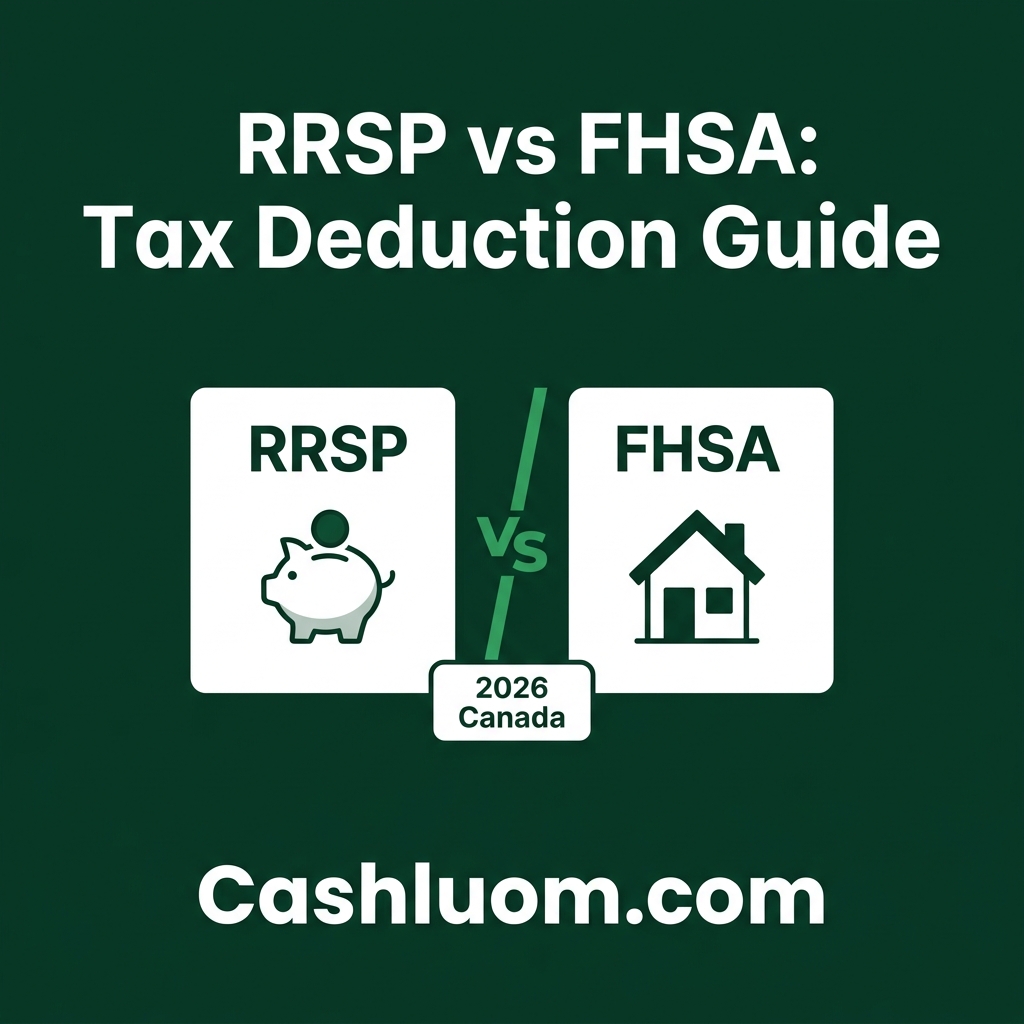
Canada now has two tax-sheltered paths to a first home down payment: the First Home Savings Account (FHSA), launched in 2023, and the long-standing RRSP Home Buyers' Plan (HBP). They can be used together, but they work differently, and for most first-time buyers, the FHSA should be the primary vehicle. This guide compares both options, shows when to use each, and explains the strategy for combining them to maximize your first home down payment in 2026.
FHSA vs RRSP HBP. The Headline Numbers
FHSA: $40,000 max | Tax-free withdrawal | No repayment | RRSP HBP: $35,000 max | Repay over 15 years
Combined maximum for one buyer: $75,000 (FHSA $40K + HBP $35K). Combined for a couple buying together: $150,000 ($40K FHSA × 2 + $35K HBP × 2). The FHSA has no repayment obligation; HBP requires repayment into the RRSP.
FHSA vs RRSP Home Buyers' Plan: Detailed Comparison
| Feature | FHSA | RRSP Home Buyers' Plan (HBP) |
|---|---|---|
| Contribution deduction | Yes — $8,000/year up to $40,000 lifetime | Contributions already deducted when made to RRSP |
| Tax on withdrawal for home | Zero — completely tax-free | Zero at time of withdrawal, but repayment required |
| Repayment required | No repayment — permanently out, tax-free | Yes — must repay over 15 years into RRSP; missed repayments added to income |
| Maximum withdrawal amount | Full account balance (up to $40,000) | $35,000 (per person) |
| Minimum RRSP holding period | N/A — FHSA-specific account | Contributions must be in RRSP for 90 days before withdrawal |
| RRSP room consumed | No — FHSA uses separate contribution room | Yes — withdrawals deplete RRSP growth; room is restored on repayment |
| If home not purchased | Transfer to RRSP (no room used); account must close within 15 years | Money stays in RRSP — no issue |
| Eligible since | 2023 | 1992 |
| First-time buyer requirement | Yes — 4-year lookback | Yes — same 4-year lookback |
⚠️ Source: CRA — FHSA and CRA. Home Buyers' Plan.
The HBP Repayment Cost: Why FHSA Wins on a Net-Present-Value Basis
The RRSP HBP is not "free money": the $35,000 withdrawn must be repaid over 15 years (minimum $2,333/year). If not repaid, the missed amount is added to your income for that year. Consider what this means financially:
- The RRSP loses 15+ years of compound growth on $35,000: at 6% average annual return: $35,000 × (1.06)^15 = $83,858. By withdrawing for the HBP, you potentially forgo ~$48,858 in growth inside the RRSP
- The FHSA has no repayment: the $40,000 stays invested in the home (home equity) rather than needing to flow back to the registered account
- For new homeowners with tight cash flow, the $2,333/year HBP repayment obligation on top of mortgage payments can be financially stressful
Optimal Strategy: FHSA + HBP Combined
The maximum power play for first-time buyers in Canada who have 4+ years before their intended purchase:
- Open FHSA immediately: even before contributing: to start the 15-year clock and accumulate contribution room
- Contribute $8,000/year to FHSA: take the deduction in high-income years; defer to future years if you expect higher income later
- Use the FHSA deduction refund to fund RRSP: the tax refund from FHSA contributions goes into RRSP for the HBP
- At purchase: withdraw full FHSA ($40,000, tax-free): no repayment obligation
- Also withdraw up to $35,000 from RRSP via HBP: repay over 15 years to restore RRSP room
- Total down payment contribution from registered accounts: $75,000 (single buyer) or $150,000 (couple)
Frequently Asked Questions
Is the FHSA better than the RRSP Home Buyers' Plan?
For most first-time buyers, yes: the FHSA is superior because: (1) no repayment obligation (HBP requires 15-year repayment), (2) withdrawals are permanently tax-free (HBP withdrawals are only tax-deferred), (3) the FHSA doesn't deplete your RRSP (HBP reduces RRSP growth), (4) unused FHSA funds can transfer to RRSP tax-free if you don't buy a home. The only case where HBP has an advantage: you already have a large RRSP balance and lack the time/income to maximize the $40,000 FHSA before purchasing.
Can I use both FHSA and RRSP HBP for the same home purchase?
Yes: you can use both the FHSA and RRSP HBP for the same qualifying home purchase. Withdraw from your FHSA (up to $40,000 tax-free, no repayment) AND withdraw from your RRSP under HBP (up to $35,000, repayable over 15 years) for the same purchase. A couple buying together can each use both accounts: $40K FHSA + $35K HBP per person = $75K each, $150K combined for the joint down payment from registered accounts.
What happens to RRSP Home Buyers' Plan repayments if I don't repay?
If you miss an annual HBP repayment (minimum ~$2,333/year for a $35,000 withdrawal), that year's required repayment is added to your taxable income for that year: taxed at your regular marginal rate. You also permanently lose that repayment's opportunity to grow tax-deferred inside the RRSP. Over 15 years, missed repayments compound: a $2,333 shortfall at a 30% marginal rate costs $700 in income tax that year, plus the lost RRSP growth on that amount over the remaining term.
Should I open an FHSA even if I don't plan to buy a home for 7+ years?
Yes: opening the FHSA now (even with $0 balance) starts accumulating contribution room and begins your 15-year account lifespan clock. You don't need to contribute immediately. Every year the account is open, you accumulate $8,000 of contribution room (plus one-year carryforward). If you wait 5 years to open, you permanently lose those 5 years × $8,000 = $40,000 in contribution room. Even if life plans change and you never buy, the FHSA transfers to your RRSP tax-free: no downside to opening it early.
Can an FHSA hold any investment (stocks, ETFs, GICs)?
Yes: an FHSA can hold the same eligible investments as an RRSP or TFSA: Canadian and foreign listed stocks, ETFs, mutual funds, GICs, government and corporate bonds, and cash deposits. You choose the financial institution (bank, credit union, brokerage) and the investments within the account. For long time horizons (5+ years), most advisors recommend equity ETFs for growth; shift to more conservative assets (GICs, short-term bonds) as your purchase date approaches within 1–2 years.
Final Thoughts
The FHSA is the clear winner over the RRSP HBP as a primary vehicle for first-time home savings: the no-repayment tax-free withdrawal structure is simply more advantageous in almost every scenario. The ideal approach is to max FHSA first, then supplement with RRSP HBP if more down payment is needed. Open your FHSA now: the only downside of opening it today rather than later is administrative effort, and that risk is far outweighed by the contribution room you'll accumulate. Use the FHSA Calculator to see your projected savings and tax benefits, and explore our full FHSA 2026 Guide and RRSP vs TFSA guide for the complete picture of Canadian registered account planning.
Sources & Citations
Free Calculator
Canada RRSP Tax Savings Calculator
See how much you save in tax by contributing to your RRSP. Calculate your refund based on your marginal tax rate.
Comments are coming soon. Have feedback? Contact us.