

British Columbia's tax system is more complex than it appears at first glance. Unlike Ontario and Atlantic Canada (which use a single harmonized HST rate), BC has two separate taxes: the federal GST and the provincial PST. These have different taxable bases: some items attract both, some attract only GST, and some attract neither. For businesses, this means separate registration, separate remittance, and separate ITC rules for each tax. For consumers, the key question before any purchase is: does this item have GST only, PST only, or both? This guide answers that and shows you the exact reverse-calculation formulas for every BC tax scenario.
BC Tax Rates 2026
GST: 5% | PST: 7% | Combined (where both apply): 12%
GST and PST are NOT combined: they're calculated separately on the net price. Not all items subject to GST are subject to PST, and vice versa. Always confirm which taxes apply before invoicing or purchasing.
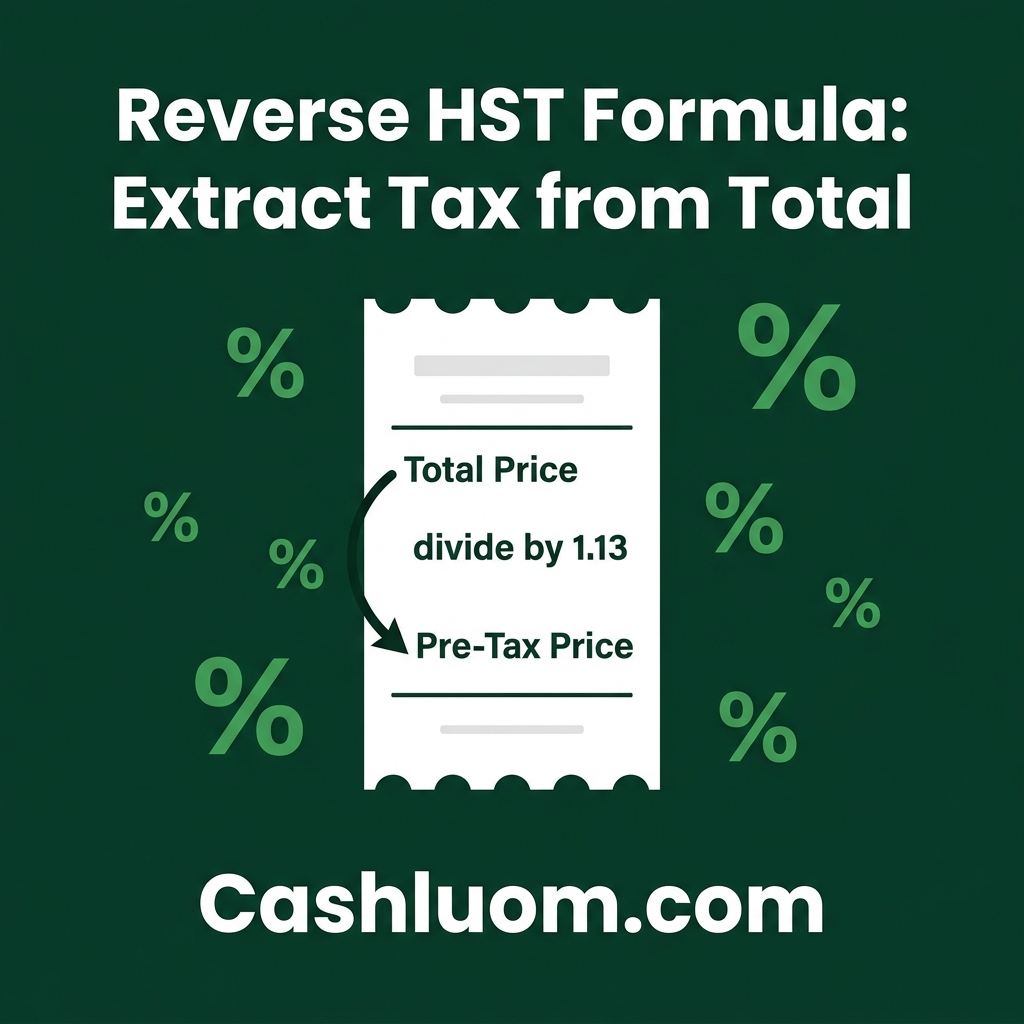
Reverse Tax Formulas for BC
The formula you use depends on which taxes are included in the total:
| Situation | Formula | Example | Net Price | Tax |
|---|---|---|---|---|
| GST + PST both apply (12%) | Net = Total ÷ 1.12 | $560 total | $500.00 | $60.00 ($25 GST + $35 PST) |
| GST only (5% — e.g., basic groceries PST-exempt) | Net = Total ÷ 1.05 | $105 total | $100.00 | $5.00 GST |
| PST only (7% — e.g., some software, legal services) | Net = Total ÷ 1.07 | $107 total | $100.00 | $7.00 PST |
| No tax (zero-rated or exempt) | Total = Net (no division needed) | $100 groceries | $100.00 | $0 |
⚠️ BC PST rate is 7%. GST is 5%. When both apply, combined rate is 12%. Always apply both taxes to the same net price (not cascading). Source: BC Government. Provincial Sales Tax.
What Is PST Taxable in BC?
BC's PST does not mirror the federal GST — BC's taxable and exempt items differ significantly from the federal GST/HST rules:
| Category | GST Applies? | BC PST Applies? | Combined Rate |
|---|---|---|---|
| Clothing and apparel | Yes (5%) | Yes (7%) | 12% |
| Electronics and appliances | Yes (5%) | Yes (7%) | 12% |
| Restaurant meals | Yes (5%) | Yes (7%) | 12% |
| Basic groceries (food for home consumption) | No (zero-rated) | No | 0% |
| Children's clothing (under 15) | No (zero-rated) | No | 0% |
| Prescription drugs | No (zero-rated) | No | 0% |
| New residential homes (from builder) | Yes (5%, GST rebate may apply) | No | 5% (subject to rebate) |
| Used vehicles (private sale) | No (exempt) | Yes (7–20% on purchase price) | PST only |
| Alcohol (purchased for home) | Yes (5%) | Yes (7%) | 12% |
| Most professional services (legal, accounting) | Yes (5%) | No | 5% |
| Software (downloaded/SaaS) | Yes (5%) | Yes (7%) | 12% |
⚠️ BC PST rules are complex and item-specific. Source: BC Government PST Overview. When in doubt, check the BC government's PST bulletin for your specific product or service category.
BC PST Registration Requirements
Unlike federal GST (which has a $30,000 annual revenue threshold before mandatory registration), BC PST registration is mandatory if you are in BC and sell taxable goods or provide taxable services regularly: with no minimum revenue threshold. If you sell even one PST-taxable item to a BC customer in the ordinary course of business, you must be registered to collect PST.
Out-of-province businesses (including online retailers in Ontario, the US, or internationally) must also register for BC PST if they make sales to BC customers of PST-taxable goods or services that exceed $10,000 in a calendar year. This has been increasingly enforced for digital goods, software subscriptions, and online marketplace sellers.
| Total (GST + PST at 12%) | Net Price | GST (5%) | PST (7%) |
|---|---|---|---|
| $112.00 | $100.00 | $5.00 | $7.00 |
| $224.00 | $200.00 | $10.00 | $14.00 |
| $560.00 | $500.00 | $25.00 | $35.00 |
| $1,120.00 | $1,000.00 | $50.00 | $70.00 |
| $5,600.00 | $5,000.00 | $250.00 | $350.00 |
📊 Chart Suggestion: "Side-by-side comparison chart showing what $1,000 of net purchases costs in total in BC (12%), Ontario (13%), Alberta (5%), and Quebec (14.975%). Title: 'Which Canadian Province Has the Lowest Sales Tax? 2026 Total Tax Comparison'"
Frequently Asked Questions
What is BC's sales tax rate in 2026?
BC charges 5% federal GST plus 7% provincial PST on most purchases: a combined rate of 12% where both taxes apply. Unlike Ontario's HST (which combines both into one 13% rate), BC's GST and PST are separate taxes with separate registration, remittance, and taxable item rules. Not all items are subject to both taxes.
How do I reverse-calculate BC sales tax from a total price?
If both GST (5%) and PST (7%) are included: divide the total by 1.12 to get the net price; the tax is the total minus the net price. Then: GST = net price × 0.05; PST = net price × 0.07. If only GST applies: divide by 1.05. If only PST applies: divide by 1.07. Example: $336 total (GST + PST) → $336 ÷ 1.12 = $300 net. GST = $15; PST = $21; Total tax = $36. ✓
Do I need to register for BC PST as an out-of-province seller?
Yes: if you make sales to BC customers of PST-taxable goods or services exceeding $10,000 in a calendar year, you must register for BC PST even if your business is based in another province or country. This applies to online retailers, software companies, digital content providers, and marketplace sellers. BC has actively been auditing and requiring registration from out-of-province e-commerce businesses since 2021.
Can I claim back BC PST on business purchases?
Generally no — BC PST is a final consumer tax with very limited exemptions for businesses. Unlike federal GST (where businesses can claim Input Tax Credits), BC PST paid on most inputs cannot be recovered. Exceptions exist for manufacturing equipment, goods used to produce exempt goods, and other specific categories. Consult the BC PST exemption bulletins for your industry. This is one of the key differences between BC's separate PST and Ontario's harmonized HST system.
Are there things exempt from BC PST?
Yes: many important categories are PST-exempt in BC: basic groceries, prescription drugs, children's clothing (under 15 years old), medical equipment, residential rent, most financial services, agriculture equipment and livestock, and most professional services (legal, accounting, consulting). Some exemptions require a completed exemption certificate: for example, manufacturing equipment buyers must provide a specific form to the seller to purchase without PST.
Final Thoughts
BC's dual-tax system requires more careful tracking than Ontario's single HST: particularly for businesses that must file separately with both the CRA (for GST) and the BC Ministry of Finance (for PST). The combined 12% rate on most consumer goods is very competitive within Canada, but the complexity of determining which items attract which taxes demands careful attention. Use the Reverse Tax Calculator for instant GST + PST breakdowns on any BC total, and explore our BC Tax Changes 2026 guide for the full picture on BC's evolving tax landscape.
Sources & Citations: Content verified against official guidelines from the IRS (US), HMRC (UK), and ATO (AU). Information is reviewed for accuracy prior to publication.
Free Calculator
Reverse Tax Calculator
Calculate the original pre-tax price from any price-inclusive total. This tool is essential for business owners and shoppers who need to back out sales tax, VAT, or GST. Supports all 50 US states, UK VAT (20%), Australia GST (10%), Canada GST/HST (all provinces), and custom tax rates for any country worldwide.
Comments are coming soon. Have feedback? Contact us.