

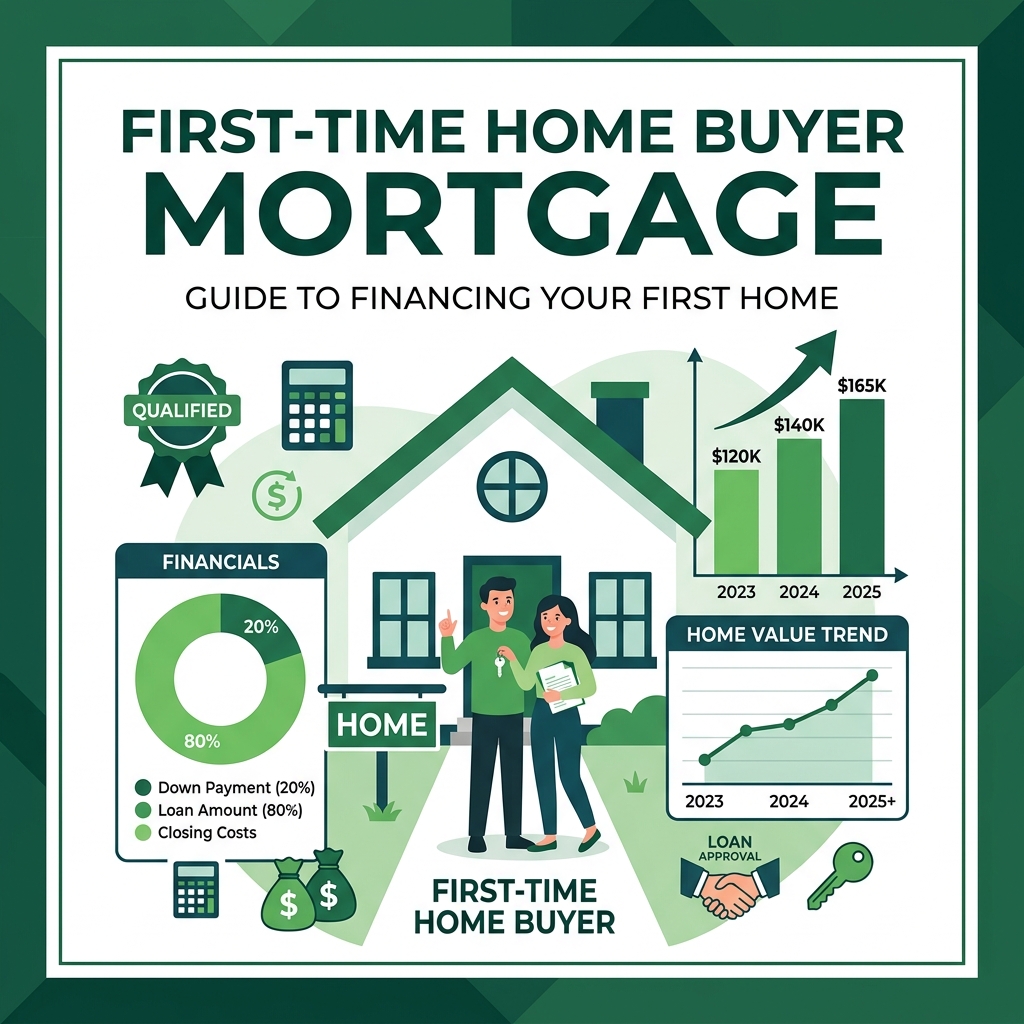
Buying your first home in Canada is exciting and overwhelming in equal measure. The vocabulary alone: amortization, stress test, insured vs conventional, fixed vs variable: is enough to make a first-time buyer's head spin. And that's before you factor in CMHC insurance premiums, land transfer taxes, and the Home Buyers' Plan. This guide strips away the jargon and explains the mechanics of Canadian mortgages in plain terms, with real numbers so you understand what you're signing before your lawyer hands you the pen.
Canada Mortgage Quick Facts (2026)
Min down payment: 5% (up to $500K) | 10% ($500K–$999,999) | 20% ($1M+)
Max amortization: 30 years (insured), 25 years (conventional). Stress test rate: 5.25% or offered rate + 2%, whichever is higher.
Down Payment Rules in Canada
Canada's minimum down payment rules are tiered by purchase price:
| Purchase Price | Minimum Down Payment | CMHC Insurance Required? | Max Amortization |
|---|---|---|---|
| Up to $500,000 | 5% of purchase price | Yes | 30 years (new in 2024) |
| $500,001 – $999,999 | 5% on first $500K + 10% on remainder | Yes | 30 years |
| $1,000,000 and above | 20% minimum | No (ineligible for insurance) | 25 years conventional |
⚠️ 2026 rules per OSFI and CMHC guidelines. Source: FCAC. Mortgage Default Insurance. Rules can change: verify before any offer.
CMHC Mortgage Insurance: What It Costs
If your down payment is less than 20%, you must purchase CMHC mortgage default insurance. This protects the lender (not you) if you default. The premium is a percentage of the insured loan amount, added to your mortgage balance and repaid over the amortization period:
| Loan-to-Value (LTV) | Down Payment | CMHC Premium Rate | Cost on $600K Home |
|---|---|---|---|
| 95% LTV (min down) | 5% | 4.00% | $22,800 added to mortgage |
| 90% LTV | 10% | 3.10% | $16,740 added to mortgage |
| 85% LTV | 15% | 2.80% | $14,280 added to mortgage |
| 80% LTV | 20% | 0% — no insurance required | $0 |
⚠️ Premiums current as of 2026. CMHC premiums are also subject to provincial sales tax (not HST-exempt) in most provinces. The premium is added to your mortgage principal: you pay interest on it over your full amortization.
Fixed vs Variable Rate: Which Is Right in 2026?
The choice between fixed and variable rate is one of the most debated in Canadian real estate. Here's how they work:
| Feature | Fixed Rate Mortgage | Variable Rate Mortgage |
|---|---|---|
| Rate | Locked for the term (1–5 years typically) | Fluctuates with Bank of Canada prime rate |
| Payment stability | Completely predictable ✅ | May change if rate changes |
| Typical 5-yr rate (2026) | ~5.0–5.5% | ~Prime + 0.5–1% (currently ~5.7%) |
| Prepayment penalty | IRD (Interest Rate Differential) — often large | 3 months interest — usually smaller |
| Best when | Rates expected to rise, budget is tight | Rates expected to fall, can handle payment changes |
The Stress Test: Your Qualification Reality Check
Canada's mortgage stress test requires all buyers to qualify at the higher of: (a) 5.25% or (b) their actual contract rate plus 2%. This is designed to ensure you could still afford your mortgage if rates rose by 2 percentage points. In 2026, with most fixed rates in the 5–5.5% range, the stress test effectively qualifies you at 7.0–7.5%.
The stress test reduces the maximum home price you can afford by approximately 20–25% compared to what your actual monthly payment would suggest. Budget carefully using the stress test rate to ensure you qualify.
📊 Chart Suggestion: "Bar chart comparing total interest paid over 25-year vs 30-year amortization at 5.25% on a $500K insured mortgage. Title: 'Is a 30-Year Amortization Worth It? The True Cost Comparison'"
Frequently Asked Questions
How much do I need for a down payment on a $600,000 home in Canada?
For a $600,000 home: minimum 5% on the first $500,000 ($25,000) plus 10% on the remaining $100,000 ($10,000) = $35,000 minimum down payment. You'd also need to purchase CMHC mortgage insurance on the $565,000 insured mortgage. At 3.10% premium, that adds $17,515 to your mortgage. Aim for 20% down ($120,000) to avoid CMHC insurance entirely.
What is the mortgage stress test in Canada?
The stress test requires all mortgage applicants to qualify at the greater of: 5.25% OR their contracted rate plus 2%. It's administered by federally regulated lenders (banks) and applies to all purchases regardless of down payment size. It means a buyer who qualifies for a $600,000 mortgage at their actual 5.25% rate must prove they could also afford that payment at 7.25%. This effectively reduces buying power by ~20%.
Is a 30-year amortization a good idea for first-time buyers?
The 30-year amortization option (introduced for insured mortgages in August 2024) reduces monthly payments compared to a 25-year amortization by about 8–10%: helpful for cash flow. However, you pay significantly more interest over the life of the loan. On a $500,000 mortgage at 5.25%: 25-year amortization costs approximately $430,000 in interest; 30-year costs approximately $530,000 — $100,000 more. Use the extra cash flow carefully if choosing 30 years.
What are closing costs for a first-time home buyer in Canada?
Budget 1.5–4% of the purchase price for closing costs beyond the down payment: land transfer tax (0.5–2%, varies by province and city), legal fees ($1,500–$3,000), home inspection ($400–$600), title insurance (~$300), HST on new homes, and any adjustments at closing. First-time Ontario buyers get up to $4,000 off provincial LTT and up to $3,725 from Toronto's MLTT rebate. CMHC premium and interest adjustments also apply.
Can I use the RRSP Home Buyers' Plan for my down payment?
Yes. First-time buyers can withdraw up to $35,000 from their RRSP tax-free to put toward a home purchase (Home Buyers' Plan, HBP). Couples can each withdraw $35,000 for a combined $70,000. The money must be repaid to your RRSP over the following 15 years: missing a repayment year means that amount is added to your taxable income. The FHSA ($40,000 lifetime, no repayment) is now available as a superior alternative for new savers.
Final Thoughts
Buying a home in Canada is one of the largest financial decisions you'll ever make. Understanding the stress test before you start shopping, knowing the exact CMHC insurance cost for your down payment level, and factoring in all closing costs prevents surprises at the worst possible time. Use the Canada Mortgage Calculator to model your specific scenario: different rates, amortizations, and down payment amounts, and explore our RRSP vs FHSA guide to plan the most tax-efficient way to save your down payment.
Sources & Citations: Content verified against official guidelines from the IRS (US), HMRC (UK), and ATO (AU). Information is reviewed for accuracy prior to publication.
Free Calculator
Compound Interest Calculator
Visualize the power of compounding on your savings and investments. Enter your starting balance, monthly contributions, and expected interest rate to see your wealth grow over time. Features a detailed year-by-year breakdown and a comparison between your contributions and the total interest earned over the decades.
Comments are coming soon. Have feedback? Contact us.