

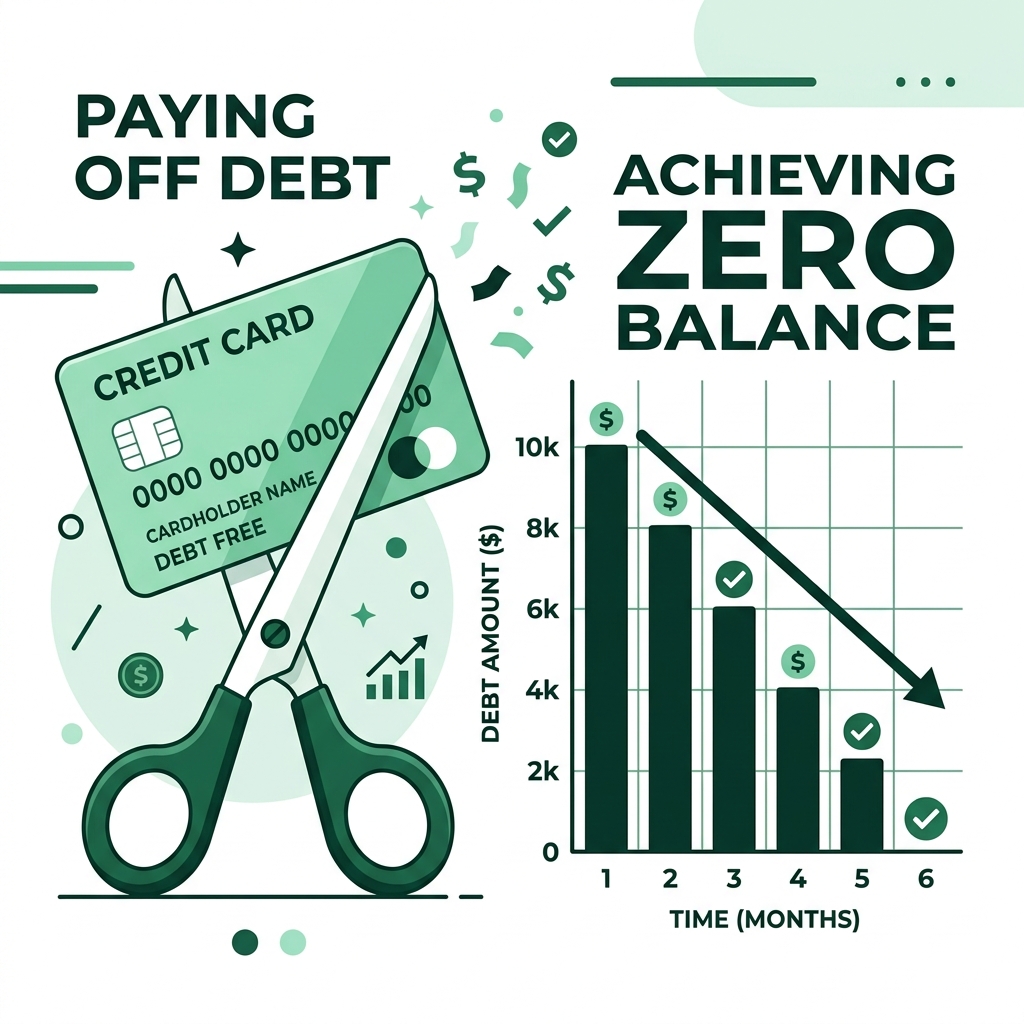
Credit card debt is the most expensive debt most households carry. More expensive than mortgages, student loans, and car loans combined. At 19.99% to 24.99% APR (higher on premium rewards cards), carrying a balance is mathematically devastating to your wealth. There are proven strategies that speed up payoff dramatically, and understanding how the interest compounds gives you the motivation to use them. This guide covers both the math and the strategy for Canadian cardholders in 2026.
The Cost of Minimum Payments
$15,000 at 22% APR, minimum payments only → 19 years, $21,600 in interest
Canadian credit cards typically set minimum payments at 2–3% of the balance or $10, whichever is greater. At 2% minimum payments, you'll barely keep up with accruing interest on a large balance: paying for nearly two decades.
The True Cost of Credit Card Interest in Canada
Most Canadians don't feel the sting of 22% APR because they see only the minimum payment on their statement, not the daily interest accumulating on their balance. Credit card interest compounds daily in Canada. Every day, your balance is multiplied by (Annual Rate ÷ 365), and that interest is added to your balance. Then the next day's interest is calculated on the new, slightly higher balance. This is why seemingly small balances spiral.
| Balance | APR | Min Payment Strategy | Payoff Time | Total Interest Paid | Fixed $500/mo Strategy | Fixed $500 Payoff Time |
|---|---|---|---|---|---|---|
| $5,000 | 22% | Min only (~2%) | ~11 years | $4,200 | $500/month | 12 months |
| $10,000 | 22% | Min only | ~16 years | $11,500 | $500/month | 24 months |
| $15,000 | 22% | Min only | ~19 years | $21,600 | $500/month | 38 months |
| $20,000 | 24.99% | Min only | ~24 years | $40,000+ | $600/month | 46 months |
⚠️ Estimates using standard amortization formula. Minimum payment calculated at 2% of balance. Actual payoff time depends on card's specific minimum calculation formula. Use the Credit Card Payoff Calculator for precise modeling.
The Two Main Payoff Strategies: Avalanche vs Snowball
If you have multiple credit cards, the order you pay them off matters. Two popular strategies give you different advantages:
| Strategy | How It Works | Best For | Total Interest Saved | Psychological Benefit |
|---|---|---|---|---|
| Avalanche Method | Pay minimums on all cards; throw extra cash at highest-rate card first | Those who want to minimize total interest mathematically | Maximum possible | Lower — takes longer to eliminate first card |
| Snowball Method | Pay minimums on all cards; throw extra cash at lowest-balance card first | Those who need quick wins to stay motivated | Less than avalanche | Higher — eliminates cards faster, reducing account count |
Real example: Card A has $3,000 at 15%; Card B has $8,000 at 22.99%. Avalanche: Attack Card B first: saves more in interest over the full payoff. Snowball: Attack Card A first: smaller balance, paid off in a few months, giving a psychological "win" that research shows helps people stay on track. For people who've tried and failed to get out of debt using discipline alone, the snowball's motivational advantage can outweigh the interest cost.
Balance Transfer Cards: The Canadian Landscape
A balance transfer moves your high-rate credit card debt to a new card with a low or 0% promotional rate: typically for 6–12 months. In Canada, balance transfer offers are less aggressive than in the US (fewer 0% offers, more 0.99% to 3.99% promo rates), but they still cut interest meaningfully during the promotional period.
| Card Type | Typical Promo Rate | Duration | Transfer Fee | Best Use |
|---|---|---|---|---|
| MBNA True Line (CA) | 0% first 12 months | 12 months | 3% of balance transferred | Large balances ($5,000+) with a clear payoff plan |
| Scotiabank Value Visa | 0.99% for 6 months | 6 months | No transfer fee | Medium balances, want to avoid fees |
| Tangerine Money-Back | 1.95% for 6 months | 6 months | No transfer fee | Modest balances, fast payoff |
⚠️ Offers current as of May 2026. Always read the fine print: promo rates often require minimum payments and revert to 19.99%+ at the end of the promotional period. New purchases on balance transfer cards typically accrue interest at full rate from day one.
Finding Extra Money to Accelerate Payoff
The math on accelerating payoff is compelling. An extra $200/month on a $10,000 balance at 22% cuts the payoff time from 16 years to under 2 years and saves over $9,000 in interest. Finding that $200 is the real challenge. Common sources:
- Tax refunds: The average Canadian tax refund is $1,800–$2,200. Apply it entirely to your highest-rate card
- CPP/EI cap paydays: Once CPP and EI stop deducting mid-year, you have $300–$600 extra per month: direct it to debt immediately
- Subscription audit: Cancelling unused subscriptions ($50–$200/month) and redirecting to debt is one of the highest-return financial moves
- Side income: Even $300/month in side hustle income applied to a $10,000 balance cuts payoff time dramatically
📊 Chart Suggestion: "Line chart comparing three payoff strategies for $15,000 at 22% APR: minimum payments, $400/month fixed, $600/month fixed: showing months to zero and total interest. Title: 'Credit Card Payoff Speed vs Monthly Payment: The Math (2026)'"
Frequently Asked Questions
What is the fastest way to pay off credit card debt in Canada?
The mathematically fastest method is the avalanche: list all your cards by interest rate, pay minimums on all, and put every available extra dollar toward the highest-rate card. Once that's paid, roll the freed-up payment into the next highest card. This minimizes total interest paid and gets you to zero faster than any other strategy, assuming you stick to it.
How much does making only minimum payments really cost?
Minimum-only payments are catastrophically expensive on high-rate debt. A $10,000 balance at 22% APR with 2% minimum payments takes approximately 16 years to pay off and costs over $11,500 in interest: more than the original balance. Fixed monthly payments of $500 on the same balance would pay it off in about 24 months with under $2,000 in interest.
Should I use a balance transfer to consolidate credit card debt?
Balance transfers can be very effective if you have a clear payoff plan within the promotional period. The key: calculate the total amount you can pay during the promo window, and only transfer what you can realistically clear. Transferring $8,000 but only being able to pay $5,000 before the promo ends means $3,000 reverts to the full rate. If you can't pay it all off in time, the savings evaporate.
Is a personal loan or HELOC better than credit cards for consolidation?
For large balances, a debt consolidation personal loan (typically 8–15% APR in Canada vs 22% on cards) or HELOC (home equity line of credit, typically prime + 0.5–1% for homeowners) can dramatically reduce your interest rate and provide a fixed payoff schedule. The risk: a HELOC is secured against your home: missing payments has serious consequences. Use consolidation as a rate reduction tool, not as permission to reload the credit cards you just paid off.
What credit card interest rate is typical in Canada in 2026?
Standard credit card APR in Canada in 2026 ranges from 19.99% (most major bank cards) to 24.99% (store cards and high-rewards premium cards). Some low-rate cards from credit unions charge 8.99%–12.99% and are worth considering for people who sometimes carry a balance. The Bank of Canada's policy rate affects HELOC and line-of-credit rates but does not directly change credit card APRs: most card issuers maintain 19.99% regardless of the overnight rate.
Final Thoughts
Getting out of credit card debt is one of the highest-return financial moves you can make. Paying off a 22% APR balance is equivalent to earning a guaranteed 22% after-tax return: something no investment can reliably match. Pick a strategy (avalanche if you trust the math, snowball if you need momentum), find an extra $200–$400 per month to throw at it, and use every one-time windfall to accelerate. Use the Credit Card Payoff Calculator to build your exact payoff plan, and read our guide on compound interest to understand how the same math that works against you in debt can work for you in investments.
Sources & Citations: Content verified against official guidelines from the IRS (US), HMRC (UK), and ATO (AU). Information is reviewed for accuracy prior to publication.
Free Calculator
Credit Card Payoff Calculator
Discover the true cost of your credit card debt and build a plan to escape it. Our AI-enhanced calculator shows exactly how much interest you will pay and when you will finally be debt-free. Compare different monthly payment strategies and see how much time and money you save by paying more than the minimum.
Comments are coming soon. Have feedback? Contact us.