

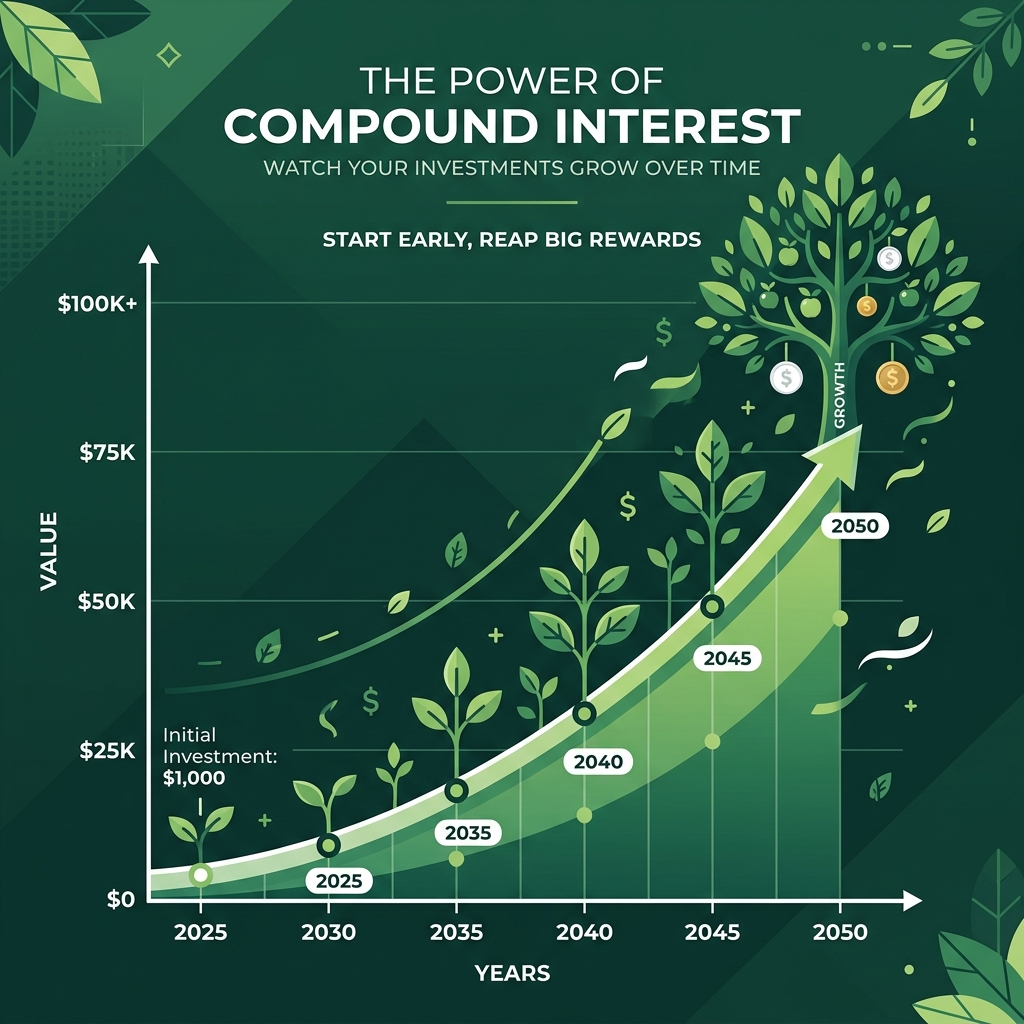
Start investing $500/month at age 25 and you'll have more at 65 than if you'd invested $1,000/month starting at 35. That's not a trick or a marketing slogan: it's the mathematics of compound growth playing out over different time horizons. Time is the single most important variable in the compound interest formula, and it's the one resource you can't buy back once it's gone. This guide breaks down exactly how compound interest works, shows you the math, and explains why starting now: even with a modest amount: is always better than waiting.
The Compound Interest Formula
A = P × (1 + r/n)^(n×t)
Where: A = final amount, P = principal, r = annual rate (as decimal), n = compounding periods per year, t = time in years. For annual compounding: A = P × (1 + r)^t.
Simple Interest vs Compound Interest: The Numbers
Simple interest only earns on your original principal. Compound interest earns on both your original principal and all the interest that's already accumulated. Over short periods, the difference is small. Over decades, it's staggering.
| Years | $10,000 Simple Interest (8%) | $10,000 Compound Interest (8%, annual) | Compound Advantage |
|---|---|---|---|
| 5 | $14,000 | $14,693 | +$693 |
| 10 | $18,000 | $21,589 | +$3,589 |
| 15 | $22,000 | $31,722 | +$9,722 |
| 20 | $26,000 | $46,610 | +$20,610 |
| 25 | $30,000 | $68,485 | +$38,485 |
| 30 | $34,000 | $100,627 | +$66,627 |
| 40 | $42,000 | $217,245 | +$175,245 |
⚠️ No inflation adjustment. 8% is the approximate long-run average real return of broad equity indices (nominal returns closer to 10%). Past performance doesn't guarantee future results. Compound calculations assume no withdrawals.
The Rule of 72: A Mental Shortcut
The Rule of 72 lets you quickly estimate how long it takes to double your money at any interest rate: divide 72 by the annual return rate. At 8%, your money doubles in approximately 9 years (72 ÷ 8 = 9). At 6%, about 12 years. At 12%, about 6 years.
| Annual Return Rate | Years to Double (Rule of 72) | Doublings in 30 Years | $10,000 Grows To |
|---|---|---|---|
| 2% (HISA) | 36 years | 0.83× | $18,114 |
| 4% (Bonds) | 18 years | 1.67× | $32,434 |
| 6% (Balanced Portfolio) | 12 years | 2.5× | $57,435 |
| 8% (Equity Index) | 9 years | 3.33× | $100,627 |
| 10% (Long-run S&P 500 average) | 7.2 years | 4.17× | $174,494 |
| 22% (Credit card debt) | 3.3 years | 9.1× | Works against you — debt multiplier |
Regular Contributions: The Real Power of Compounding
A single investment grows well through compounding, but regular contributions amplify the effect dramatically. Each new contribution starts its own compounding journey, and all previous contributions continue compounding. Here's what $500/month looks like at different starting ages, all retiring at 65 at 7% annual return:
| Start Age | Monthly Contribution | Years Investing | Total Contributed | Balance at 65 | Compound Growth |
|---|---|---|---|---|---|
| 25 | $500 | 40 | $240,000 | $1,312,000 | $1,072,000 |
| 30 | $500 | 35 | $210,000 | $923,000 | $713,000 |
| 35 | $500 | 30 | $180,000 | $635,000 | $455,000 |
| 40 | $500 | 25 | $150,000 | $422,000 | $272,000 |
| 45 | $500 | 20 | $120,000 | $268,000 | $148,000 |
| 50 | $500 | 15 | $90,000 | $160,000 | $70,000 |
⚠️ 7% annual return, monthly compounding. No inflation adjustment. Illustrative only: actual returns will vary and are not guaranteed. Balance is gross before any applicable taxes at withdrawal.
Compounding Frequency: Does It Matter?
Interest can compound annually, semi-annually, monthly, daily, or even continuously. More frequent compounding accelerates growth slightly. In practice, most investments (ETFs, mutual funds, index funds) compound daily or continuously, and the difference between monthly and daily compounding on long-term investments is relatively small:
| Compounding Frequency | $10,000 at 8% after 30 Years | Difference from Annual |
|---|---|---|
| Annual | $100,627 | — |
| Semi-annual | $103,048 | +$2,421 |
| Monthly | $104,840 | +$4,213 |
| Daily | $105,126 | +$4,499 |
| Continuously | $105,163 | +$4,536 |
📊 Chart Suggestion: "Exponential growth chart comparing $500/month invested at 25 vs 35 vs 45 years old, all to age 65 at 7% return. Title: 'Why Starting 10 Years Earlier Triples Your Retirement Balance (Compound Interest 2026)'"
Frequently Asked Questions
What is compound interest in simple terms?
Compound interest means you earn interest on your interest, not just on your original investment. In year 1, you earn interest on your deposit. In year 2, you earn interest on your deposit plus last year's interest. Over time, this "snowball effect" makes the growth curve increasingly steep: slow at first, then accelerating dramatically in later years. This is why long-time horizons are so powerful.
How is compound interest calculated?
The formula is: A = P × (1 + r/n)^(n×t). P is your principal (starting amount), r is the annual interest rate as a decimal (8% = 0.08), n is how many times interest compounds per year (12 for monthly, 365 for daily), and t is the number of years. For example: $10,000 at 8% annual, compounded monthly, for 30 years: A = 10,000 × (1 + 0.08/12)^(12×30) = $104,840.
What rate of return should I assume for long-term investing?
For broad equity index investing (Canadian, US, or global equity ETFs), the historical long-run nominal return has been approximately 9–10% per year. After inflation (~2–3%), the real return is 6–8%. Financial planners commonly use 6–7% as a conservative real-return assumption for retirement planning. Using 8% nominal is reasonable for projections, with the understanding that actual returns vary significantly year to year.
Where can I invest to earn compound interest in Canada?
The most common compound growth vehicles in Canada: TFSA (tax-free) with stock ETFs or mutual funds, RRSP (tax-deferred) with equity investments, GICs (Guaranteed Investment Certificates) through banks and credit unions for fixed-rate compounding, and high-interest savings accounts (HISAs) for short-term compounding at ~4–5% in 2026. For true long-term compound growth, diversified equity ETFs inside a TFSA or RRSP have the best risk-adjusted track record.
Does compound interest work against you in debt?
Yes, and aggressively. Credit card interest compounds daily at 22%+ APR. The Rule of 72 says your debt doubles every 3.3 years at 22%. A $10,000 credit card balance ignored for 6 years could grow to ~$40,000 in total owed. This is why eliminating high-rate debt is the financial equivalent of earning a guaranteed 22%+ return: arguably the best "investment" available to someone carrying card debt.
Final Thoughts
Compound interest is the rare financial concept where understanding it completely changes behaviour. Once you see the difference between starting at 25 vs 35, or between investing $500/month consistently vs trying to "time the market," the urgency to start: even imperfectly, even with small amounts: becomes obvious. Use the Compound Interest Calculator to build your own projection, and read our RRSP vs TFSA Guide to decide which account best captures your compound growth tax-efficiently.
Sources & Citations: Content verified against official guidelines from the IRS (US), HMRC (UK), and ATO (AU). Information is reviewed for accuracy prior to publication.
Free Calculator
Compound Interest Calculator
Visualize the power of compounding on your savings and investments. Enter your starting balance, monthly contributions, and expected interest rate to see your wealth grow over time. Features a detailed year-by-year breakdown and a comparison between your contributions and the total interest earned over the decades.
Comments are coming soon. Have feedback? Contact us.