

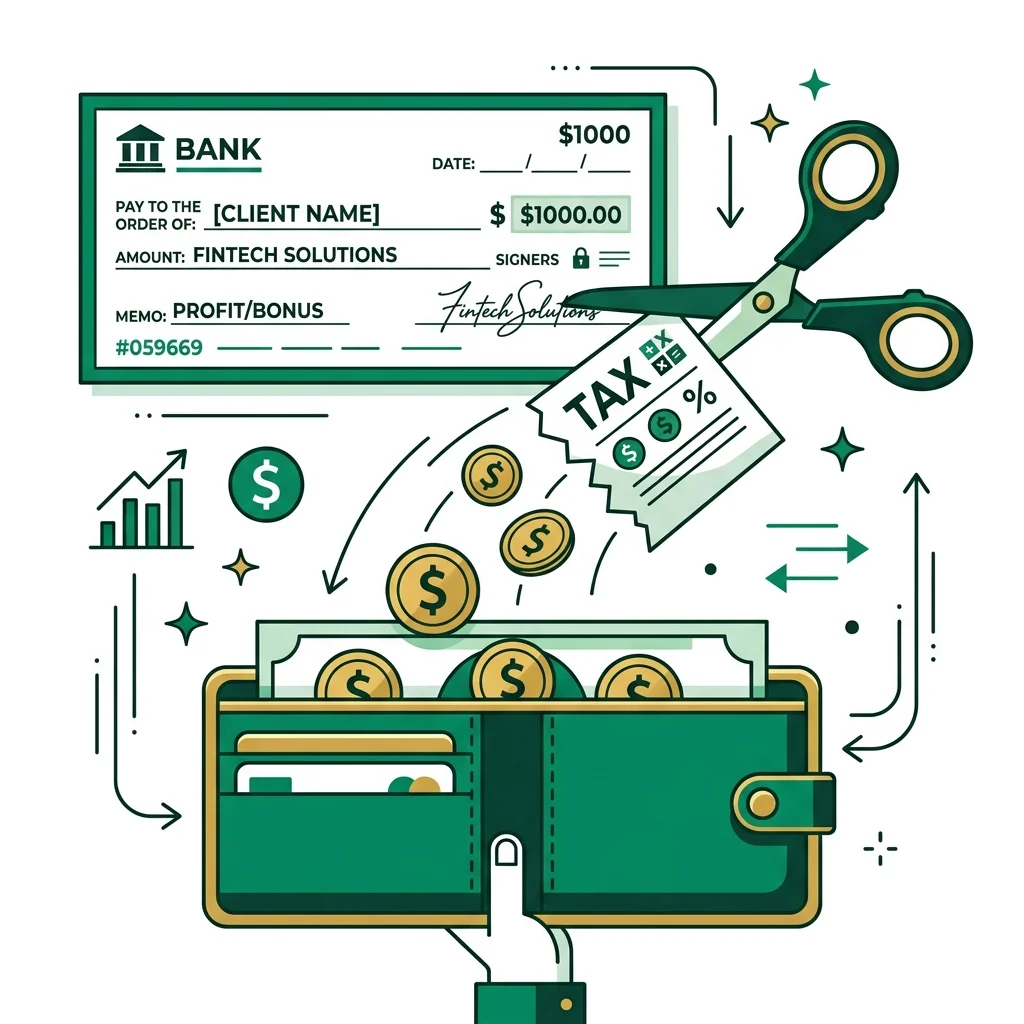
You found out you are getting a £1,000 bonus. You are excited — until you see your payslip and realise you only received £720. The rest went to tax and National Insurance. It feels like your bonus was taxed at a punishing rate. Here is what actually happened, the exact numbers for your situation, and — the part most people miss — why you might get some of it back.
Your £1,000 / $1,000 Bonus After Tax — Quick Answer
£1,000 Bonus
UK Basic Rate (20%)
£720
£1,000 Bonus
UK Higher Rate (40%)
£580
$1,000 Bonus
US (No State Tax)
$703.50
$1,000 Bonus
US (California ~9.3%)
$610.50
Why Does a Bonus Get Taxed So Much?
In the UK: The PAYE system annualises your pay. If you get a £1,000 bonus on top of your normal £3,500 monthly salary, HMRC sees a monthly earnings spike of £4,500. The underlying maths assumes you'll earn this higher amount every month for the rest of the year, instantly shoving your provisional earnings above the £50,270 higher rate band.
In the US: The IRS treats your bonus as "supplemental wages." Rather than guessing your annual tax bracket, employers apply a mandatory flat 22% federal withholding rate on the spot. By the time Social Security and Medicare (FICA) take their 7.65%, the money is gone before it hits your checking account.
The important thing to know is that in most cases you are not permanently losing that extra tax — it gets settled when your employer adjusts later in the year, or when you file your annual tax return.
Bonus After Tax Table — Common Amounts (UK)
| Bonus | Basic rate (20%) | Higher rate (40%) |
|---|---|---|
| £500 | £360 take-home | £290 take-home |
| £1,000 | £720 take-home | £580 take-home |
| £2,000 | £1,440 take-home | £1,160 take-home |
| £5,000 | £3,600 take-home | £2,900 take-home |
| £10,000 | £7,200 take-home | £5,800 take-home |
These figures assume your bonus is the only income above your personal allowance for that pay period. Your actual deduction may differ if your regular salary already puts you in the higher rate band.
Bonus After Tax Table — Common Amounts (US)
| Bonus | Federal (22%) | FICA (7.65%) | Take-home |
|---|---|---|---|
| $500 | -$110 | -$38.25 | ~$351.75 |
| $1,000 | -$220 | -$76.50 | ~$703.50 |
| $2,000 | -$440 | -$153 | ~$1,407 |
| $5,000 | -$1,100 | -$382.50 | ~$3,517.50 |
| $10,000 | -$2,200 | -$765 | ~$7,035 |
Will You Get Any of That Tax Back?
In the UK: Yes, you absolutely will recoup the extra payment if you don't actually belong in the higher tax band. If your bonus pushed you into the 40% band for one month but your total annual income ultimately stays below £50,270, HMRC doesn't get to keep that extra 20%. Your employer's payroll should self-correct by the end of the tax year.
In the US: Yes, you'll see it as a refund. If the flat 22% withholding is higher than your actual effective tax rate for the year, the difference appears as a cash tax refund when you file. If your total effective rate is only 14%, you over-withheld 8% — on a $1,000 bonus that's an extra $80 coming back to you.
At the £5,000+ level in the UK, the annualisation effect is distinctly more pronounced. A modest basic rate taxpayer may see 40% withheld in that specific pay period. This always self-corrects at year-end. Similar principles apply when investigating completely different tax zones, such as observing how UK and US tax systems compare.
Frequently Asked Questions
How much is a $1,000 bonus after tax in the US?
In the US, a $1,000 bonus typically leaves you with about $703.50 take-home pay if your employer uses the standard 22% flat withholding rate and you have no state tax. You lose $220 to federal withholding and $76.50 to FICA taxes immediately.
How much is a £1,000 bonus after tax in the UK?
In the UK, a basic rate taxpayer takes home £720 from a £1,000 bonus, while a higher rate taxpayer takes home £580. The deduction covers standard income tax paired with National Insurance contributions.
Why is my bonus taxed at 40% in the UK?
Your bonus briefly spikes your monthly earnings within HMRC's PAYE system. Even if your normal annual salary is far below the £50,270 higher rate threshold, the system temporarily assumes you earn that spiked amount every month, forcing the 40% tax bracket to engage.
Is a bonus taxed at a higher rate than salary?
No, legally your bonus is taxed at the exact same marginal rate as your regular income. The heavy cuts you see on your payslip are just aggressive withholding estimates, which often get refunded or adjusted automatically later.
What is the bonus tax rate in the US for 2026?
For 2026, the US federal flat withholding rate on supplemental wages like bonuses remains 22% for amounts under $1 million. Any bonus money over $1 million is withheld at a steep 37% rate.
Will I get my bonus tax back when I file my tax return?
Yes, if your employer withheld 22% on the bonus but your actual effective tax rate ends up being only 14%, you'll get the 8% difference returned to you as a refund. The withholding is just an upfront payment, not your final tax bill.
How do I calculate my bonus after tax?
Take your gross amount, subtract the fixed federal or income tax percentages, and deduct standard social security or National Insurance figures. Or use our dedicated salary calculator to instantly process UK and US tax codes correctly.
Sorting through sudden wage variations feels needlessly chaotic when all you want is accurate budgeting data. Drop your upcoming figures into our salary calculator to pinpoint your precise baseline take-home today.
Sources & Citations: Content verified against official guidelines from the IRS (US), HMRC (UK), and ATO (AU). Information is reviewed for accuracy prior to publication.
Free Calculator
Salary Calculator
Calculate your exact net salary after tax, NI, and deductions.

Comments are coming soon. Have feedback? Contact us.