

You quoted a client $2,000 for a project, added GST, and they paid $2,200. Now you need to work out how much of that $2,200 goes to the ATO on your next BAS. The calculation is simpler than most people think — but there's one mistake almost everyone makes the first time, and it leads to remitting more GST than you actually owe.
How GST Works in Australia — The Basics
GST (Goods and Services Tax) is a 10% flat-rate tax on most goods and services sold in Australia. It's been in place since 1 July 2000. Unlike the UK's VAT system — which has multiple rates — Australia has one rate for everything that attracts GST. That makes the maths much simpler for business owners and consumers alike.
If your annual turnover is $75,000 or more, you must register for GST with the ATO and charge it on your invoices. Below $75,000, registration is voluntary — but once you register, you must charge GST on all applicable sales. It's an important decision for many new small businesses and freelancers.
The key idea behind GST is the input tax credit system: you collect GST from your customers, claim back the GST you paid on your own business expenses, and remit the difference to the ATO via your Business Activity Statement (BAS). You're essentially acting as a GST collector for the government — the tax ultimately falls on the end consumer, not your business.
The GST Formula — Adding and Removing GST
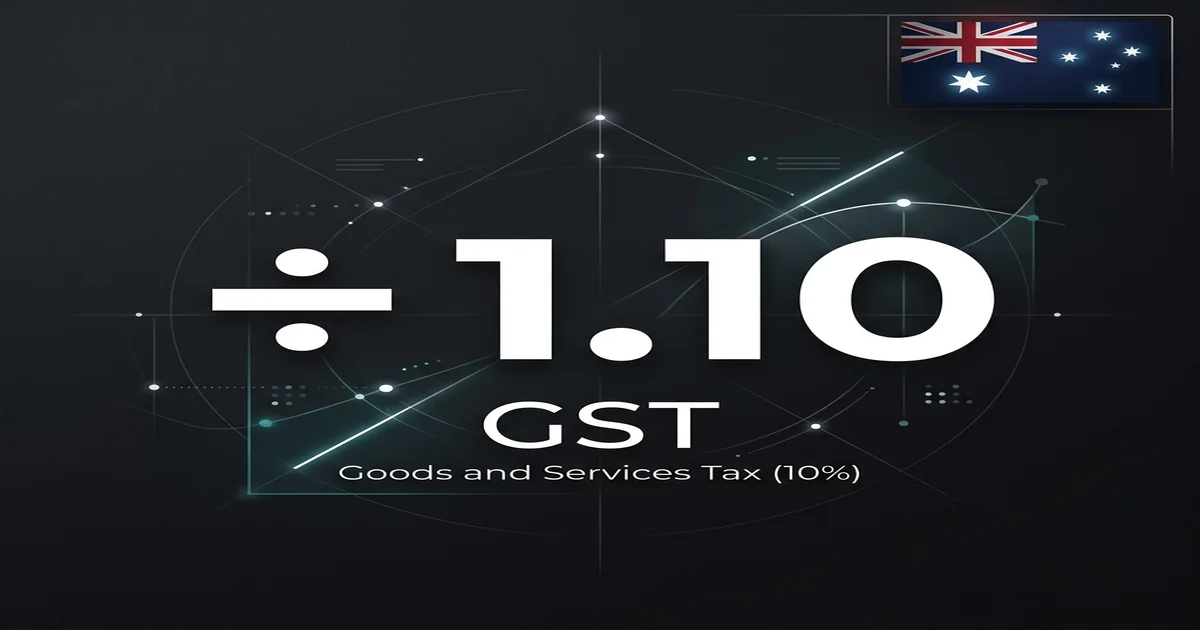
The GST system sounds complicated but the maths really does come down to one simple rule: divide by 1.10 to remove, and multiply by 1.10 to add. Understanding this relationship is vital for accurate bookkeeping.
To remove GST from a GST-inclusive price:
GST-exclusive price = Total price ÷ 1.10
GST amount = Total price − GST-exclusive price
To add GST to a GST-exclusive price:
GST-inclusive price = Price × 1.10
GST amount = Price × 0.10
The mistake almost everyone makes:
❌ $165 × 10% = $16.50 — Wrong
✅ $165 ÷ 1.10 = $150 → GST = $15.00 — Correct
Why? GST is 10% of the exclusive price ($150), not 10% of the inclusive price ($165). The $1.50 difference might seem small on a single transaction — but across a year of invoices it compounds into a meaningful overpayment to the ATO.
Step-by-Step GST Calculation
Removing GST (you received a GST-inclusive payment):
Step 1: Take the total amount paid — e.g., $2,200
$2,200 ÷ 1.10 = $2,000 (GST-exclusive)
$2,200 − $2,000 = $200 GST amount
Adding GST (you're quoting a GST-exclusive price):
Step 1: Start with your base price — e.g., $2,000
$2,000 × 0.10 = $200 GST amount
$2,000 + $200 = $2,200 (Total to invoice)
Free GST Calculator Australia
Our GST calculator Australia handles both directions instantly. Enter the total amount, set the rate to 10%, and it shows you the GST-exclusive price, the GST amount, and the inclusive total — no manual arithmetic needed. The reverse GST calculator also works for checking receipts, comparing quotes with and without GST, and preparing BAS figures. For the full background on how to remove tax from a total price using the divisor method, see our detailed guide.
GST Reference Table — Common Amounts
Bookmark this table — it covers the most common GST calculations Australian freelancers and business owners encounter daily.
| GST-Inclusive Price | GST-Exclusive Price | GST Amount |
|---|---|---|
| $11.00 | $10.00 | $1.00 |
| $55.00 | $50.00 | $5.00 |
| $110.00 | $100.00 | $10.00 |
| $550.00 | $500.00 | $50.00 |
| $1,100.00 | $1,000.00 | $100.00 |
| $5,500.00 | $5,000.00 | $500.00 |
What Is GST-Free in Australia?
Not every sale attracts the 10% tax. Australia has several major categories of goods and services that are GST-free:
- Most basic food (groceries, but not restaurant meals or takeaway)
- Exports (goods and services exported overseas are zero-rated)
- Medical and health services
- Educational courses
- Childcare services
It's important to recognise that "GST-free" and "input-taxed" are different categories. Financial services and residential rent are input-taxed — a subtle distinction where no GST is charged but the business also can't claim input tax credits on related expenses. It's a technical area that mostly affects financial providers and landlords.
GST and Your BAS — What You Owe the ATO
GST-registered businesses lodge a Business Activity Statement (BAS) reporting three figures: GST you collected from customers, GST credits you can claim on business purchases (input tax credits), and the net amount payable to the ATO.
Worked example:
- GST collected from sales: $2,000
- GST credits for business expenses: $500
- Net GST payable: $2,000 − $500 = $1,500
Keep in mind that you only remit the net amount. If you spent $500 on GST-inclusive business purchases this quarter, the ATO gives that back to you via the input tax credit. For official BAS lodgement, always use the ATO's Business Portal or a registered BAS agent.
GST for Freelancers and ABN Holders
Do you need to register? If your total annual turnover from your sole trader or company activities is $75,000 or more, authorisation is compulsory. Below that, it's your choice — but if you register voluntarily, you must charge GST on all applicable invoices from that point forward.
Practical Tip: Treat the GST you collect as a pass-through. The moment a client pays you $2,200, recognize that $200 belongs to the ATO. Opening a separate bank account and transferring the GST portion immediately avoids a nasty surprise when your quarterly BAS is due.
For help calculating your hourly rate as a freelancer — including whether to quote GST-inclusive or exclusive — see our full rate calculation guide.
Frequently Asked Questions
How do I remove GST from a price in Australia?
Divide the GST-inclusive price by 1.10. The result is the GST-exclusive price. Subtract that from the original price to find the GST amount. For example: $165.00 ÷ 1.10 = $150.00 (GST-exclusive). GST = $165.00 − $150.00 = $15.00. Do not multiply by 10% — that gives you the wrong answer because GST is 10% of the exclusive price, not the inclusive total.
What is the GST rate in Australia in 2026?
Australia's GST rate is 10% and has been since it was introduced on 1 July 2000. It's a flat rate applied uniformly to most goods and services — there are no reduced rates as in other countries. Certain categories are GST-free (basic food, health services, exports) or input-taxed (financial services, residential rent), but the rate itself has not changed.
How do I add GST to a price?
Multiply the GST-exclusive price by 1.10 to get the GST-inclusive total. Alternatively, multiply by 0.10 to calculate just the GST amount, then add it to the original price. Example: $2,000 × 1.10 = $2,200 (total to invoice). Or: $2,000 × 0.10 = $200 GST, so total = $2,200. Both methods give the same result.
Do I need to register for GST in Australia?
You must register for GST if your annual business turnover reaches $75,000 or more (or $150,000 for non-profit organisations). Below this threshold, registration is voluntary. Once registered — whether compulsory or voluntary — you must charge GST on all applicable sales and lodge regular BAS statements with the ATO.
How do I calculate GST on my BAS?
Add up all the GST you collected from customers during the quarter. Then add up all the GST you paid on business expenses (input tax credits). Subtract the credits from the GST collected — the result is your net GST payable to the ATO. Your accounting software or the ATO's Business Portal can help you authorise and lodge these figures.
What items are GST-free in Australia?
The main GST-free categories are: most basic food, exports, medical and health services, educational courses, and childcare. Note that "GST-free" and "input-taxed" are different categories — residential rent is input-taxed, meaning no GST is charged but you also can't claim credits on related costs. The ATO website has an exhaustive programme of exempt items.
Why can't I just multiply by 10% to find the GST in a price?
Because 10% of a GST-inclusive price is not the same as the GST contained in it. When a price already includes GST, the tax is 10% of the pre-GST amount, which is exactly 1/11 of the total. On a $165 price: $165 × 10% = $16.50 (wrong). The actual GST is $15.00 ($165 ÷ 11). Using the 1.10 divisor is the safest way to avoid arithmetic errors.
Whether you're calculating GST for a single invoice or working out your quarterly BAS liability, the maths is always the same — and once you know the divisor method, you'll never need to second-guess it again. Our reverse GST calculator does the arithmetic instantly for any amount. For more on personal finance and tax calculations, see the rest of the Cashluom blog. Success in business starts with getting the numbers right.
Sources & Citations: Content verified against official guidelines from the IRS (US), HMRC (UK), and ATO (AU). Information is reviewed for accuracy prior to publication.
Free Calculator
Reverse Tax Calculator
Find the original pre-tax price from any total. Supports US sales tax by state, UK VAT, Australia GST, Canada GST/HST, and any custom rate.
Comments are coming soon. Have feedback? Contact us.