

At some point, your money should grow without you actively adding to it. If you have £5,000 sitting securely in an account right now, you probably want to see the real numbers behind its long-term potential in 10, 20, or even 30 years. You keep hearing about compound interest, but seeing exactly how the formula turns a modest initial sum into serious wealth is the freeing moment that changes how you view investing completely.
The Formula
A = P × (1 + r)^t
Example — £5,000 at 7% for 20 years:
A = £5,000 × (1.07)^20
A = £5,000 × 3.8697 = £19,348
The Compound Interest Formula. Step by Step
The standard formula looks slightly intimidating initially, but it breaks down logically. Here is how you arrive at the massive £19,348 finish line from a £5,000 start.
Identify Your Principal (P) and Rate (r)
Your principal is your £5,000 starting cash. Your annual interest rate converts directly into a decimal. A 7% rate correctly becomes 0.07. Add 1 to this, creating 1.07.
Raise to the Power of Time (t)
This is where the math happens. Because you are investing for 20 years, you multiply 1.07 by itself 20 times. 1.07^20 equals precisely 3.8697.
Calculate the Final Result
Multiply your original £5,000 by 3.8697. You land safely at £19,348. An astonishing £14,348 of that is pure interest earned on interest.
Compound vs Simple Interest
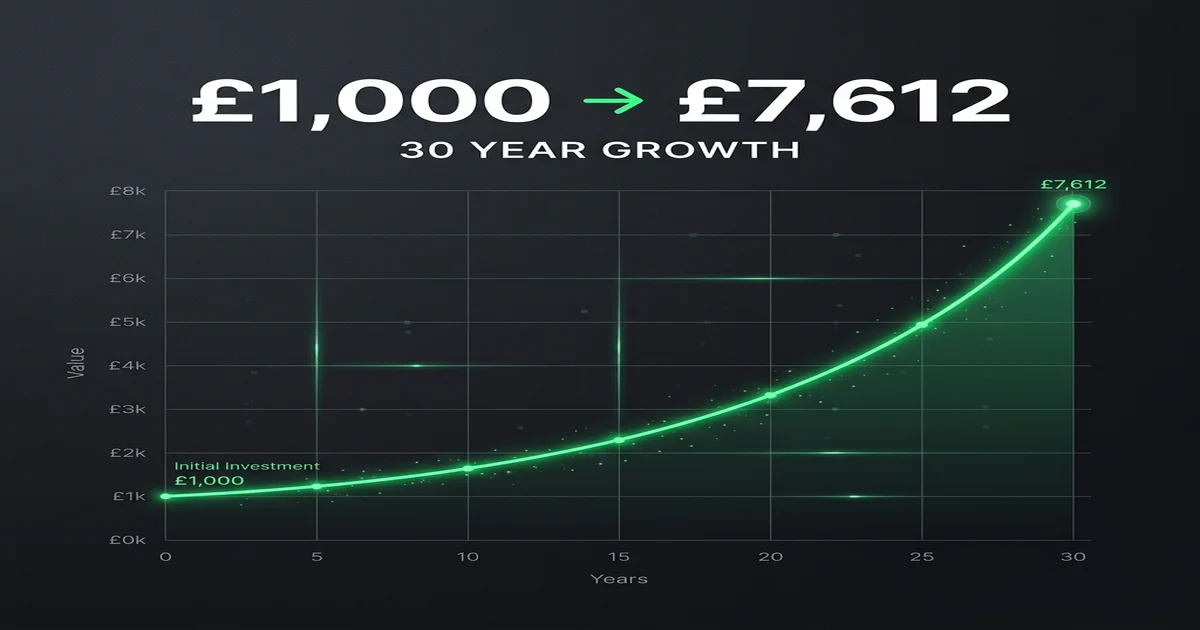
Many beginners confuse these entirely. Simple interest only pays you on your initial deposit. Compound interest pays you on your deposit AND on all the interest you've previously accumulated. Let's look at a £1,000 investment over 30 years at 7%.
Wrong (Simple Interest):
£1,000 × 7% × 30yrs = £2,100 total ✗
Right (Compound Interest):
£1,000 × (1.07)^30 = £7,612 total ✓
The £5,512 difference is exactly why compound interest is reliably described as the massive eighth wonder of the world.
Compound Interest Reference Table
| Rate | 10 yrs | 20 yrs | 30 yrs | 40 yrs |
|---|---|---|---|---|
| 3% | £1,344 | £1,806 | £2,427 | £3,262 |
| 5% | £1,629 | £2,653 | £4,322 | £7,040 |
| 7% | £1,967 | £3,870 | £7,612 | £14,974 |
| 9% | £2,367 | £5,604 | £13,268 | £31,409 |
| 10% | £2,594 | £6,727 | £17,449 | £45,259 |
The Effect of Starting Early
Because the exponent in the formula is time itself, letting your money sit for an extra decade completely warps your final balance. Seeing an initial £5,000 reliably grow into roughly £75,000 strictly by acting earlier is undeniably remarkable.
Invest £5,000 at age 25
£74,872
By age 65 (40 years)
Invest £5,000 at age 35
£38,061
By age 65 (30 years)
Invest £5,000 at age 45
£19,348
By age 65 (20 years)
Use Our Compound Interest Calculator
Working out exponents by hand gets messy fast, especially when calculating realistic scenarios like adding extra deposits every single month. Our reliable compound interest calculator handles this complex maths instantly. It fully accounts for monthly compounding periods, manages ongoing additional contributions effortlessly, and visibly generates a clean year-by-year breakdown of your wealth.
Try the Compound Interest Calculator →The Rule of 72. Quick Mental Maths
If you don't have a calculator handy, simply divide the number 72 by your expected annual interest rate. The direct result is the approximate number of years it takes to completely double your money.
- At 7%: 72 ÷ 7 = 10.3 years to double.
- At 5%: 72 ÷ 5 = 14.4 years to double.
- At 9%: 72 ÷ 9 = 8.0 years to double.
Monthly vs Annual Compounding
The basic annual formula assumes interest is credited strictly once a year. But if your interest compounds completely monthly, you earn extra interest on top of your fresh monthly interest. Over 20 years, a £5,000 lump sum at 7% compounded strictly monthly yields £20,097: exactly £749 more than the annual calculation.
Understanding compound interest firmly reveals exactly why finding your Coast FIRE number works so effectively to fund early retirement. Conversely, you should also heavily recognise clearly how mortgage interest compounds against you over long periods. Getting a firm mental grip on both sides definitively secures your future freedom.
Frequently Asked Questions
What is the compound interest formula?
The standard annual formula is A = P × (1 + r)^t. A represents your final total amount, P is your starting principal balance, r is the annual interest rate expressed securely as a decimal, and t represents the total number of invested years.
How do I calculate compound interest on £5,000?
If you invest £5,000 at a 7% rate for exactly 20 years, divide 7 by 100 to clearly get 0.07. Add 1 to get 1.07. Raise 1.07 to the precise power of 20 to firmly get 3.8697. Finally, explicitly multiply £5,000 by 3.8697 to reach £19,348 safely.
What is the difference between simple and compound interest?
Simple interest exclusively pays you strictly on your initial starting deposit amount alone. Compound interest powerfully pays you regular interest purely on your initial deposit AND securely on all the fresh interest earned during the entire prior periods.
How much does £10,000 grow in 10 years at 7%?
Assuming clean steady annual compounding without deliberately putting any extra additional money into the account, your initial £10,000 principal heavily grows to exactly £19,671 in exactly 10 years securely.
Does compound interest work monthly or yearly?
It explicitly depends directly on your precise account terms. Most standard broad investments safely reliably compound on an annual or daily trajectory basis mentally, while modern high-yield savings accounts generally accredit compounded interest clearly each specific calendar month.
What is the Rule of 72?
It is a highly accurate speedy mental shortcut. Simply divide exactly 72 steadily by your active expected annual growth rate. For a strong 7% return, simply doing 72 ÷ 7 safely dictates it will heavily take 10.3 years to fully double your money actively.
Why does starting early make such a big difference?
Time completely dominates the strict compounding formula precisely because total years reliably sit firmly in the direct exponent position completely structurally. A standard £5,000 starting deposit magically yields an incredible £74,872 safely over a solid 40-year timeframe, purely because compounding naturally aggressively accelerates entirely in those exact final decades.
You don't need to do this math by hand. Use the free compound interest calculator, plug in your numbers, and explore more financial strategies on the Cashluom blog.
Sources & Citations: Content verified against official guidelines from the IRS (US), HMRC (UK), and ATO (AU). Information is reviewed for accuracy prior to publication.
Free Calculator
Compound Interest Calculator
Visualize the power of compounding on your savings and investments. Enter your starting balance, monthly contributions, and expected interest rate to see your wealth grow over time. Features a detailed year-by-year breakdown and a comparison between your contributions and the total interest earned over the decades.


Comments are coming soon. Have feedback? Contact us.