

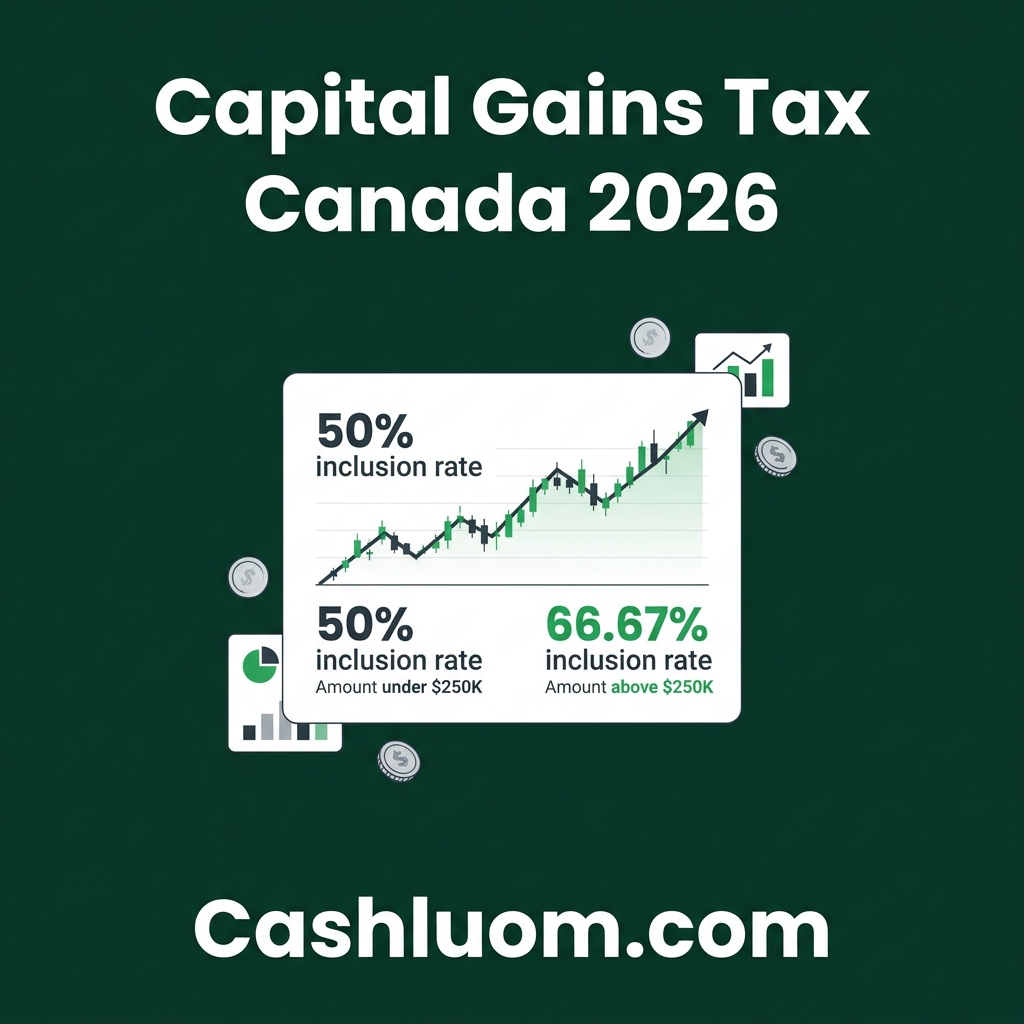
Capital gains tax in Canada underwent significant changes in the 2024 federal budget, with the inclusion rate increasing from 50% to 66.67% for capital gains above $250,000 in a single year for individuals. This is a complex change with several exceptions, exemptions, and planning strategies. Whether you're selling real estate (other than your principal residence), investments, a small business, or other capital property, understanding the new inclusion rate rules is essential for accurate tax planning in 2026.
2026 Capital Gains Inclusion Rate. Quick Reference
First $250K of gains: 50% inclusion | Above $250K: 66.67% inclusion | Corporations: 66.67% (all gains)
Inclusion rate determines what % of your capital gain is added to taxable income. A $100,000 gain at 50% inclusion adds $50,000 to income: taxed at your marginal rate. At 66.67%, the same $100K gain adds $66,670 to income.
How Canada Capital Gains Tax Works: Step by Step
Calculating Canadian capital gains tax involves four steps:
- Calculate the capital gain: Proceeds of disposition − Adjusted Cost Base (ACB) − outlays and expenses = capital gain
- Apply the inclusion rate: First $250,000 × 50%; amount above $250,000 × 66.67%
- Add the taxable capital gain to income: This portion is added to your total income for the year
- Apply your marginal rate: The included amount is taxed at your combined federal + provincial marginal rate
Capital Gains Tax by Gain Amount (Ontario, 2026)
| Capital Gain | Portion Below $250K (50%) | Portion Above $250K (66.67%) | Taxable Gain (Added to Income) | Est. Tax Owing (Ontario, ~43% marginal) | Effective Rate on Gain |
|---|---|---|---|---|---|
| $50,000 | $25,000 | $0 | $25,000 | ~$10,750 | ~21.5% |
| $100,000 | $50,000 | $0 | $50,000 | ~$21,500 | ~21.5% |
| $250,000 | $125,000 | $0 | $125,000 | ~$53,750 | ~21.5% |
| $350,000 | $125,000 | $66,670 | $191,670 | ~$82,418 | ~23.5% |
| $500,000 | $125,000 | $166,670 | $291,670 | ~$125,418 | ~25.1% |
⚠️ Estimates based on Ontario combined top marginal rate of ~43.41% on the taxable gain amount. The taxable gain is added to all other income: if you have significant other income in the same year, the capital gain may push you into a higher bracket. The principal residence exemption eliminates the gain on your primary home entirely. Source: CRA. Capital Gains.
The Principal Residence Exemption
The most important capital gains exemption in Canada: the gain on the sale of your principal residence is completely tax-free. A "principal residence" is a home that you or your family habitually inhabited at some point during each year you designate it as your principal residence. The exemption can be claimed for each year the property was your principal residence.
| Scenario | Principal Residence? | Capital Gains Taxable? |
|---|---|---|
| Sold your only home after 10 years of living in it | Yes — all 10 years | No — full exemption |
| Sold a cottage (vacation home) — primary home elsewhere | Possibly — if designated and inhabited annually | Partially — years not designated are taxable |
| Sold investment/rental property you never lived in | No | Yes — full gain is taxable (at inclusion rate) |
| Sold a home, moved, then rented out for 2 years before selling 2nd property | Split designation — consult CRA | Possible partial gain on rental period years |
| Sold a property owned by a corporation | Corporations can't claim PRE | Yes — full gain at 66.67% corporate inclusion rate |
Lifetime Capital Gains Exemption (LCGE)
The LCGE provides additional protection from capital gains tax for specific asset types:
- Qualified Small Business Corporation (QSBC) shares: LCGE limit is $1,250,000 (increased from $1,016,602 in 2025 budget)
- Qualified Farm Property: $1,250,000 LCGE limit
- Qualified Fishing Property: $1,250,000 LCGE limit
For entrepreneurs selling a small business, the LCGE is one of the most powerful tax breaks in the Canadian tax code: potentially eliminating hundreds of thousands of dollars in capital gains tax on the sale of a qualifying CCPC.
Frequently Asked Questions
What is the capital gains inclusion rate in Canada for 2026?
For individuals: 50% on the first $250,000 of capital gains per year; 66.67% (2/3) on capital gains above $250,000. For corporations and trusts: 66.67% on all capital gains (no $250,000 threshold). This two-tier system was introduced in the 2024 federal budget. The inclusion rate determines what fraction of your capital gain is added to your taxable income: it's not a capital gains "tax rate" itself, but determines the base on which your regular marginal rate applies.
Do I pay capital gains tax on my home in Canada?
Generally no: the sale of your principal residence is exempt from capital gains tax under the Principal Residence Exemption (PRE). You must designate the property as your principal residence on Schedule 3 of your T1 for each year you claim the exemption. If the property was your principal residence for every year you owned it, the entire gain is exempt. Partial exemption applies if you rented out the property for some years or had a second property that could also qualify.
How are capital losses treated in Canada?
Capital losses can only be applied against capital gains, not against other types of income. In a year where your capital losses exceed your capital gains, the net capital loss can be carried back 3 years or carried forward indefinitely to offset future capital gains. If you sell an investment at a loss and buy the same or identical investment within 30 days before or after the sale, the "superficial loss" rules apply and the loss is denied (added to the ACB of the repurchased investment instead).
What is the Adjusted Cost Base (ACB) and why does it matter?
The ACB is your cost in a capital property for tax purposes: essentially what you paid for it, plus certain adjustable amounts (capital improvements to real estate, reinvested dividends for mutual funds, etc.). Your capital gain = Proceeds − ACB − selling costs. A higher ACB means a smaller capital gain; tracking ACB accurately minimizes your tax. For investments, your brokerage reports the ACB; for real estate, you must track it yourself: including purchase price, legal fees, and qualifying capital improvements.
Can I time the sale of an investment to reduce capital gains tax?
Yes: timing strategies are legitimate and commonly used: (1) Selling in a year with low income (retirement year, career break) to have a lower marginal rate on the included gain. (2) Spreading gains across multiple years to stay under the $250,000 annual threshold for each year (keeping the 50% inclusion rate). (3) Holding until a year when you have significant capital losses to offset. (4) Using RRSP contribution room to shelter income in a year with a large gain. Consult a tax professional before executing large dispositions.
Final Thoughts
Canada's capital gains tax system, while complex, is significantly more favourable than the equivalent treatment of interest income or employment income: the inclusion rate ensures you're only taxed on a fraction of the gain. The 2026 two-tier inclusion rate (50% under $250K; 66.67% above) adds a planning dimension: strategic disposal timing across multiple years can substantially reduce the tax cost of large gains. Use the Canada Income Tax Calculator to model your specific scenario, and explore our Dividend Tax Credit guide to compare the tax efficiency of dividends vs capital gains as an investor.
Sources & Citations
Free Calculator
Canada Capital Gains Calculator
Calculate tax on your investment gains. Supports the 2026 inclusion rate and provincial tax brackets.

Comments are coming soon. Have feedback? Contact us.