

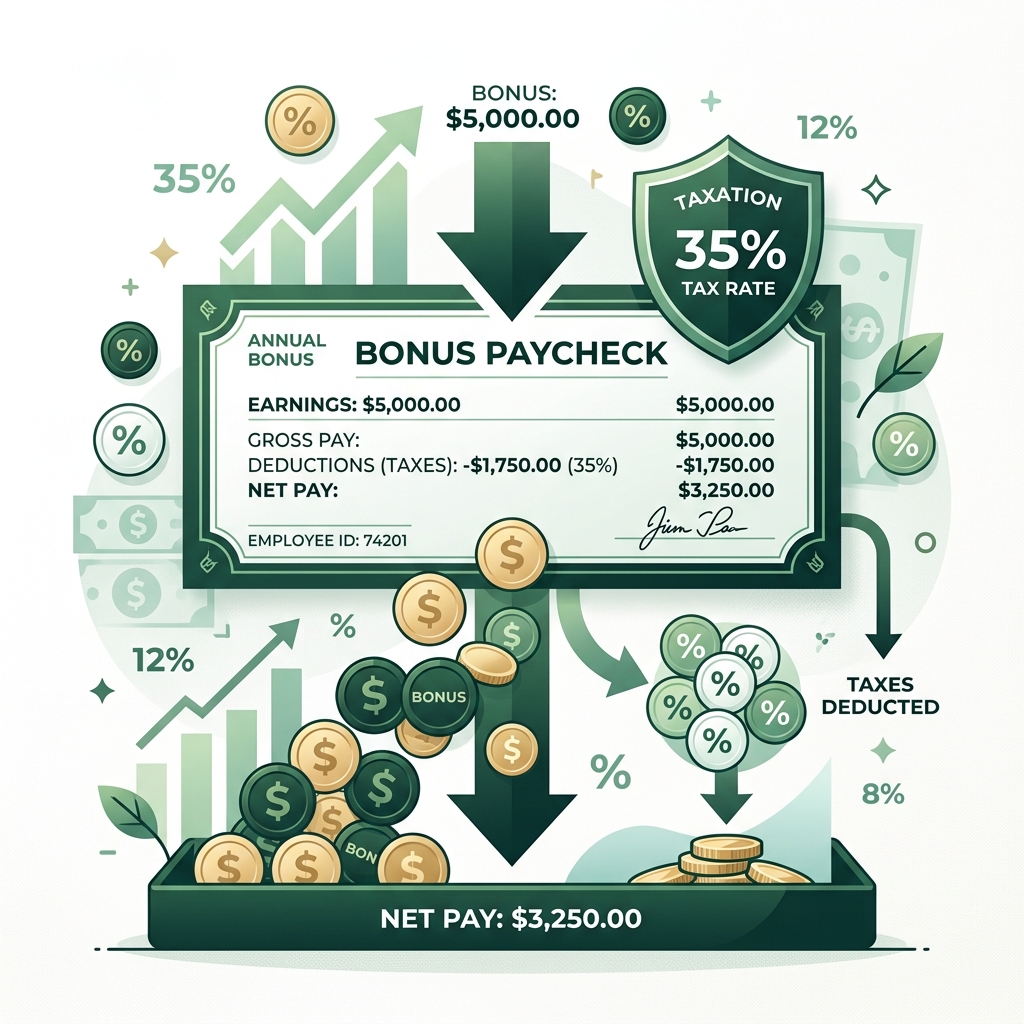
If you've ever received a large bonus and been shocked by how much disappeared to tax, you're not alone. People commonly believe bonuses are penalised by the government. The truth is simpler and more reassuring: what you see on your payslip is an estimate, not your final bill.
The Withholding vs Liability Distinction. This Is Key
The most important thing to understand is the difference between withholding and tax liability.
Withholding is the money your employer sends to the government on your behalf each payday: it's an upfront estimate of what you might owe.
Tax liability is the actual amount you owe for the entire year, calculated based on your total annual income across all sources.
Example: You earn a $60,000 salary and receive a $10,000 bonus. Your total income is $70,000. Your effective tax rate on $70,000 is roughly 14.5%, so the true tax on that $10,000 bonus is approximately $1,450. But your employer may have withheld $2,200 using the standard rate. You overpaid by $750, and you'll get it back at filing.
How It Works in the UK (PAYE)
The UK's PAYE system does not use the US "percentage method." Instead, your bonus is added to your normal monthly pay and the whole amount is taxed together.
If your normal monthly salary is £4,000 and you receive a £5,000 bonus in December, your December gross becomes £9,000. PAYE software assumes this means you'll earn £108,000 for the year: putting you firmly in the 40% higher rate band. The result is a very large deduction in that pay period.
The good news: HMRC self-corrects. If your actual annual income stays below £50,270, any overpaid tax is automatically refunded or corrected through your tax code.
How It Works in the US
The IRS treats bonuses as "supplemental wages." Employers must use the flat 22% federal withholding rate for bonus payments below $1 million (37% above $1 million). FICA (Social Security 6.2% + Medicare 1.45%) is applied on top of that.
| Calculation Step | Amount | Explanation |
|---|---|---|
| Base Salary | $75,000 | Your standard annual income |
| Gross Bonus | $15,000 | Lump sum payment received |
| Withholding (22%) | $3,300 | Flat rate applied immediately |
| FICA (7.65%) | $1,148 | Social Security + Medicare |
| Actual Federal Tax Owed | ~$2,700 | At your true ~18% effective rate |
| Estimated Refund | ~$600 | Over-withholding returned at filing |
Strategies to Keep More of Your Bonus
Pension / 401(k) Contributions
In the UK, salary sacrifice before the bonus is paid reduces both income tax and National Insurance. In the US, contributing a portion of your bonus directly to a traditional 401(k) reduces your taxable income dollar-for-dollar.
Timing Your Bonus
If you expect lower income next year (parental leave, career change, sabbatical), ask HR to defer your bonus into the new tax year. This can push the income into a lower marginal bracket: particularly useful in the US.
ISAs and Tax-Advantaged Accounts (UK)
Funnelling your net bonus into a Stocks and Shares ISA shields all future growth and dividends from Capital Gains Tax, up to £20,000 per year.
HSA Contributions (US)
If you're enrolled in a qualifying high-deductible health plan, maxing out your HSA with bonus funds is fully tax-deductible upfront (2026 limits: $4,300 individual, $8,550 family).
Is a bonus taxed at a higher rate than regular salary?
No. Bonuses are subject to higher initial withholding, not a higher permanent tax rate. Your actual tax liability is calculated at your annual effective rate when you file, and any excess withholding is refunded.
Why did my UK bonus get taxed at 40% if I'm a basic rate taxpayer?
The PAYE system annualises your monthly pay. If your bonus spikes your December earnings, the software assumes that level every month, temporarily placing you in the higher rate band. HMRC corrects this at year-end.
Can I ask my employer not to withhold tax on my bonus?
No. Employers are legally required by the IRS and HMRC to follow withholding rules on all supplemental wage payments. You can reduce your taxable amount through pension or 401(k) contributions before the bonus is paid.
How does a 401(k) or pension contribution help with a bonus?
Pre-tax contributions reduce your taxable income in that pay period, meaning a smaller portion of the bonus is subject to the aggressive upfront withholding rate.
Will I get my bonus tax back when I file?
Yes: if your actual effective tax rate is lower than the 22% flat rate (US) or the higher rate band temporarily applied (UK), the overpayment is returned as a refund or coded out in subsequent months.
Read more about exactly how much a £1,000 or $1,000 bonus is worth after tax with worked tables for both countries.
Sources & Citations: Content verified against official guidelines from the IRS (US), HMRC (UK), and ATO (AU). Information is reviewed for accuracy prior to publication.
Free Calculator
Salary Calculator
Calculate your exact net take-home pay after all government deductions. Our salary tool handles UK PAYE/NI, US Federal/State taxes, Australian ATO rates, and more. Enter your gross annual pay to see your monthly, bi-weekly, and weekly cash in hand. Updated for the latest 2026 tax brackets and social security thresholds.
Comments are coming soon. Have feedback? Contact us.