

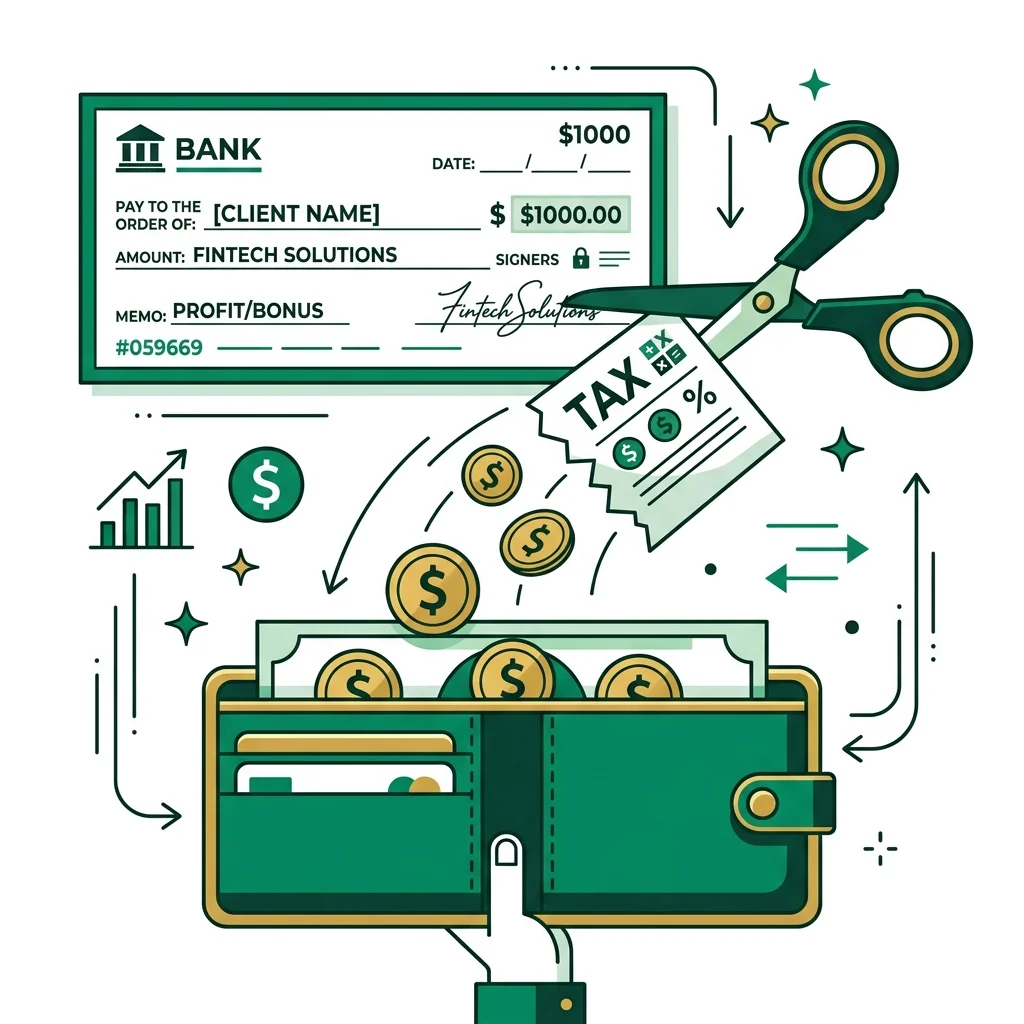
"My bonus was taxed at 50%!": you've heard this from a colleague, or maybe experienced it yourself. It's one of the most common misconceptions in personal finance, and it's wrong. Bonuses are not taxed at a special penalty rate. What you're actually seeing is payroll withholding mathematics: your employer's payroll software annualizes your bonus month's earnings and temporarily withholds more tax to account for the higher apparent annual income. This guide walks through exactly what happens, how much you'll actually keep from a $1,000 bonus at various income levels, and how to recalculate if you think too much was withheld.
What You Actually Keep From a $1,000 Bonus
At 30% marginal rate (Ontario): ~$700 net | At 43% marginal rate: ~$570 net
Your marginal rate is the rate on your highest dollar of income: in the bracket above your regular salary. If your regular salary doesn't use your entire 26% bracket, the bonus fills the remaining room at 26%, then spills into 29% if large enough.
How Much Is a $1,000 Bonus After Tax? (Canada, 2026)
Your take-home from a $1,000 bonus depends on which combined federal + provincial marginal rate applies to the bonus dollars. Here's how much you keep across common income levels (Ontario example):
| Annual Salary | Federal + ON Marginal Rate on Bonus | Tax on $1,000 Bonus | Net Bonus Take-Home |
|---|---|---|---|
| Under $46,295 | 20.05% | ~$201 | ~$799 |
| $46,296 – $57,375 | 24.15% | ~$242 | ~$758 |
| $57,376 – $92,454 | 31.48% | ~$315 | ~$685 |
| $92,455 – $100,392 | 33.89% | ~$339 | ~$661 |
| $100,393 – $114,750 | 37.91% | ~$379 | ~$621 |
| $114,751 – $150,000 | 43.41% | ~$434 | ~$566 |
| $150,001 – $220,000 | 46.41% | ~$464 | ~$536 |
| Over $220,000 | 53.53% | ~$535 | ~$465 |
⚠️ Ontario 2026 combined federal + provincial marginal rates on employment income. Excludes CPP/EI (if already at maximum contributions for the year, which may apply to mid/end-year bonuses). Source: CRA Tax Rates 2026.
Why Your Bonus Paycheque Shows Higher Withholding
When your employer pays a bonus, the payroll system often annualizes your gross earnings for that pay period. Example: you earn $6,000/month normally. In the bonus month, you receive $7,000 ($6,000 salary + $1,000 bonus). The payroll system annualizes this: $7,000 × 12 = $84,000/year. It then calculates the monthly withholding appropriate for an $84,000 annual income: higher than your normal monthly withholding based on $72,000/year.
The important point: this is just a withholding mechanism. Your actual tax is assessed on your real annual income at year-end. If the annualized withholding method caused over-withholding, you'll get a refund when you file your T1. The bonus was not permanently taxed at a higher rate: only the withholding was temporarily inflated.
The Same Analysis for the UK
UK workers face the same dynamic. A £1,000 bonus processed through PAYE is subject to Income Tax and National Insurance based on the marginal rate:
| Annual Salary (UK) | Income Tax Rate on Bonus | NI Rate on Bonus | Combined Rate | Net £1,000 Bonus |
|---|---|---|---|---|
| Under £12,570 (no tax) | 0% | 0% | 0% | £1,000 |
| £12,571 – £50,270 (Basic Rate) | 20% | 8% | 28% | £720 |
| £50,271 – £100,000 (Higher Rate) | 40% | 2% | 42% | £580 |
| £100,001 – £125,140 (PA taper zone) | 60% effective | 2% | 62% | £380 |
| Over £125,140 (Additional Rate) | 45% | 2% | 47% | £530 |
⚠️ 2025/26 UK rates. The £100K–£125,140 band has an effective 60% rate due to Personal Allowance tapering: a £1,000 bonus in this zone nets only £380. Consider making pension contributions to preserve your Personal Allowance if you're near this threshold.
Tax-Smart Ways to Maximize Your Bonus
While you can't change your marginal rate, you can reduce your taxable income before the bonus is assessed:
- Canada: Direct your bonus toward RRSP contributions if you have room: reducing your taxable income dollar-for-dollar at your marginal rate
- UK: Consider salary sacrifice (pension contributions) to reduce your gross income before the bonus is calculated through PAYE: especially effective if you're near the £100,000 Personal Allowance taper
- US (W-2): Increase 401k contributions in the bonus month to shelter the pre-tax amount
- Timing flexibility: If you have any say in bonus payment timing, a bonus in January (a new tax year) starts fresh at your lowest marginal rate for the year: potentially saving significant withholding
Frequently Asked Questions
How much of a $1,000 bonus do you actually keep in Canada?
Depending on your income level and province, a $1,000 bonus nets approximately $465–$799 in Ontario. At a $80,000 salary (31.48% combined marginal rate on the bonus dollars), you'd keep about $685 from a $1,000 bonus. Your province matters. Alberta residents at the same salary keep more (lower provincial rate), Quebec residents keep less (higher provincial rate). CPP and EI may also apply if you haven't hit your annual maximum.
Is a bonus taxed differently than regular salary in Canada?
No. Bonuses are treated as regular employment income by the CRA: added to your other employment income and taxed at your marginal rate. They are not subject to a special "bonus tax rate." What happens is that your employer's payroll system may annualize your bonus month's earnings and temporarily withhold more tax: creating the illusion of a higher tax rate on the bonus. But at year-end, your actual tax is calculated on your true annual income, and any over-withholding is refunded.
Why does my bonus cheque show so much tax taken off?
Because of payroll annualization. Your employer's payroll software takes your bonus month's total earnings (regular pay + bonus), multiplies by 12, and calculates the monthly withholding appropriate for that annualized income. In a month with a bonus, your apparent annualized income is much higher, so more tax is withheld. This is a conservative approach to ensure you don't underpay during the year: any excess is returned as a refund when you file.
What's the net take-home on a £1,000 bonus in the UK?
Depends on your Income Tax bracket: Basic Rate taxpayer (income £12,571–£50,270): £1,000 − 20% income tax − 8% NI = £720 net. Higher Rate taxpayer (income £50,271–£100,000): £1,000 − 40% income tax − 2% NI = £580 net. Personal Allowance taper zone (income £100,001–£125,140): approximately £380 net due to the 60% effective marginal rate. Additional Rate (above £125,140): approximately £530 net.
Can I reduce the tax on my bonus by contributing to my RRSP?
Yes — RRSP contributions reduce your taxable income. If you receive a $1,000 bonus and contribute $1,000 to your RRSP (assuming you have room), your net taxable income doesn't increase. The RRSP contribution effectively shelters the bonus at your marginal rate. At a 40% marginal rate, contributing the bonus to an RRSP saves $400 in tax immediately: while preserving the $1,000 for tax-deferred growth in the RRSP until retirement withdrawal.
Final Thoughts
The "bonus tax" myth persists because payroll withholding mechanics make bonuses look like they're taxed at a special rate. They're not: bonuses are ordinary income, taxed at your marginal rate. The key insight is that withholding is not the same as final tax. Your year-end T1 (or P60 in the UK) is the true measure of your tax liability. Use the Canada Income Tax Calculator to model your bonus take-home precisely, and read our Bonus Tax Canada guide for a deeper dive into the CRA annualization method and how bonuses interact with your overall annual tax position.
Sources & Citations: Content verified against official guidelines from the IRS (US), HMRC (UK), and ATO (AU). Information is reviewed for accuracy prior to publication.
Free Calculator
Salary Calculator
Calculate your exact net take-home pay after all government deductions. Our salary tool handles UK PAYE/NI, US Federal/State taxes, Australian ATO rates, and more. Enter your gross annual pay to see your monthly, bi-weekly, and weekly cash in hand. Updated for the latest 2026 tax brackets and social security thresholds.
Comments are coming soon. Have feedback? Contact us.