

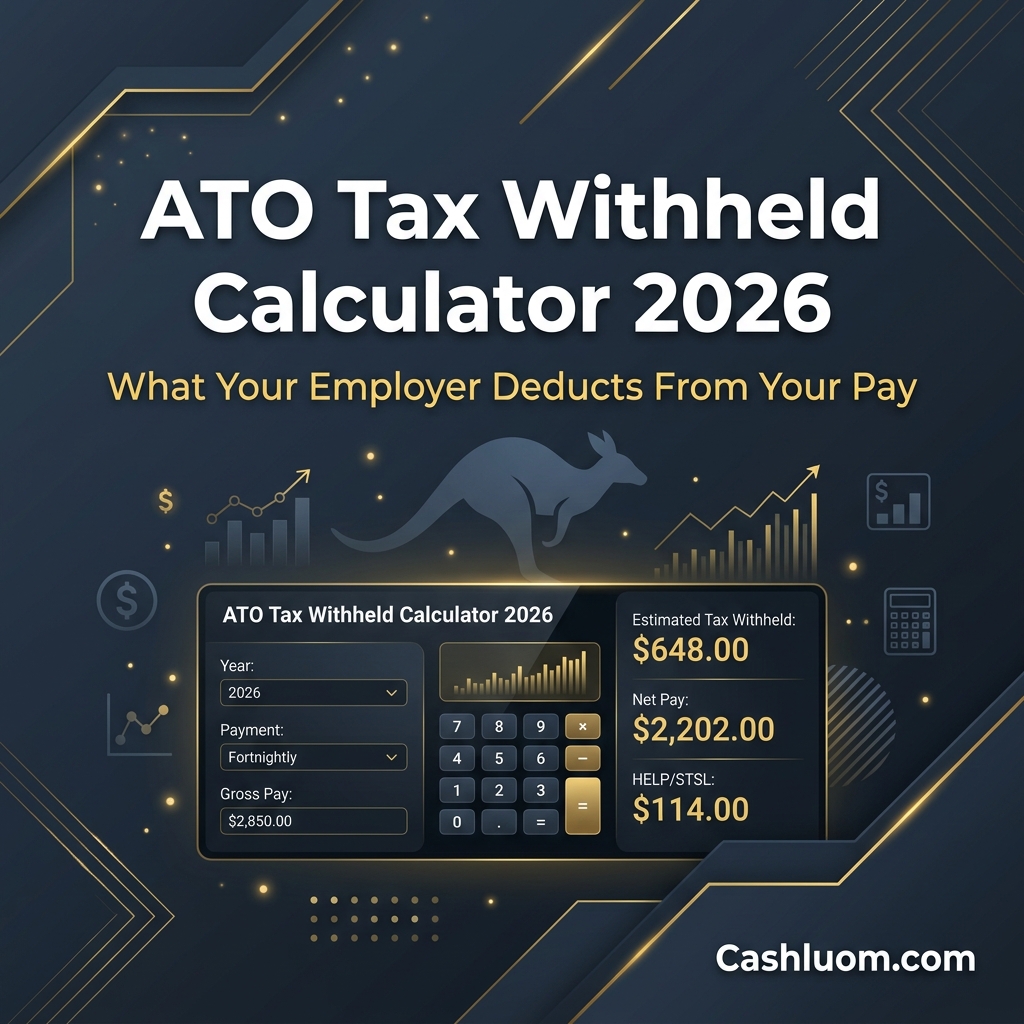
You just received your first payslip at a new Australian job. You were excited about the $3,200 gross figure you negotiated, but then you look at the "Net Pay" line and see $2,537. That $663 disappeared before it even touched your bank account. Where did it go? It went to the Australian Taxation Office (ATO), and you need to know if they took exactly what they were supposed to.
Pay As You Go (PAYG) withholding is the mechanism that keeps the Australian government running, but it is also the source of the most common payroll errors. Whether you are a casual worker or a full-time professional, checking your withholding rate today can save you from a massive surprise tax bill when you lodge your return in July.
Estimated PAYG Withholding (2026)
| Annual Income | Weekly Withheld | Fortnightly Withheld | Monthly Withheld |
|---|---|---|---|
| $40,000 | $156 | $312 | $677 |
| $60,000 | $279 | $558 | $1,210 |
| $80,000 | $422 | $844 | $1,832 |
| $100,000 | $602 | $1,204 | $2,613 |
| $120,000 | $842 | $1,684 | $3,653 |
*Estimates include the 2% Medicare Levy. Actual amounts may vary based on HELP debts or tax offsets.
What is PAYG Withholding?
PAYG withholding is simply the ATO collecting your income tax in small, manageable installments throughout the year. Instead of hitting you with a $20,000 bill at the end of the financial year, your employer acts as a middleman, skimming a portion of every paycheck and sending it directly to the ATO on your behalf.
If your employer takes too much, you'll get a "Tax Refund" after you lodge your return. if they take too little—perhaps because you have a second job or didn't disclose a debt—you'll receive a "Tax Bill." The goal of a perfect payroll setup is to have your withholding match your actual tax liability as closely as possible, so you aren't essentially giving the government an interest-free loan or digging yourself into a debt hole.
Australia's 2026 Income Tax Brackets
To understand your withholding, you must know which bracket your last dollar falls into. Australia uses a progressive system where you pay $0 on your first $18,200 of earnings, and increasing rates on everything above that.
| Income Bracket | Tax Rate | Tax Owed (Cumulative) |
|---|---|---|
| $0 – $18,200 | 0% (Tax-Free Threshold) | $0 |
| $18,201 – $45,000 | 19% | Up to $5,092 |
| $45,001 – $120,000 | 32.5% | Up to $29,467 |
| $120,001 – $180,000 | 37% | Up to $51,667 |
| $180,001+ | 45% | — |
On top of these rates, most Australians pay a 2% Medicare Levy, which is usually included in your employer's withholding calculation.
Three Worked Examples
Example 1: The Casual Worker
You work in a café and earn $38,000 a year. Because you are below the $45k bracket, your tax rate is lower. Your weekly withholding is approximately $156. By the end of the year, you will have paid roughly $8,112 in tax and Medicare, which should match your final liability perfectly.
Example 2: The Full-Time Professional
You earn a salary of $85,000. You are firmly in the 32.5% bracket. Your monthly gross is $7,083, and your employer withholds $1,544. This means you keep $5,539 every month. Over the year, the ATO receives $18,528 of your money.
Example 3: The Graduate with HELP Debt
You earn $85,000, but you also have a student (HELP) debt. Because you've cleared the repayment threshold, your employer must withhold an extra amount—roughly 5% of your income—to pay down your loan. Your monthly withholding jumps from $1,544 to $1,898. You take home $354 less per month, but your student debt is being wiped out automatically.
The "Second Job" Surprise
You can only claim the $18,200 tax-free threshold from ONE employer. If you have two jobs and claim the threshold on both, both employers will assume your first $18k with them is tax-free. At tax time, the ATO will combine your incomes and realize you owe 19% or 32.5% on that second $18k. This mistake can lead to a surprise $3,500 bill. Always claim the threshold at your highest-paying job and "No" at the second.
Why Your Withholding Might Be Wrong
The most common reason for incorrect withholding is an outdated TFN Declaration form. If you've recently finished a degree and started a new job, or if you've paid off your HELP debt, you must tell your employer. Otherwise, they will continue to deduct money for a debt that no longer exists, leaving you with less cash each week until your next tax refund.
Another common issue is "lumpy" income. If you receive a large performance bonus in a single month, your payroll software might assume you earn that much every month and withhold tax at the 45% rate for that specific payslip. While you'll get the overpayment back eventually, it can be a shock to see half your bonus disappear to the ATO.
Check your estimated Australian tax withheld
For precise PAYG amounts including specific offsets, we recommend the ATO's official calculator. To back out GST or reverse-calculate tax from any price, use our tool below.
How to Check if Your Employer is Correct
Don't just trust the software. Take these four steps to verify your pay today:
- Find your year-to-date (YTD) gross: Look at your most recent payslip.
- Calculate your expected tax: Use the bracket table above to see what you should have paid on that YTD amount.
- Compare to YTD tax withheld: Look for the "Tax" or "PAYG" line on your payslip.
- Spot the gap: If your withheld tax differs from your calculation by more than 5%, something is wrong. Contact your payroll department or consider lodging a withholding variation.
Frequently Asked Questions
What happens if too much tax is withheld from my pay?
You'll receive the overpayment back as a tax refund after you lodge your annual tax return. The ATO essentially holds the extra money for you until the end of the financial year.
Can I ask my employer to withhold less tax?
Only if you have a valid reason and apply for a "Withholding Variation" from the ATO. This is common for people with high investment property losses (negative gearing) who want to receive their tax benefit throughout the year rather than as a lump sum refund.
Does working two jobs mean I pay more tax?
No. You pay the same amount of tax on $80,000 total income whether it comes from one job or five. The only difference is that your withholding might be higher on the second job to ensure you don't end up with a bill.
When do I need to lodge a tax return in Australia?
The Australian financial year ends on June 30th. You usually have until October 31st to lodge your return, or later if you use a registered tax agent.
Pull up your last payslip right now. Divide the "year-to-date tax withheld" by your "year-to-date gross." That result is your effective withholding rate. Compare it to the bracket table above to see if you are on track. If the numbers don't add up, check our Australian GST guide to ensure you aren't also overpaying on your business expenses.
Sources & Citations: Content verified against official guidelines from the IRS (US), HMRC (UK), and ATO (AU). Information is reviewed for accuracy prior to publication.
Free Calculator
Reverse Tax Calculator
Calculate the original pre-tax price from any price-inclusive total. This tool is essential for business owners and shoppers who need to back out sales tax, VAT, or GST. Supports all 50 US states, UK VAT (20%), Australia GST (10%), Canada GST/HST (all provinces), and custom tax rates for any country worldwide.

Comments are coming soon. Have feedback? Contact us.