

Australia's 10% GST is one of the most straightforward national tax systems for calculation purposes. Unlike Canada (with 11 different rate combinations), the US (with state-by-state rates), or the EU (with multiple rates per country), Australia uses one flat 10% GST rate nationwide. This guide covers the complete reverse GST calculation for Australia: including the 1/11 rule, Business Activity Statement (BAS) reporting, which items are GST-free, and the ATO's tax withholding calculator.
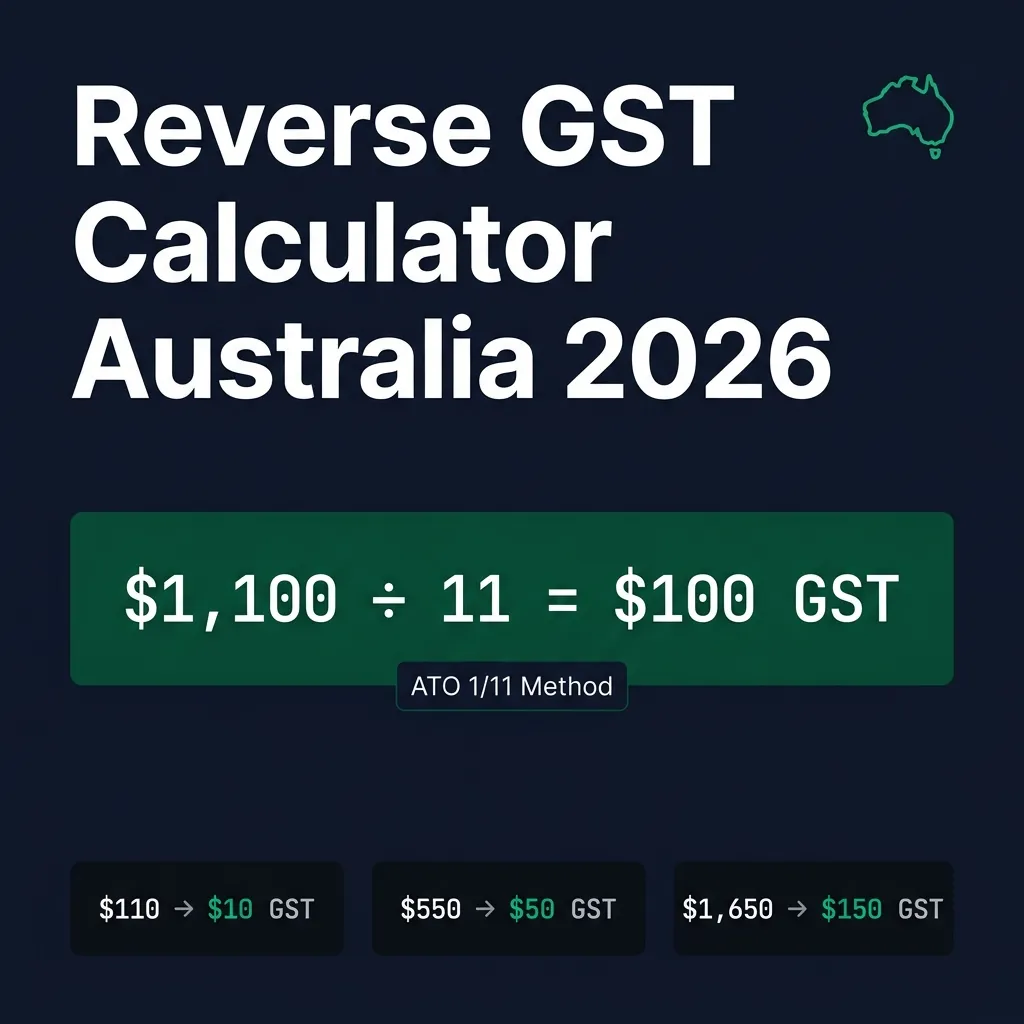
The 1/11 Rule. Australian Reverse GST
GST Amount = Total ÷ 11 | Net Price = Total × (10/11) = Total ÷ 1.10
Example: $330 AUD total → GST = $330 ÷ 11 = $30. Net price = $300. Check: $300 × 1.10 = $330. ✓ The "divide by 11" shortcut works because 10% of net = 10/110 of total = 1/11 of total.
Australian GST: Key Reference Table
| GST-Inclusive Total (AUD) | Net Price (Total ÷ 1.10) | GST Amount (Total ÷ 11) |
|---|---|---|
| $11.00 | $10.00 | $1.00 |
| $55.00 | $50.00 | $5.00 |
| $110.00 | $100.00 | $10.00 |
| $275.00 | $250.00 | $25.00 |
| $550.00 | $500.00 | $50.00 |
| $1,100.00 | $1,000.00 | $100.00 |
| $5,500.00 | $5,000.00 | $500.00 |
| $11,000.00 | $10,000.00 | $1,000.00 |
⚠️ Australia's GST rate is 10%, applied uniformly across all states and territories. The same rate and rules apply everywhere in Australia: no state-level GST variation. Source: ATO. Goods and Services Tax (GST).
What Is GST-Free in Australia?
Not everything in Australia is subject to 10% GST. Similar to Canada's zero-rated supplies, Australia has "GST-free" and "input taxed" supplies:
| Category | GST Status | Examples | Business Can Claim Input Tax Credits? |
|---|---|---|---|
| Taxable Supplies | 10% GST | Most goods, services, rent on commercial property, restaurant meals, clothing | Yes ✅ |
| GST-Free (Zero-Rate) | 0% | Basic foods (groceries), most health services, most education, exports, most childcare, prescription medicines | Yes ✅ |
| Input Taxed | 0% | Financial services, residential rent, sale of existing residential property | No ❌ |
⚠️ Source: ATO. Types of GST supplies. Some food items have unusual GST treatment (e.g., biscuits are GST-free but biscuits covered in chocolate are taxable). Always verify unusual food items with the ATO's food determination guide.
Australian GST Registration Threshold
Australian businesses must register for GST when:
- GST turnover is $75,000 or more per year (or $150,000 for non-profit bodies)
- You provide taxi/ridesharing services (regardless of turnover)
- You want to claim fuel tax credits (requires GST registration)
Once registered, you report and pay GST through your Business Activity Statement (BAS): submitted monthly, quarterly, or annually depending on your turnover. On the BAS, you report G1 (total sales), 1A (GST on sales), 1B (GST credits on purchases), and remit the net (1A − 1B).
Australia vs Canada vs UK: GST Rate Comparison
| Country | Tax Name | Standard Rate | Multiple Rates? | State/Provincial Variation? | Reverse Formula |
|---|---|---|---|---|---|
| Australia | GST | 10% | No (GST-free at 0%) | No — uniform nationwide | ÷ 1.10 (or ÷ 11) |
| Canada (Ontario) | HST | 13% | Yes (0%, 5%, 13%, 15%) | Yes — 5–15% by province | ÷ 1.13 |
| UK | VAT | 20% | Yes (0%, 5%, 20%) | No — uniform (Scotland has no VAT variation) | ÷ 1.20 |
| New Zealand | GST | 15% | No | No | ÷ 1.15 (or × 3/23) |
Frequently Asked Questions
How do I reverse-calculate GST in Australia?
Divide the GST-inclusive total by 11 to get the GST amount. The net (ex-GST) price equals the total minus the GST (or total ÷ 1.10 or total × 10/11). Example: $660 AUD total → GST = $660 ÷ 11 = $60 → Net = $600. This works because 10% of the net price equals 1/11 of the GST-inclusive total: a property specific to a 10% rate.
What is the Australian GST rate in 2026?
Australia's GST rate is 10% and has been since its introduction on 1 July 2000. It applies uniformly across all states and territories: there is no state-level GST equivalent in Australia (unlike Canada or the US). The 10% rate applies to taxable supplies; GST-free supplies (basic foods, most health, most education) charge 0% but businesses can still claim input tax credits on related costs.
Which foods are GST-free in Australia?
Basic food items for human consumption are generally GST-free: fresh fruit and vegetables, bread, cereals, meat, fish, dairy products, eggs, cooking oils. However, many prepared/processed foods are taxable: confectionery, savoury snacks, biscuits, carbonated drinks, ice cream, restaurant and takeaway meals (even if from a supermarket deli counter). The ATO maintains a detailed food determination guide: when in doubt, check the ATO website for your specific product.
When does an Australian business need to register for GST?
When annual GST turnover reaches or is expected to reach $75,000 (or $150,000 for non-profits). "GST turnover" means your gross business income excluding GST on sales. Rideshare and taxi drivers must register regardless of turnover. Voluntary registration is available below $75,000 and is beneficial if you have significant GST-taxable business expenses you wish to recover as input tax credits.
How is Australian GST different from Canadian HST?
Key differences: (1) Australia has a single nationwide 10% rate; Canada has 11 different rate combinations by province (5%–15%). (2) Australia has no provincial/state equivalent tax; Canada has separate provincial sales taxes (PST/QST) in some provinces. (3) Australia's "GST-free" category is similar to Canada's "zero-rated" in allowing input credit recovery; Australia's "input taxed" is similar to Canada's "exempt." (4) Australian BAS reporting differs from Canadian HST return mechanics, though the underlying ITC concept is the same.
Final Thoughts
Australia's flat 10% GST and the elegant "divide by 11" reverse formula make it one of the easiest national sales tax systems to work with mathematically. The main complexity lies in correctly classifying supplies as taxable, GST-free, or input taxed: particularly in food, health, and financial services. Use the Australia GST Calculator for instant calculations, and consult the ATO website for definitive guidance on the GST status of any specific supply or product category.
Sources & Citations: Content verified against official guidelines from the IRS (US), HMRC (UK), and ATO (AU). Information is reviewed for accuracy prior to publication.
Free Calculator
Reverse Tax Calculator
Calculate the original pre-tax price from any price-inclusive total. This tool is essential for business owners and shoppers who need to back out sales tax, VAT, or GST. Supports all 50 US states, UK VAT (20%), Australia GST (10%), Canada GST/HST (all provinces), and custom tax rates for any country worldwide.
Comments are coming soon. Have feedback? Contact us.