

You have a receipt for $84.75. You need to enter it into your expense report, but your accounting software is demanding the "Pre-Tax" amount. The receipt is faded, the sales tax line is a blur, and you have no idea if the rate was 6%, 7.25%, or 8.5%. You are stuck doing guesswork on a Tuesday afternoon when you should be finishing your real work.
Calculating the pre-tax price in the United States is uniquely frustrating because every state, county, and city can stack their own rates. If you just subtract the percentage, your math will be wrong. To "back out" sales tax correctly, you need the right divisor. Here is the universal formula and every US state rate for 2026.
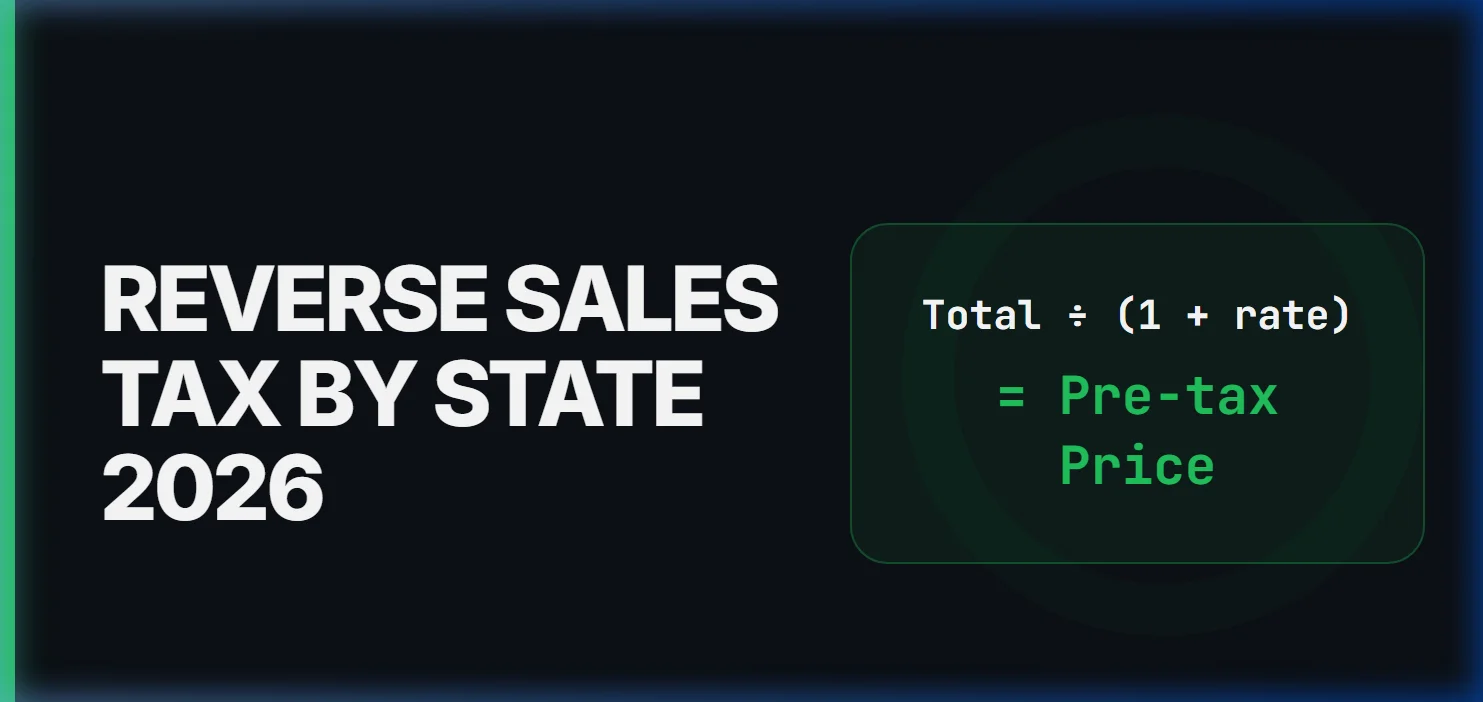
The Universal Reverse Sales Tax Formula
Pre-Tax Price = Total Price ÷ (1 + Sales Tax Rate)
Tax Amount = Total Price - Pre-Tax Price
Example: A $84.75 receipt in a 8.25% zone.
$84.75 ÷ 1.0825 = $78.29 (Pre-tax Price)
$84.75 - $78.29 = $6.46 (Tax Amount)
Quick Guide for the Top 10 Most Populous States
If you are in one of these states, here is what a $100.00 total actually breaks down into, based on average 2026 rates.
| State | Avg Rate | Pre-Tax Price | Tax Amount |
|---|---|---|---|
| California | 8.85% (avg) | $91.87 | $8.13 |
| Texas | 8.20% (avg) | $92.42 | $7.58 |
| New York | 8.52% (avg) | $92.15 | $7.85 |
| Florida | 7.02% (avg) | $93.44 | $6.56 |
| Illinois | 8.86% (avg) | $91.86 | $8.14 |
| Pennsylvania | 6.34% (avg) | $94.04 | $5.96 |
| Ohio | 7.24% (avg) | $93.25 | $6.75 |
| Georgia | 7.40% (avg) | $93.11 | $6.89 |
| North Carolina | 6.98% (avg) | $93.48 | $6.52 |
| Michigan | 6.00% (flat) | $94.34 | $5.66 |
All 50 US States Sales Tax Rates (2026)
Use this table to find the divisor for your state. Remember that "Combined Avg" includes the state rate plus the typical local additions. If your city has a special tax, use that specific rate instead.
| State | State Rate | Combined Avg | Divisor |
|---|---|---|---|
| Alabama | 4.00% | 9.29% | 1.0929 |
| Alaska | 0.00% | 1.82% | 1.0182 |
| Arizona | 5.60% | 8.40% | 1.0840 |
| Arkansas | 6.50% | 9.46% | 1.0946 |
| California | 7.25% | 8.85% | 1.0885 |
| Colorado | 2.90% | 7.81% | 1.0781 |
| Connecticut | 6.35% | 6.35% | 1.0635 |
| Delaware | 0.00% | 0.00% | 1.0000 |
| Florida | 6.00% | 7.02% | 1.0702 |
| Georgia | 4.00% | 7.40% | 1.0740 |
| Hawaii | 4.00% | 4.44% | 1.0444 |
| Idaho | 6.00% | 6.03% | 1.0603 |
| Illinois | 6.25% | 8.86% | 1.0886 |
| Indiana | 7.00% | 7.00% | 1.0700 |
| Iowa | 6.00% | 6.94% | 1.0694 |
| Kansas | 6.50% | 8.75% | 1.0875 |
| Kentucky | 6.00% | 6.00% | 1.0600 |
| Louisiana | 4.45% | 9.56% | 1.0956 |
| Maine | 5.50% | 5.50% | 1.0550 |
| Maryland | 6.00% | 6.00% | 1.0600 |
| Massachusetts | 6.25% | 6.25% | 1.0625 |
| Michigan | 6.00% | 6.00% | 1.0600 |
| Minnesota | 6.875% | 7.52% | 1.0752 |
| Mississippi | 7.00% | 7.07% | 1.0707 |
| Missouri | 4.225% | 8.40% | 1.0840 |
| Montana | 0.00% | 0.00% | 1.0000 |
| Nebraska | 5.50% | 7.01% | 1.0701 |
| Nevada | 6.85% | 8.23% | 1.0823 |
| New Hampshire | 0.00% | 0.00% | 1.0000 |
| New Jersey | 6.625% | 6.60% | 1.0660 |
| New Mexico | 4.875% | 7.63% | 1.0763 |
| New York | 4.00% | 8.52% | 1.0852 |
| North Carolina | 4.75% | 6.98% | 1.0698 |
| North Dakota | 5.00% | 7.04% | 1.0704 |
| Ohio | 5.75% | 7.24% | 1.0724 |
| Oklahoma | 4.50% | 8.99% | 1.0899 |
| Oregon | 0.00% | 0.00% | 1.0000 |
| Pennsylvania | 6.00% | 6.34% | 1.0634 |
| Rhode Island | 7.00% | 7.00% | 1.0700 |
| South Carolina | 6.00% | 7.44% | 1.0744 |
| South Dakota | 4.20% | 6.12% | 1.0612 |
| Tennessee | 7.00% | 9.55% | 1.0955 |
| Texas | 6.25% | 8.20% | 1.0820 |
| Utah | 6.10% | 7.25% | 1.0725 |
| Vermont | 6.00% | 6.36% | 1.0636 |
| Virginia | 5.30% | 5.77% | 1.0577 |
| Washington | 6.50% | 9.40% | 1.0940 |
| West Virginia | 6.00% | 6.57% | 1.0657 |
| Wisconsin | 5.00% | 5.43% | 1.0543 |
| Wyoming | 4.00% | 5.44% | 1.0544 |
The Local Tax Warning
The state rate is just the floor. Over 11,000 local jurisdictions in the US add their own taxes on top of the state number. For example, in Chicago, the actual rate is 10.25% despite the Illinois state rate being only 6.25%. Always check your receipt or your city's Department of Revenue website for the most accurate combined rate.
Worked Examples
Example 1: The Tennessee E-commerce Expense
You purchased office supplies for $2,340 total. The order was shipped to your warehouse in Tennessee, which has an average combined rate of 9.55%. You need the pre-tax amount for your tax deduction.
Calculation: $2,340 ÷ 1.0955 = $2,136.01. The sales tax paid was $203.99.
Example 2: The Florida Vehicle Purchase
You bought a used delivery van for $24,750 inclusive of Florida's 6% sales tax. You want to verify that the dealership didn't add any "hidden" fees into the tax line.
Calculation: $24,750 ÷ 1.06 = $23,349.06. If the dealership's base price doesn't match this, you have grounds to ask for a breakdown.
Example 3: The NYC Restaurant Check
You had a business dinner in Manhattan. The total bill was $67.50, and you know the NYC combined rate is 8.875%. You need to separate the meal cost from the tax for your expense app.
Calculation: $67.50 ÷ 1.08875 = $61.99. The tax was $5.51.
Remove sales tax instantly from any total
Works for any US state or local rate—just enter the total and the combined rate.
Frequently Asked Questions
Which US states have no sales tax?
Five states have no statewide sales tax: Oregon, Montana, New Hampshire, Delaware, and Alaska. Note that local municipalities in Alaska can still charge their own local sales taxes.
Is sales tax the same across a whole state?
Rarely. Most states allow counties and cities to add their own "local option" sales taxes. This is why the rate can change just by driving five minutes across a city border.
Can I get a sales tax refund if I overpaid?
Yes, but it is complicated. You usually have to file a claim with the state's Department of Revenue and provide proof that the tax was charged in error or that you were exempt.
How do online purchases work for sales tax?
Following the Wayfair ruling, most online retailers must charge sales tax based on the destination address (where the item is shipped), not where the store is located.
What is the difference between sales tax and VAT?
Sales tax is only collected at the final point of sale to the consumer. VAT (Value Added Tax) is collected at every stage of the supply chain. Sales tax is much simpler to "reverse" because you only deal with one rate.
Next time you get a receipt that needs to go on an expense report, don't waste time with a pencil and paper. Bookmark this page and use the 50-state table above. You'll never need to guess a divisor or accidentally under-report your expenses again. If you have a bulk list of invoices to process, use our instant removal tool to finish the job in seconds.
Sources & Citations: Content verified against official guidelines from the IRS (US), HMRC (UK), and ATO (AU). Information is reviewed for accuracy prior to publication.
Free Calculator
Reverse Tax Calculator
Calculate the original pre-tax price from any price-inclusive total. This tool is essential for business owners and shoppers who need to back out sales tax, VAT, or GST. Supports all 50 US states, UK VAT (20%), Australia GST (10%), Canada GST/HST (all provinces), and custom tax rates for any country worldwide.

Comments are coming soon. Have feedback? Contact us.