

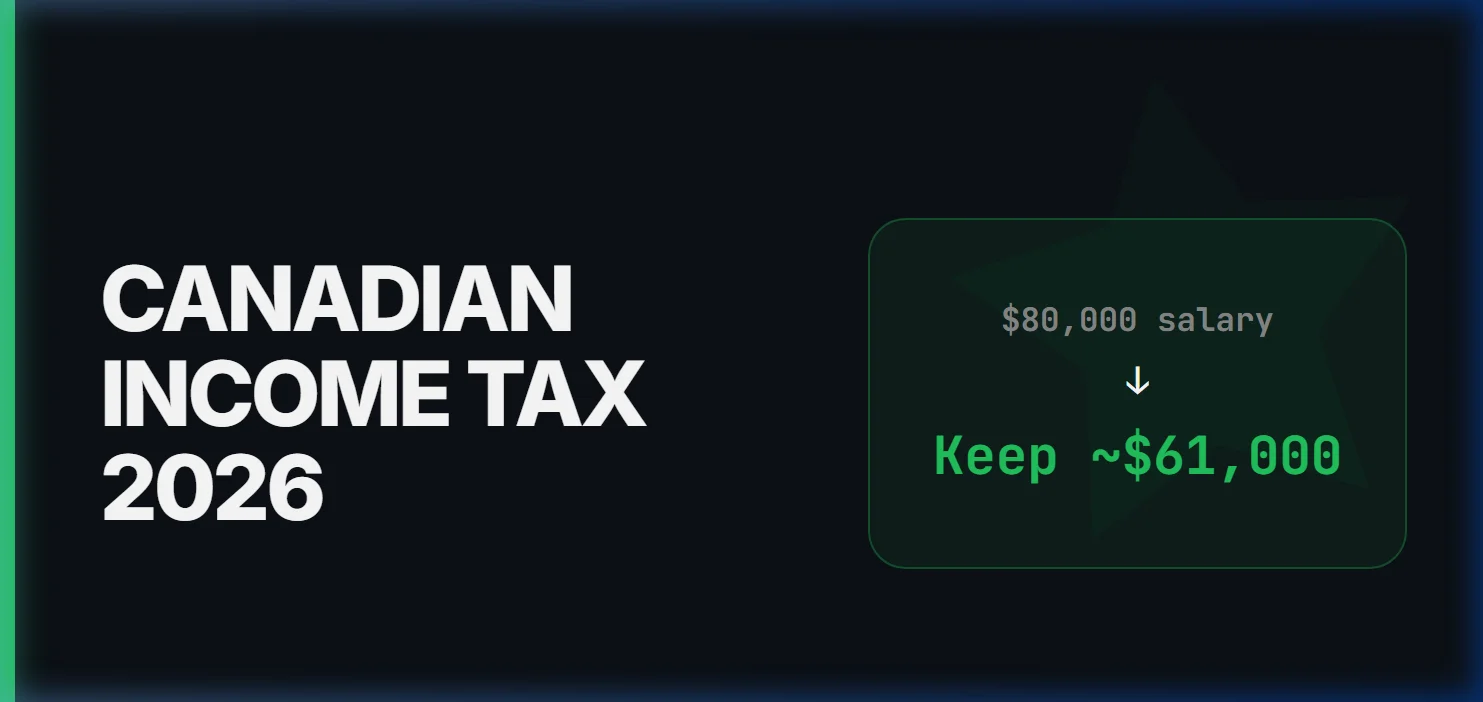
| Federal Taxable Income | Tax Rate |
|---|---|
| Up to $57,375 | 15% |
| $57,376 to $114,750 | 20.5% |
| $114,751 to $158,519 | 26% |
| $158,520 to $220,000 | 29% |
| Over $220,000 | 33% |
⚠️ Basic Personal Amount (BPA) for 2026: $16,129 — subtract this before calculating. Provincial tax is applied on top at separate rates. Source: CRA — Canadian Income Tax Rates 2026.
"How much income tax will I actually pay?" is the most common Canadian tax question, and the answer depends on more variables than most people expect. Your province matters enormously (an Alberta resident earning $100,000 pays thousands less than a comparable Quebec resident). Your deductions and credits change the calculation. CPP and EI come off the top before income tax is calculated. This guide cuts through the complexity to give you real numbers for real incomes across the most common Canadian salary ranges in 2026.
Canada's 2026 Federal Tax Brackets
15% → 20.5% → 26% → 29% → 33%
Applied on: $57,375 / $114,750 / $158,519 / $220,000. Add provincial tax on top. The BPA ($16,129 federally) means the first ~$16K of income is tax-free.
2026 Federal Income Tax Brackets
| Federal Bracket | Rate | Income Range | Tax on This Bracket (Max) |
|---|---|---|---|
| 1st bracket | 15% | $0 – $57,375 | $8,606.25 |
| 2nd bracket | 20.5% | $57,376 – $114,750 | $11,761.88 |
| 3rd bracket | 26% | $114,751 – $158,519 | $11,379.94 |
| 4th bracket | 29% | $158,520 – $220,000 | $17,829.20 |
| 5th bracket | 33% | Over $220,000 | 33% on all above |
⚠️ 2026 federal brackets indexed for inflation from 2025 actuals. The Basic Personal Amount (BPA) of $16,129 generates a 15% credit ($2,419), effectively making the first ~$16K tax-free. Source: CRA Federal Tax Rates.
How Much Tax on Common Salaries? (Ontario, 2026)
| Annual Salary | Federal Tax | Ontario Provincial Tax | CPP (Employee) | EI (Employee) | Total Deductions | Net Take-Home | Effective Rate |
|---|---|---|---|---|---|---|---|
| $40,000 | ~$3,500 | ~$1,300 | ~$2,177 | ~$664 | ~$7,641 | ~$32,359 | ~19.1% |
| $60,000 | ~$7,000 | ~$2,600 | ~$3,214 | ~$997 | ~$13,811 | ~$46,189 | ~23.0% |
| $80,000 | ~$11,200 | ~$4,200 | ~$3,868 | ~$1,049 | ~$20,317 | ~$59,683 | ~25.4% |
| $100,000 | ~$16,700 | ~$6,700 | ~$4,215 | ~$1,049 | ~$28,664 | ~$71,336 | ~28.7% |
| $120,000 | ~$22,500 | ~$9,300 | ~$4,215 | ~$1,049 | ~$37,064 | ~$82,936 | ~30.9% |
| $150,000 | ~$32,000 | ~$14,000 | ~$4,215 | ~$1,049 | ~$51,264 | ~$98,736 | ~34.2% |
⚠️ Estimates. Assumes no RRSP deductions, standard BPA and CPP/EI credits claimed. Actual amounts will vary. CPP includes CPP1 and CPP2 combined max. Use the Canada Income Tax Calculator for precision.
Provincial Tax Comparison at $80,000 Salary (2026)
Province makes a significant difference. Alberta's no-PST and lower provincial income tax saves residents thousands per year compared to Quebec:
| Province | Federal Tax | Provincial Tax | Combined Income Tax | Effective Income Tax Rate | Net Take-Home (after CPP/EI) |
|---|---|---|---|---|---|
| Alberta | ~$11,200 | ~$4,900 | ~$16,100 | 20.1% | ~$62,700 |
| BC | ~$11,200 | ~$5,400 | ~$16,600 | 20.8% | ~$62,200 |
| Ontario | ~$11,200 | ~$5,400 | ~$16,600 | 20.8% | ~$62,200 |
| Manitoba | ~$11,200 | ~$6,700 | ~$17,900 | 22.4% | ~$60,900 |
| Nova Scotia | ~$11,200 | ~$7,900 | ~$19,100 | 23.9% | ~$59,700 |
| Quebec | ~$9,000 | ~$11,800 | ~$20,800 | 26.0% | ~$57,900 |
⚠️ Federal tax in Quebec appears lower because Quebecers claim the Quebec abatement (16.5% reduction in federal tax). However, Quebec's high provincial tax more than offsets this. Take-home figures are after income tax + CPP + EI but before other deductions. Estimates only.
The Basic Personal Amount: Your First Layer of Tax-Free Income
Before any tax is calculated, the Basic Personal Amount (BPA) gives every Canadian a non-refundable credit that shields approximately $16,129 of income from federal tax. The BPA is a credit (not a deduction): it's worth 15% of the BPA amount, or $2,419 off your federal tax. Provinces have their own BPA credits on top of this. The combined effect: the first chunk of your income is effectively tax-free.
📊 Chart Suggestion: "Stacked bar chart showing how an $80,000 Ontario salary breaks down: take-home, federal tax, provincial tax, CPP, EI. Title: 'Where Does an $80,000 Salary in Ontario Go? 2026 Tax Breakdown'"
Frequently Asked Questions
How much income tax do I pay on $80,000 in Ontario?
On a $80,000 salary in Ontario in 2026, you pay approximately $11,200 in federal income tax and $5,400 in provincial income tax, plus $4,215 CPP and $1,049 EI. Total deductions of approximately $21,864 leave a net take-home of about $58,136. Your marginal rate is 29.65% (federal + Ontario) on income between $51,446 and $80,000.
What is Canada's highest federal income tax rate?
Canada's top federal income tax rate is 33%, applying to income over $220,000. Combined with provincial top rates (Ontario 13.16%, Quebec 25.75%, BC 20.5%, Alberta 15%), the highest combined federal + provincial marginal rate in Canada is in Quebec at approximately 53.31% on income above $119,910. Ontario's top combined rate is 53.53% on income over $220,000.
How do Canada's tax rates compare to the United States?
At similar income levels, Canadian effective rates are generally higher than US rates: driven largely by higher provincial income taxes vs US state taxes. However, Canadians receive universal healthcare, free K-12 education, and more extensive social programs from those taxes. At $80,000: a Canadian might keep ~$58,000 after all taxes; a US earner in a moderate-tax state might keep ~$60,000–$62,000. The real comparison depends on the specific state's tax rate and how you value government services in each country.
Is the CPP deducted from my income before income tax is calculated?
No — CPP is deducted separately from income tax but generates a 15% non-refundable tax credit (reducing your federal tax owing). EI premiums also generate a 15% credit. Your taxable income for federal and provincial purposes is your gross income minus RRSP contributions, union dues, and other deductions, not minus CPP/EI. The CPP/EI credits offset part of the amount you paid in premiums at the 15% rate.
What's the best way to reduce income tax in Canada?
The top strategies (in rough order of impact for most Canadians): (1) Maximize RRSP contributions: saves tax at your marginal rate; (2) Maximize FHSA contributions ($8,000/year) if a first-time buyer; (3) Claim all eligible credits: medical, charitable donations, disability; (4) Contribute to a TFSA for future tax-free growth; (5) If self-employed, claim all legitimate business deductions; (6) Consider pension income splitting if retired. Each dollar in RRSP/FHSA saves between 20% and 53% depending on your province and income level.
Final Thoughts
Canada's income tax system is progressive: the more you earn, the higher your marginal rate, but your effective rate is always lower than your marginal rate because lower-bracket income is still taxed at lower rates. Province matters enormously: Albertans consistently pay thousands less than Quebecers at the same income. The most powerful tools for reducing your tax bill are RRSP contributions, FHSA contributions, and maximizing all eligible credits. Use the Canada Income Tax Calculator to model your exact situation, and read our RRSP vs FHSA guide for the most powerful deduction strategies available in 2026.
Sources & Citations: Content verified against official guidelines from the IRS (US), HMRC (UK), and ATO (AU). Information is reviewed for accuracy prior to publication.
Free Calculator
Salary Calculator
Calculate your exact net take-home pay after all government deductions. Our salary tool handles UK PAYE/NI, US Federal/State taxes, Australian ATO rates, and more. Enter your gross annual pay to see your monthly, bi-weekly, and weekly cash in hand. Updated for the latest 2026 tax brackets and social security thresholds.
Comments are coming soon. Have feedback? Contact us.