

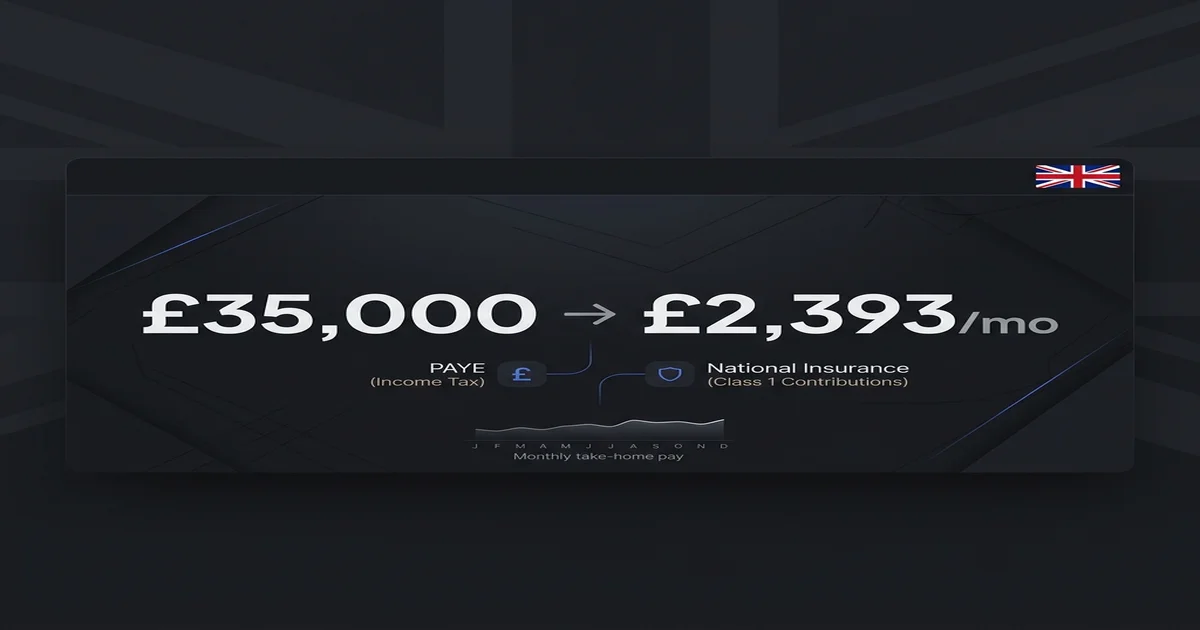
The 2026/27 tax year started on 6 April, and if your payslip looks slightly different this month, you are not alone. Whether you're trying to figure out why your take-home pay has changed, or you've just received a job offer for £38,000 and need to know exactly what hits your bank account, understanding the core deductions is critical. You know you pay income tax and National Insurance, but how those figures are actually calculated often feels like a complete mystery.
The Formula
Take-home = (Salary − Tax − NI) ÷ 12
Example — £35,000 salary:
Tax: £4,486/yr = £374/mo · NI: £1,794/yr = £150/mo
Monthly take-home: £2,917 − £374 − £150 = £2,393
How UK Take-Home Pay Is Calculated
Subtract the Personal Allowance
Before any income tax is calculated, you get a tax-free allowance of £12,570. On a £35,000 salary, your actual taxable income is only £22,430 (£35,000 − £12,570).
Apply Income Tax Rates
Your taxable income of £22,430 falls entirely within the basic rate band, which is 20%. So, £22,430 × 20% equals a yearly income tax bill of £4,486 (or £374 per month).
Calculate National Insurance
National Insurance is charged at a rate of 8% on earnings above £12,570. Your eligible earnings are £22,430. Applying the 8% rate gives a yearly National Insurance cost of £1,794 (or £150 per month).
UK Tax Rates 2026/27
The rates haven't changed drastically since last year, but you'll want to recognise the exact thresholds to understand your pay.
Income Tax Bands
- Personal Allowance: £12,570 (0%)
- Basic Rate: £12,571 – £50,270 (20%)
- Higher Rate: £50,271 – £125,140 (40%)
- Additional Rate: Above £125,140 (45%)
National Insurance
- 0%: Up to £12,570
- 8%: £12,570 – £50,270
- 2%: Above £50,270
Practical Tip: The personal allowance taper above £100,000 is one of the more counterintuitive parts of the UK tax system: your allowance reduces £1 for every £2 earned above £100,000, creating an effective 60% marginal rate on income between £100,000 and £125,140.
UK Take-Home Pay Table 2026/27
| Salary | Monthly Gross | Tax + NI | Monthly Take-Home | Effective Rate |
|---|---|---|---|---|
| £20,000 | £1,667 | £149 | £1,518 | 10.8% |
| £25,000 | £2,083 | £290 | £1,793 | 13.9% |
| £30,000 | £2,500 | £373 | £2,127 | 14.9% |
| £35,000 | £2,917 | £524 | £2,393 | 17.9% |
| £40,000 | £3,333 | £657 | £2,676 | 19.7% |
| £45,000 | £3,750 | £790 | £2,960 | 21.1% |
| £50,000 | £4,167 | £880 | £3,287 | 21.1% |
| £55,000 | £4,583 | £1,109 | £3,474 | 24.2% |
| £60,000 | £5,000 | £1,219 | £3,614 | 27.7% |
| £70,000 | £5,833 | £1,482 | £4,017 | 29.6% |
| £80,000 | £6,667 | £1,815 | £4,519 | 32.3% |
| £100,000 | £8,333 | £2,482 | £5,518 | 39.5% |
* Assumptions: standard 1257L tax code, zero pension contributions, zero student loans, living in England, Wales, or Northern Ireland.
The Most Common Tax Calculation Mistake
This catches a lot of people out: even those who have been employed for years. Many falsely assume their entire salary is fully taxable. They'll just multiply their gross salary directly by the 20% basic rate.
Wrong Calculation:
£35,000 × 20% = £7,000/year ✗
Right Calculation:
(£35,000 − £12,570) × 20% = £4,486/year ✓
Because the £12,570 Personal Allowance essentially shields that initial chunk of earnings, you never pay tax on your whole salary. This is exactly why your effective tax rate is always much lower than your top marginal tax bracket.
Use Our UK Salary Calculator
Working out these percentages manually isn't much fun, especially if you have student loans or pension contributions to factor in. Our dedicated UK salary calculator runs these exact calculations instantly. It automatically handles income tax alongside National Insurance reductions.
Try the UK Salary Calculator →It acts as a complete take-home pay calculator, letting you tweak variables like student loan plans and Scottish tax bands to mirror your exact circumstances.
Examples at Different Salary Levels
It's helpful to see how these numbers shift as you move up the brackets. Here's what your real net pay looks like at three common milestones.
Entry Level (£25,000)
£1,793/mo
Tax: £207/mo · NI: £83/mo
Effective rate: 13.9%
Mid-Career (£35,000)
£2,393/mo
Tax: £374/mo · NI: £150/mo
Effective rate: 17.9%
Higher Rate (£60,000)
£3,614/mo
Tax: £952/mo · NI: £268/mo
Effective rate: 27.7%
Student Loan Repayments
Student Loan Deductions
If you went to university, your student loans will eat into your take-home pay. You'll repay 9% of everything earned over your specific plan's threshold (Plan 1 is £22,015, Plan 2 is £27,295, Plan 4 is £27,660, Plan 5 is £25,000).
On a Plan 2 loan at £35,000, you'll be paying £58/month. This quietly knocks your real monthly take-home from £2,393 down to £2,335.
What About Scottish Income Tax?
Scotland sets its own specific income tax rates via the Scottish Parliament. They use several different tax bands rather than just the three used in England and Wales. For a standard £35,000 salary, Scottish taxpayers pay slightly more overall: roughly £70 to £100 extra per year. However, National Insurance functions identically across the entire UK. Use our salary calculator and check the 'Scotland' option to view your precise deductions.
If you're weighing an entirely different career move abroad, understanding how UK taxes compare to the US might heavily influence your decision. Or, perhaps you're simply trying to understand your daily worth: passing your salary through a reliable tool to convert your salary to an hourly rate can give you completely fresh perspective on your earnings.
Frequently Asked Questions
How much tax do I pay on a £35,000 salary in the UK?
On a £35,000 salary in 2026/27, you pay £4,486 in income tax and £1,794 in National Insurance per year: a combined £6,280. Your monthly take-home is £2,393, giving an effective tax rate of 17.9%. These figures assume you are in England, Wales, or Northern Ireland and have no student loan.
What is the Personal Allowance for 2026/27?
The Personal Allowance for 2026/27 is £12,570. This is the amount you earn completely free of income tax. Income tax is only charged on earnings above this threshold. The allowance applies to most UK taxpayers and has been frozen at £12,570 since 2021/22.
How is National Insurance calculated in the UK?
Employee National Insurance is charged at 8% on earnings between £12,570 and £50,270 per year, and 2% on earnings above £50,270. It is calculated separately from income tax. On a £35,000 salary, NI costs £1,794/year or £150/month.
Why did my take-home pay change in April 2026?
The new 2026/27 tax year began on 6 April 2026. Any HMRC changes to tax codes, thresholds, or NI rates take effect from this date. If your payslip looks different, check your tax code: it should end in L for the standard personal allowance. Contact HMRC or your payroll team if you believe your code is wrong.
How does the 40% higher rate tax work in the UK?
You pay 40% income tax only on the portion of your earnings above £50,270. On a £60,000 salary, you pay 40% on £9,730 (the slice above £50,270), adding £3,892 in higher-rate tax. The rest is taxed at 20%. Your effective rate at £60,000 is 27.7%, not 40%.
What happens to my personal allowance if I earn over £100,000?
Your personal allowance reduces by £1 for every £2 you earn above £100,000. At £125,140 it disappears entirely. This creates an effective 60% marginal rate on income between £100,000 and £125,140: the main reason high earners often increase pension contributions to bring adjusted income below £100,000.
Do student loan repayments reduce my monthly take-home pay?
Yes: student loan repayments are deducted from gross salary through PAYE, on top of income tax and NI. On Plan 2 at a £35,000 salary, you repay 9% on earnings above £27,295, that is £693/year or £58/month. Your monthly take-home drops from £2,393 to £2,335. Plan thresholds differ: Plan 1 is £22,015, Plan 4 (Scotland) £27,660, Plan 5 £25,000.
Getting your net pay right shouldn't require a degree in finance. Check out our online salary calculator to effortlessly see your exact take-home and explore more guides over on the main Cashluom blog.
Sources & Citations: Content verified against official guidelines from the IRS (US), HMRC (UK), and ATO (AU). Information is reviewed for accuracy prior to publication.
Free Calculator
Salary Calculator
Calculate your exact net take-home pay after all government deductions. Our salary tool handles UK PAYE/NI, US Federal/State taxes, Australian ATO rates, and more. Enter your gross annual pay to see your monthly, bi-weekly, and weekly cash in hand. Updated for the latest 2026 tax brackets and social security thresholds.


Comments are coming soon. Have feedback? Contact us.