

When you see a price on a receipt in Ontario, the total already includes the 13% HST. But if you're running a business, claiming Input Tax Credits (ITCs), processing expense reports, or just trying to understand how much tax you actually paid on a purchase, you need to extract the HST from that total. This is called reverse HST calculation, and it's simpler than it sounds. This guide walks through the exact Ontario formula with worked examples for every common scenario.
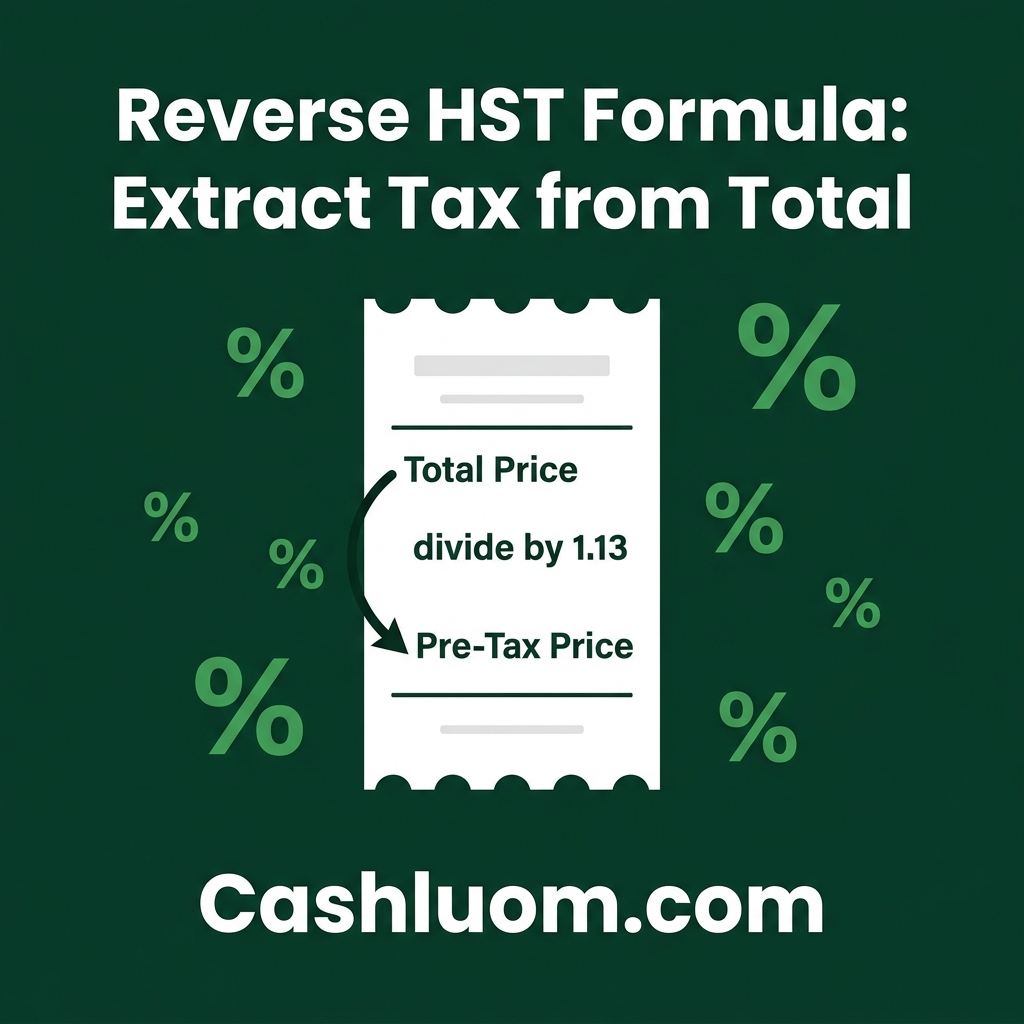
Ontario Reverse HST Formula
Net Price = Total ÷ 1.13 | HST = Total − Net Price
Example: $226 total → $226 ÷ 1.13 = $200 net → HST = $226 − $200 = $26.00. The HST is $26 and the pre-tax price is $200.
Ontario HST: Forward and Reverse Calculations
| Total (HST-Included) | Net Price (÷ 1.13) | HST Amount (13%) | Federal GST (5%) | Provincial HST (8%) |
|---|---|---|---|---|
| $56.50 | $50.00 | $6.50 | $2.50 | $4.00 |
| $113.00 | $100.00 | $13.00 | $5.00 | $8.00 |
| $226.00 | $200.00 | $26.00 | $10.00 | $16.00 |
| $565.00 | $500.00 | $65.00 | $25.00 | $40.00 |
| $1,130.00 | $1,000.00 | $130.00 | $50.00 | $80.00 |
| $5,650.00 | $5,000.00 | $650.00 | $250.00 | $400.00 |
⚠️ Ontario HST rate: 13% (5% federal + 8% provincial), current as of 2026. To separate federal from provincial: GST = Net × 5%; Provincial HST portion = Net × 8%. Source: CRA — GST/HST for Businesses.
When Do You Need to Reverse-Calculate HST?
The reverse HST calculation is used regularly by businesses and self-employed Canadians in the following situations:
- Input Tax Credit (ITC) claims: To claim HST you paid on business expenses, you need to know the exact HST amount, which requires reversing it from the receipt total when the receipt shows a grand total without a clear tax breakdown
- HST return preparation: Businesses report total HST collected and total ITCs separately on their HST return: both require knowing the HST portion of various transactions
- Expense reporting: When submitting employee expenses, many companies require the tax portion to be separated from the net amount for accounting purposes
- Real estate and new homes: When calculating the HST component of a new home purchase for CMHC or rebate calculations
- Price comparison: Comparing HST-inclusive prices in Ontario with PST/GST prices in other provinces (where only 5% GST applies) requires knowing the base price
Ontario HST Compared to Other Canadian Provinces
Ontario's 13% HST is a harmonized tax: a single combined federal + provincial rate. Other provinces use separate GST and PST systems. Here's how Ontario compares and what the reverse formula is for each jurisdiction:
| Province | Tax Structure | Total Rate | Reverse Formula | Divide Total By |
|---|---|---|---|---|
| Ontario | HST | 13% | Net = Total ÷ 1.13 | 1.13 |
| Nova Scotia | HST | 15% | Net = Total ÷ 1.15 | 1.15 |
| New Brunswick / NL / PEI | HST | 15% | Net = Total ÷ 1.15 | 1.15 |
| BC | GST + PST | 5% + 7% = 12% | Net = Total ÷ 1.12 | 1.12 |
| Quebec | GST + QST | 5% + 9.975% = 14.975% | Net = Total ÷ 1.14975 | 1.14975 |
| Alberta | GST only | 5% | Net = Total ÷ 1.05 | 1.05 |
| Saskatchewan | GST + PST | 5% + 6% = 11% | Net = Total ÷ 1.11 | 1.11 |
Separating Federal GST from Provincial HST in Ontario
For some purposes (particularly ITC allocation for partially exempt businesses), you need to separate Ontario's HST into its federal (5%) and provincial (8%) components:
- Step 1: Calculate net price: Total ÷ 1.13
- Step 2: Federal GST = Net price × 0.05
- Step 3: Provincial portion = Net price × 0.08
- Verify: GST + Provincial = Total HST amount
Example: $452 total in Ontario → Net = $452 ÷ 1.13 = $400. Federal GST = $400 × 0.05 = $20. Provincial = $400 × 0.08 = $32. Total HST = $52. Check: $400 + $52 = $452. ✓
📊 Chart Suggestion: "Visual diagram showing a $1,000 Ontario receipt: $1,000 total → ÷ 1.13 → $884.96 net + $115.04 HST (split: $44.25 GST + $70.80 provincial). Title: 'How to Split an Ontario Receipt: Net Price vs HST Breakdown'"
Frequently Asked Questions
How do I calculate the reverse HST in Ontario?
Divide the total (HST-inclusive) price by 1.13 to get the net price (before HST). Subtract the net price from the total to get the HST amount. Example: $339 total ÷ 1.13 = $300 net. $339 − $300 = $39 HST. This works because the total equals the net price multiplied by 1.13 (1 + 13%). Dividing by 1.13 reverses this multiplication.
What is the HST rate in Ontario in 2026?
Ontario's HST rate is 13%: made up of 5% federal GST and 8% provincial component. This rate has been in place since Ontario joined the harmonized system in 2010. The rate applies to most goods and services sold in Ontario, with exceptions for zero-rated items (basic groceries, prescription drugs, most health services) and exempt items (most residential rent, financial services).
Can I claim back the HST I pay on business purchases?
Yes: as a GST/HST-registered business, you can claim Input Tax Credits (ITCs) for the HST paid on business-related purchases. The ITC reduces your HST remittance to the CRA. You need a proper receipt showing the supplier's HST registration number (for amounts over $30), and the expense must be for commercial (not personal) activities. Keep all receipts for 6 years as the CRA may request them in an audit.
Do I pay HST on tips at a restaurant in Ontario?
HST applies to the food and beverage charges, not to the voluntary tip. If your bill (food + HST) is $113 and you add a 15% tip on the pre-tax amount ($15), the total you pay is $128. The tip of $15 is not subject to additional HST. Mandatory service charges added by the restaurant (for large groups) are typically subject to HST, as they're considered part of the taxable supply.
How is HST different from GST?
GST (Goods and Services Tax) is the federal 5% component that applies across all Canadian provinces and territories. In four provinces (Ontario, Nova Scotia, New Brunswick, and Newfoundland & Labrador, PEI), the provincial sales tax is combined ("harmonized") with the federal GST into a single rate: called HST (Harmonized Sales Tax). In Ontario, the 13% HST is 5% GST + 8% provincial. In non-HST provinces (BC, Quebec, Saskatchewan, Manitoba), the federal GST and provincial tax are charged separately.
Final Thoughts
Reverse HST calculation is a core skill for Ontario business owners, bookkeepers, and self-employed individuals. The formula is simple: total ÷ 1.13, but knowing when to use it and how to break down the federal vs provincial components makes a real difference in accurate ITC claims and HST return preparation. Use the Reverse HST Calculator for any amount, any province, and explore our Reverse HST Formula guide for the full mathematical explanation and all provincial formulas in one place.
Sources & Citations: Content verified against official guidelines from the IRS (US), HMRC (UK), and ATO (AU). Information is reviewed for accuracy prior to publication.
Free Calculator
Reverse Tax Calculator
Calculate the original pre-tax price from any price-inclusive total. This tool is essential for business owners and shoppers who need to back out sales tax, VAT, or GST. Supports all 50 US states, UK VAT (20%), Australia GST (10%), Canada GST/HST (all provinces), and custom tax rates for any country worldwide.
Comments are coming soon. Have feedback? Contact us.