

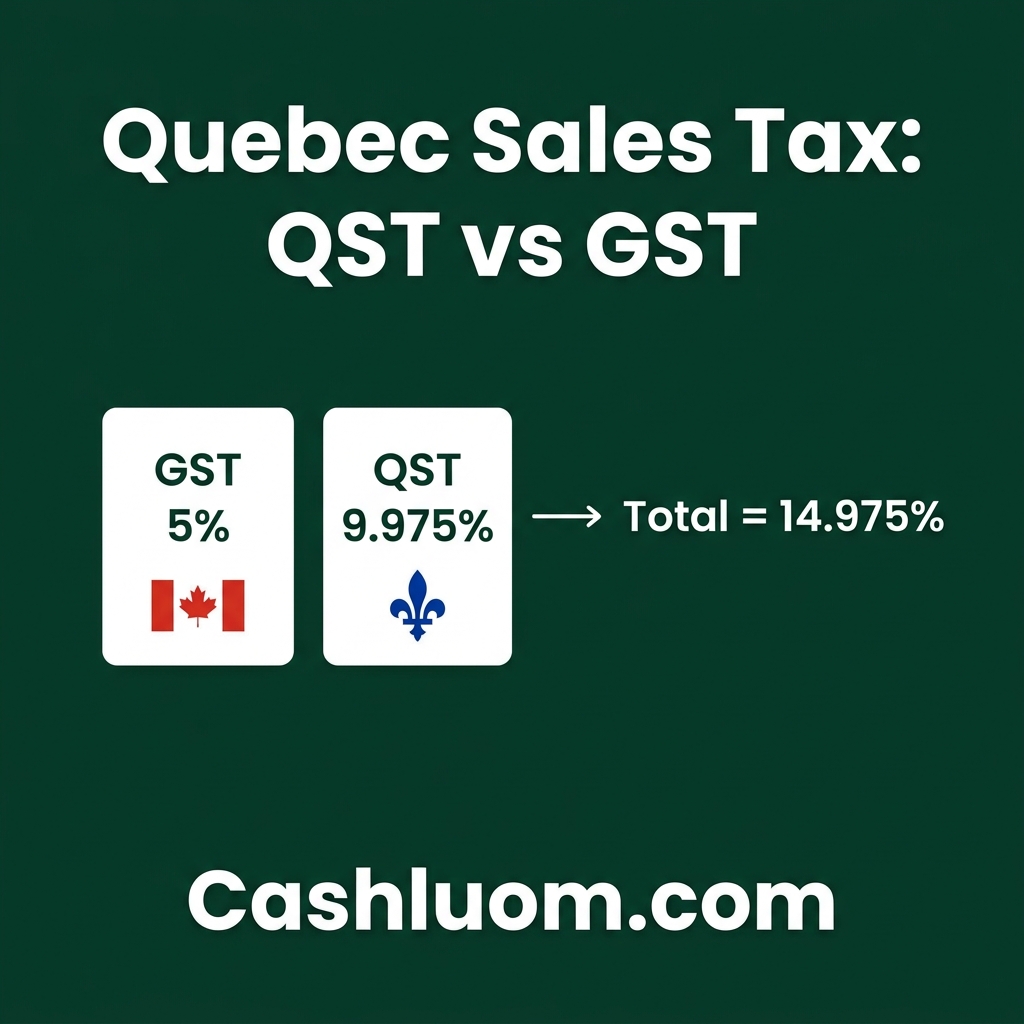
If you've bought anything in Quebec, you've noticed the two lines at the bottom of your receipt: "TPS" (the French acronym for GST) and "TVQ" (Quebec Sales Tax: taxe de vente du Québec). Together they add up to 14.975% on most purchases, but the calculation behind that combined rate is more interesting than it looks. Quebec is the only province in Canada that runs its own parallel tax administration system, separate from Ottawa. Understanding both taxes is essential for anyone living, working, or doing business in La Belle Province.
Quebec's Two-Tax Formula
Total = Pre-tax × 1.05 × 1.09975
QST is applied to the pre-GST price, not to the GST-inclusive price. That's why the combined rate is 14.975% rather than exactly 14.975%. The quick divisor for removing both taxes from a total: divide by 1.14975.
GST vs QST: What Each Tax Covers
Both taxes apply to the same general categories of goods and services, but they're administered by different governments and have slightly different rules. The 5% federal GST is collected and remitted to Ottawa via the CRA. The 9.975% QST is collected and remitted to Revenu Québec. Quebec's provincial tax authority, which also handles provincial income tax.
| Attribute | Federal GST | Quebec QST |
|---|---|---|
| Rate | 5% | 9.975% |
| Combined rate | 14.975% effective | |
| Applied to | Pre-tax price | Pre-tax price (not GST-inclusive) |
| Administered by | Canada Revenue Agency (CRA) | Revenu Québec |
| Registration threshold | $30,000 revenue | $30,000 revenue |
| Return filing | CRA GST return | Revenu Québec QST return |
| Input tax credits | ITCs (CRA) | ITRs — Input Tax Refunds (Revenu QC) |
| Acronym on receipts | TPS (taxe sur les produits et services) | TVQ (taxe de vente du Québec) |
The Math: Why 14.975% Not 14.95%?
This is the most commonly misunderstood part of Quebec's tax system. Since QST is applied to the pre-GST price (not the GST-inclusive total), the combined rate isn't a simple addition of 5% + 9.975% = 14.975%. In practice, the rates are applied sequentially: both on the same original price, which means the combined effective rate is exactly 14.975% (not 14.95%). Here's the algebra:
- Starting price: $100
- GST (5% on $100): $5.00 → subtotal with GST: $105.00
- QST (9.975% on $100): $9.975 → QST is on original price, not on $105
- Total tax: $5.00 + $9.975 = $14.975
- Total charged: $114.975 ≈ $114.98
- Effective combined rate: $14.975 ÷ $100 = 14.975%
Compare this to a hypothetical where QST was charged on the GST-inclusive price: 9.975% of $105 = $10.47: bringing the total to $115.47 and an effective rate of 15.47%. That's not how Quebec works — QST applies only to the original pre-tax price.
| Pre-tax Amount | GST (5%) | QST (9.975%) | Total Tax | Total Price |
|---|---|---|---|---|
| $10.00 | $0.50 | $1.00 | $1.50 | $11.50 |
| $50.00 | $2.50 | $4.99 | $7.49 | $57.49 |
| $100.00 | $5.00 | $9.98 | $14.98 | $114.98 |
| $500.00 | $25.00 | $49.88 | $74.88 | $574.88 |
| $1,000.00 | $50.00 | $99.75 | $149.75 | $1,149.75 |
| $5,000.00 | $250.00 | $498.75 | $748.75 | $5,748.75 |
⚠️ Data as of May 2026. QST amounts rounded to nearest cent. Verify at Revenu Québec.
QST Exemptions: Where Quebec Differs from GST
The exemption lists for GST and QST are largely harmonized: basic groceries, prescription drugs, and health services are zero-rated under both. But there are some Quebec-specific differences:
| Item | GST Status | QST Status | Net Tax in Quebec |
|---|---|---|---|
| Basic groceries | Zero-rated (0%) | Zero-rated (0%) | 0% |
| Prescription drugs | Zero-rated (0%) | Zero-rated (0%) | 0% |
| Restaurant meals | Taxable (5%) | Taxable (9.975%) | 14.975% |
| Municipal transit passes | Taxable (5%) | Exempt (0%) | 5% only |
| Electricity (residential) | Taxable (5%) | Zero-rated (0%) | 5% only |
| Books (printed) | Zero-rated (0%) | Zero-rated (0%) | 0% |
| Children's clothing (eligible) | Zero-rated (0%) | Zero-rated (0%) | 0% |
| Legal services | Taxable (5%) | Taxable (9.975%) | 14.975% |
📊 Chart Suggestion: "Side-by-side comparison bar chart showing combined sales tax rates: Quebec 14.975% vs Ontario 13% vs BC 12% vs Alberta 5%. Title: 'Canadian Sales Tax Rates by Province 2026: Quebec Pays the Most'"
Frequently Asked Questions
What is the difference between TPS and TVQ in Quebec?
TPS (taxe sur les produits et services) is the French name for the federal 5% GST. TVQ (taxe de vente du Québec) is the provincial Quebec Sales Tax at 9.975%. Both appear as separate line items on Quebec receipts. TPS is administered by the CRA; TVQ is administered by Revenu Québec. Together they make up the 14.975% combined rate.
Why is Quebec's combined sales tax rate 14.975% and not 15%?
Because QST (9.975%) is applied to the pre-GST price, not the GST-inclusive price. Both taxes are calculated on the same original price and then added together: 5% + 9.975% = 14.975% of the original amount. If QST were applied to the GST-inclusive price, the effective rate would be higher (around 15.47%). The 14.975% rate is exact, not a rounding.
Do Quebec businesses file separate GST and QST returns?
Yes. Quebec businesses register separately for GST (with the CRA) and QST (with Revenu Québec). Returns are filed separately on different schedules. However, Revenu Québec administers both taxes on behalf of the federal government in Quebec under a special agreement, so in practice many Quebec businesses file both returns through Revenu Québec's online portal.
Are there Input Tax Refunds (ITRs) for QST like ITCs for GST?
Yes. In Quebec, businesses claim back the QST paid on business inputs through Input Tax Refunds (ITRs): the QST equivalent of federal ITCs. The rules are largely harmonized with GST ITC rules. You need a valid invoice showing the supplier's QST registration number to claim an ITR, just as you need a GST number for an ITC claim.
Is there QST on out-of-province purchases delivered to Quebec?
Yes. Since 2019, Quebec requires out-of-province (including foreign) suppliers of digital services, streaming, and marketplace sales to register for and collect QST when their revenue from Quebec customers exceeds $30,000. This means Canadian and US companies selling software, streaming, or digital content into Quebec must collect QST from Quebec customers.
What's the reverse formula to extract GST and QST from a Quebec total?
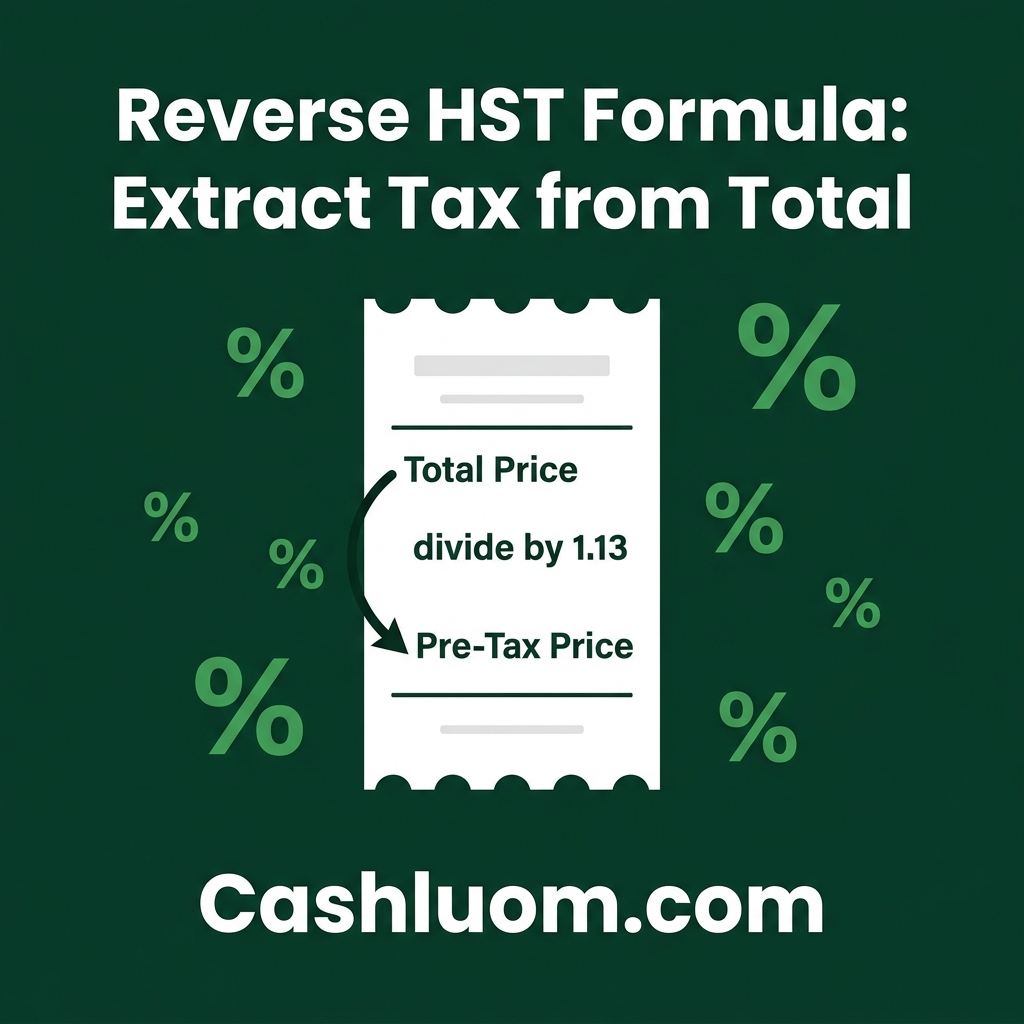
Pre-tax amount = Total ÷ 1.14975. GST portion = pre-tax × 0.05. QST portion = pre-tax × 0.09975. Example: $574.88 total ÷ 1.14975 = $500 pre-tax; GST = $25.00; QST = $49.88. Use the free Reverse Tax Calculator for instant Quebec results.
Final Thoughts
Quebec's QST + GST system is one of the most administratively complex provincial tax setups in Canada: dual registration, dual filing, and a unique Revenu Québec administration. But the combined 14.975% rate is a precise mathematical outcome, not an arbitrary number. Understanding how the two taxes stack helps you price accurately, claim ITRs correctly, and spot errors on invoices. Use our Reverse Tax Calculator (set to Quebec) to instantly extract GST and QST from any total, and read our full Quebec Tax Guide 2026 for income tax brackets, RL-1 slips, and the Quebec abatement explained.
Sources & Citations
Free Calculator
Quebec GST + QST Calculator
Calculate Quebec sales tax: GST 5% + QST 9.975% = 14.975% combined. Add or remove tax instantly.
Comments are coming soon. Have feedback? Contact us.