
What Is Reverse Tax and Why Does It Matter?

Reverse tax calculation is the process of finding the original price of an item before the tax was applied. This is incredibly useful for business expense tracking, freelance accounting, and household budgeting. Often, you only receive the final receipt total after a purchase. You do not see the pre-tax amount or the exact tax charged. Whether you are dealing with GST in Australia, VAT in the UK, or sales tax in the US, the reverse tax formula functions the same way across every tax jurisdiction. Understanding this calculation gives you precise control over your financial records.

Key Takeaway: Understanding the exact reverse tax formula allows you to accurately track expenses and claim crucial tax refunds without manual guesswork.

When you look at a final bill, the tax is already baked in. You cannot simply calculate the tax percentage based on the final total. Doing so is the most common mathematical error people make. By applying the correct reverse tax formula, you separate the exact tax paid from the true cost of the goods. This ensures your financial reporting is accurate and compliant.

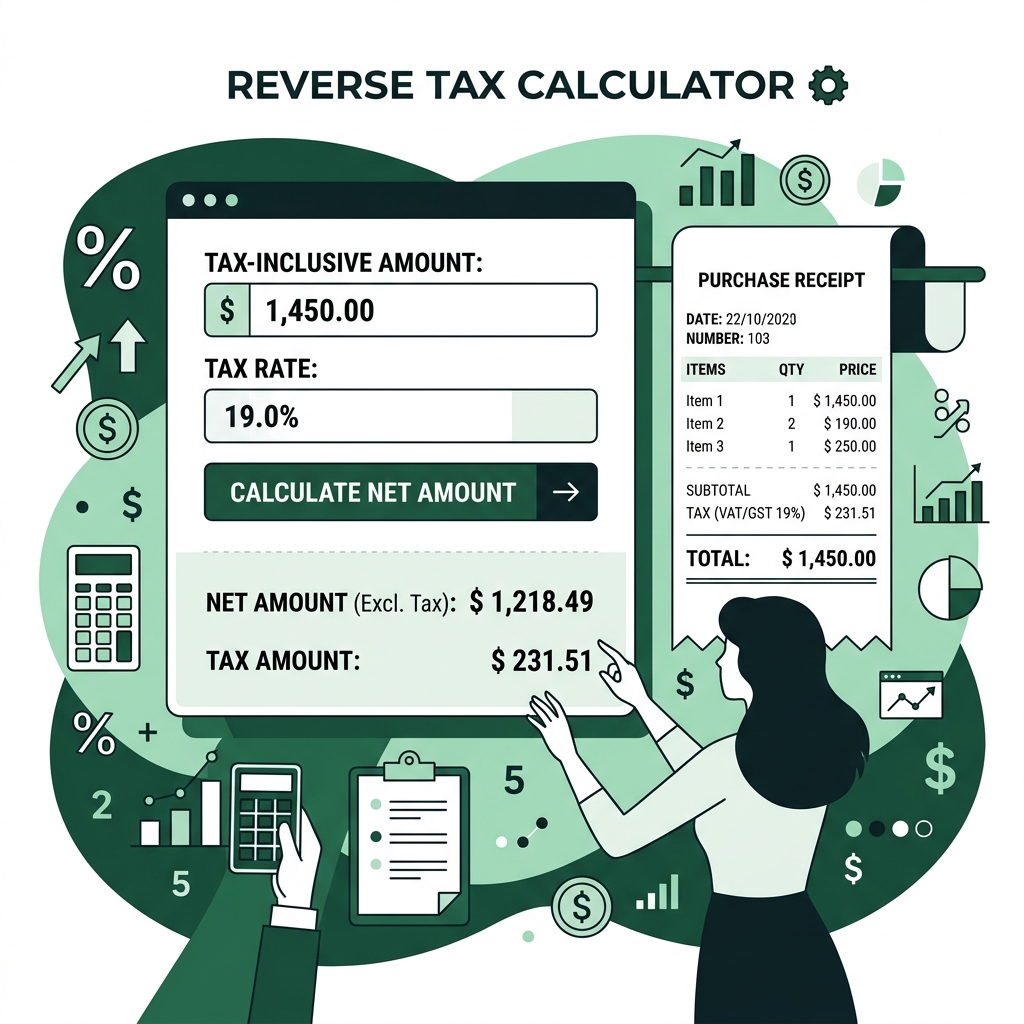
Calculate it instantly: Use the free Reverse Tax Calculator — no signup, results in seconds.

In many regions, businesses can claim back the tax they pay on purchases. If your receipts only show the gross total, you cannot legally claim the input tax credit without doing the math correctly first. A reverse tax calculator saves you significant time when dealing with a massive stack of receipts. It instantly splits gross payments into your exact net income and your tax obligations.

The Reverse Tax Formula Explained Step by Step

The formula to completely remove tax from a final price is remarkably straightforward. It requires only standard division.

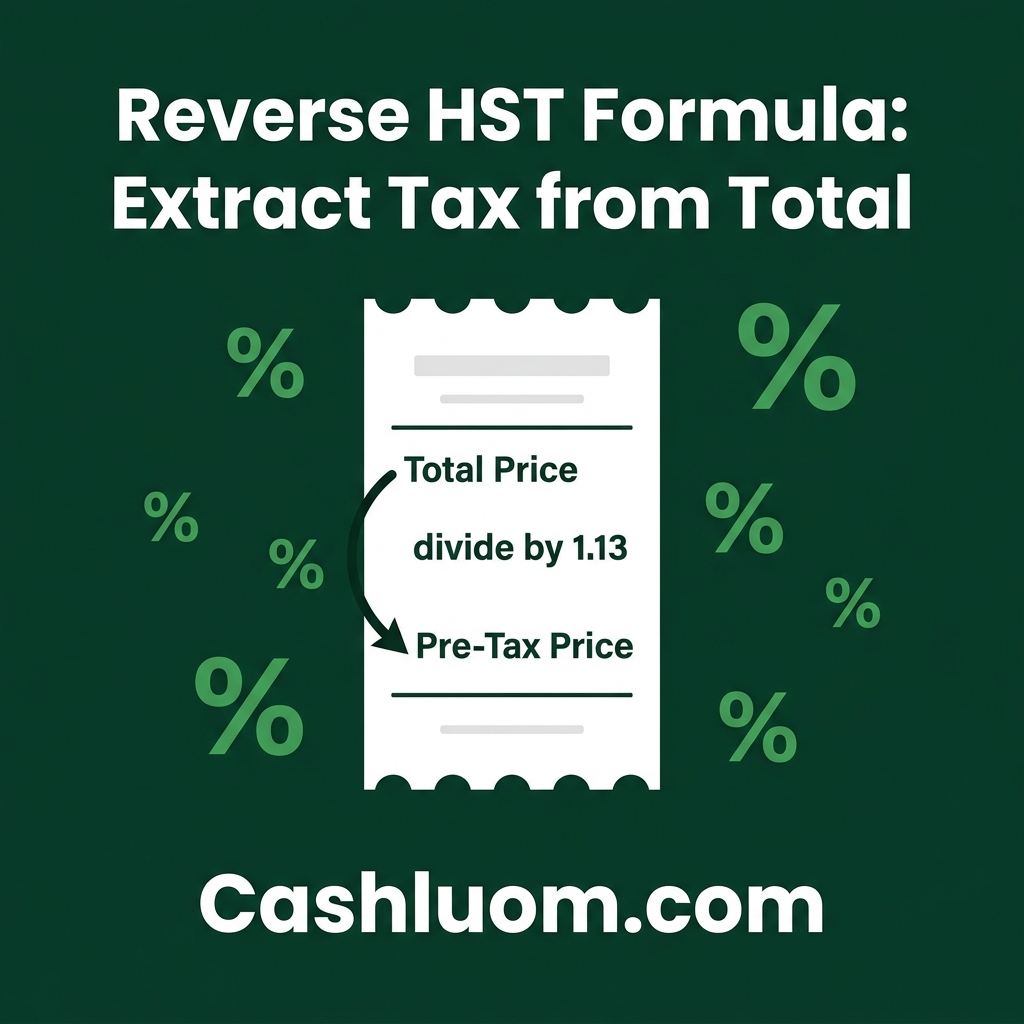
Pre-Tax Price = Total Price ÷ (1 + Tax Rate)

Once you locate the Pre-Tax Price, finding the absolute tax amount is simple subtraction.

Tax Amount = Total Price - Pre-Tax Price

Let us look at a concrete example to illustrate how this works in practice. Say you purchased office supplies and paid a final total of $110. Let us assume the local tax rate applied was 10%. To find the pre-tax amount, convert the 10% rate into the decimal 0.10.

Pre-Tax Price = $110 ÷ (1 + 0.10) Pre-Tax Price = $110 ÷ 1.10 Pre-Tax Price = $100.00

Now, to find the exact tax amount:

Tax Amount = $110 - $100.00 = $10.00

Let us examine a second example. Say you have a UK receipt for software costing £240 and the VAT rate is 20%. To find the pre-tax amount, use the decimal 0.20.

Pre-Tax Price = £240 ÷ 1.20 = £200.00 VAT Amount = £240 - £200 = £40.00

Consider a third example for India GST at an 18% standard rate on a total purchase of ₹11,800. Convert 18% to 0.18.

Pre-Tax Price = ₹11,800 ÷ 1.18 = ₹10,000 GST Amount = ₹11,800 - ₹10,000 = ₹1,800

These calculations apply universally. The math never changes, only the local tax rate and the currency symbol change.

When You Actually Need This

Understanding reverse tax calculation is not just an academic exercise. It has numerous practical applications for both personal finance and formal business operations.

Business Expense Reporting

Suppose you receive a client lunch receipt for exactly £94.80. The company finance department needs the ex-VAT amount for proper expense claims. HMRC and other tax authorities around the world require businesses to track input VAT separately. Submitting the gross amount is incorrect and creates accounting errors. Accurately extracting the pre-tax amount ensures your company can legally reclaim the VAT paid on that lunch.

When an employee submits expenses, the accounting team must diligently verify every single line item. If the receipt does not explicitly state the tax amount, the accountant must reverse calculate it. For a company processing thousands of receipts monthly, automating this calculation is essential for operational efficiency.

Freelancers and VAT Returns

VAT-registered freelancers must separate the exact tax from their total received invoices. When a client pays a combined sum, the freelancer cannot treat the entire amount as personal revenue. Quarterly VAT returns require knowing the precise tax collected on behalf of the government. This money must be ring-fenced and subsequently paid to the tax authority.

Failing to calculate this correctly could result in underpaying your tax obligations. Underpaying taxes invariably leads to severe penalties and compounding interest charges. A quick reverse calculation ensures your books balance perfectly at the end of the financial quarter.

International Shopping and Imports

When buying goods from abroad, VAT or GST is generally added at the final checkout stage. Knowing how to strip this additional cost out is very useful. It allows you to compare the true underlying costs of products across different countries. Some regions apply specific import duties alongside standard sales taxes. Being able to extract the base price helps you evaluate if an international purchase truly saves you money after all customs fees are assessed.

Tax Rates by Country — 2026 Reference Table

Tax rates vary significantly depending exactly where you live. Having a reliable reference is incredibly helpful when managing international expenses.

Country Tax Type Standard Rate Reduced Rate How It Applies
UK VAT 20% 5% / 0% Added to most goods and services.
USA (average) Sales Tax 8% Varies Added at checkout, varies heavily by state.
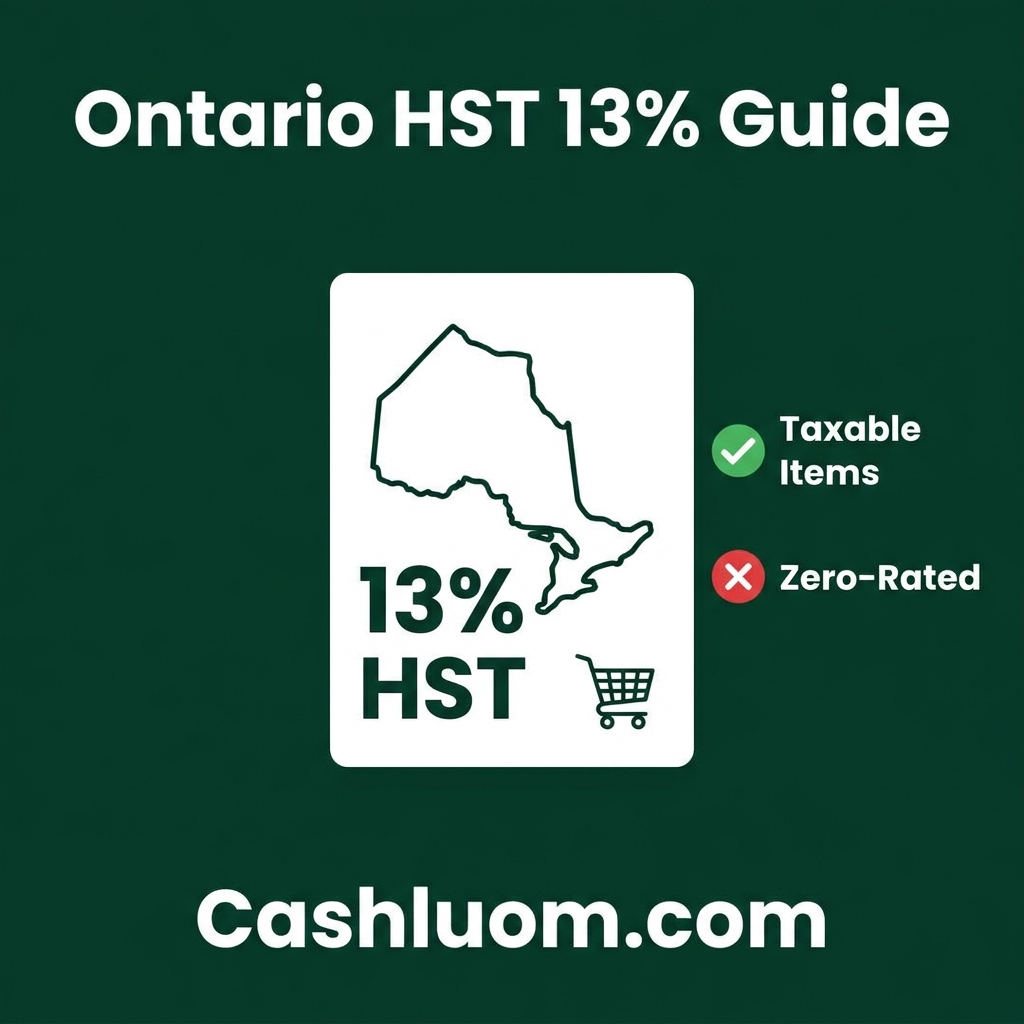
Canada GST/HST 5% - 15% 0% Depends on the specific province.
Australia GST 10% 0% Flat rate on almost all goods and services.
India GST 18% 5% / 12% Multiple slabs based on the item category.
Germany VAT 19% 7% Standard on most everyday items.
France VAT 20% 10% / 5.5% Standard rate is broadly 20%.
Japan Consumption Tax 10% 8% Standard rate applies to most consumer purchases.

Always verify the current local tax rate before completing your permanent financial records. Rates change based on new government legislation. Some specific items, like basic groceries, often benefit from a reduced or zero tax rate in many nations.

Common Mistakes When Calculating Reverse Tax

Manual tax calculations frequently lead to entirely avoidable accounting errors. Recognizing these pitfalls helps you maintain pristine financial records.

Mistake 1: Using the tax rate as a direct percentage of the final total instead of the original price. This is deeply mathematically incorrect. For example, if your total is £240 and the tax is 20%. Wrong: £240 × 20% = £48 tax. Right: £240 ÷ 1.20 = £200 pre-tax, meaning the tax is exactly £40.

Mistake 2: Confusing inclusive and exclusive prices when billing clients. If you quote an exclusive price, you must carefully add the tax on top. If you quote an inclusive price, you must extract the tax before declaring your net revenue. Mixing these up severely distorts your perceived profit margins.

Mistake 3: Applying the standard rate when a reduced rate actually applies. For instance, applying a 20% UK VAT calculation to a receipt for children\'s clothing. Children\'s clothing generally carries a 0% VAT rate. Applying the wrong percentage creates fictional tax amounts that disrupt your formal accounts.

Mistake 4: Rounding errors caused by calculating too quickly. Always carry your division out to at least three decimal places before rounding the final currency figure. Prematurely rounding intermediate numbers skews total tax sums, especially when dealing with massively expensive bulk purchases.

Mistake 5: Forgetting that local and state taxes can aggregate in the US. A single purchase in New York might include a state-level sales tax plus a separate county-level tax. You must combine these rates perfectly before attempting any reverse calculation.

Read more about the different tax systems around the world.

Frequently Asked Questions

Why can not I just subtract the tax percentage?

Subtracting the percentage calculates the tax based on the final total, not the initial pre-tax total. This leads to a mathematically incorrect tax amount.

Is the reverse tax formula the same for VAT, GST, and sales tax?

Yes. The mathematical formula required to reverse a percentage addition remains exactly the same worldwide.

How do I find out the exact tax rate?

Check your local government website (or IRS in the US) or national tax authority for the most up-to-date brackets.

Do I need to calculate this if my receipt shows the tax?

No. If your receipt distinctively items the pre-tax price and the tax paid, you can safely use those numbers directly.

Final Thoughts

Make sure you fully grasp your financial choices by utilizing our free Reverse Tax Calculator.

Sources & Citations: Content verified against official guidelines from the IRS (US), HMRC (UK), and ATO (AU). Information is reviewed for accuracy prior to publication.

Try the Reverse Tax Calculator

Find the original pre-tax price from any total. Supports US sales tax by state, UK VAT, Australia GST, Canada GST/HST, and any custom rate.

Open Calculator →