

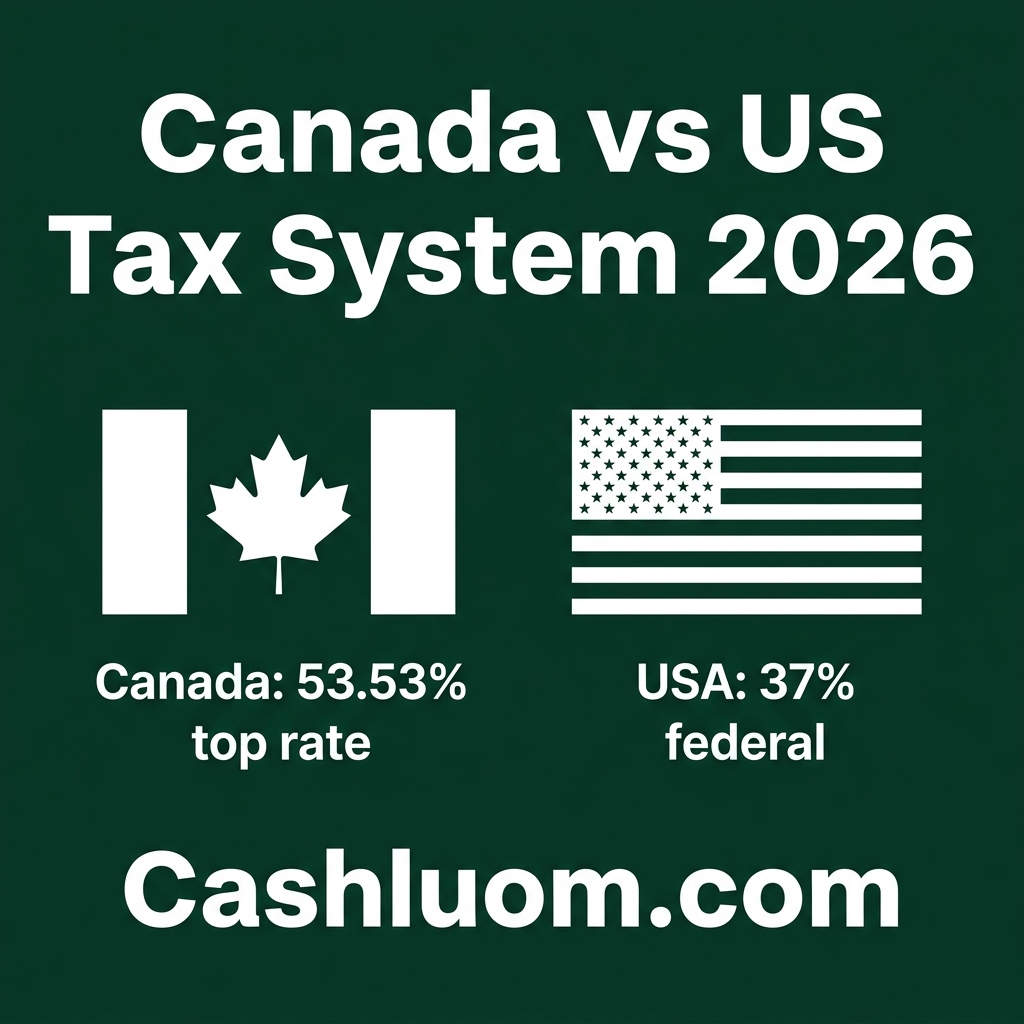
Canada vs US tax is one of the most common comparison questions for professionals considering cross-border employment, immigration, or remote work arrangements. The headline rates suggest Canada is more expensive, and at higher incomes, it often is. But the comparison is more nuanced than bracket rates alone. US workers typically pay for healthcare, childcare, and tertiary education out of pocket; Canadians receive much of this through the tax system. This guide compares the two systems with real income numbers, factoring in healthcare, retirement, and key payroll taxes.
At a Glance: Canada vs US Tax Rates 2026
Canada top: ~53% | US top federal: 37% (+ state) | Bottom: Canada 15% | US 10%
Canada starts taxing at a lower threshold (after the BPA, ~$16K) and reaches the same 33% federal rate at $220K. The US 37% rate kicks in at $626K (single). At mid-incomes ($50K–$150K), Canada's combined rates are typically 2–8% higher than US rates in no-state-tax states.
Income Tax Rate Comparison: Canada vs US (2026)
| Income (CAD/USD equivalent) | Canada (Ontario) Combined | US Federal Only | US (Texas/Florida — no state tax) | US (California) |
|---|---|---|---|---|
| $40,000 | ~20% | ~7% | ~14% (Fed + FICA) | ~18% (Fed + FICA + CA) |
| $60,000 | ~23% | ~9% | ~18% (Fed + FICA) | ~25% (Fed + FICA + CA) |
| $80,000 | ~26% | ~11% | ~21% (Fed + FICA) | ~29% (Fed + FICA + CA) |
| $100,000 | ~29% | ~14% | ~24% (Fed + FICA) | ~32% (Fed + FICA + CA) |
| $150,000 | ~34% | ~21% | ~30% (Fed + FICA) | ~38% (Fed + FICA + CA) |
| $250,000 | ~42% | ~28% | ~35% (Fed + FICA) | ~44% (Fed + FICA + CA) |
⚠️ Approximate effective total rates (income tax + payroll taxes, excluding healthcare). Canada figures include CPP + EI; US figures include FICA. Canada rates are in CAD; the comparison is meaningful for rough purchasing power parity at these income levels. State/provincial rates for select jurisdictions. Actual rates depend on specific deductions, credits, and filing status.
The Hidden Cost Comparison: What You Pay Out of Pocket
The true cost-of-living comparison must include what you pay privately in the US that Canadians receive through the tax system:
| Item | Canada (Taxpayer Funded) | USA (Typically Out of Pocket) |
|---|---|---|
| Healthcare (individual) | Covered by provincial health plan (0$ premiums in most provinces) | $300–$600/month employer-sponsored premium (employee share); more if self-employed |
| Prescription drugs | Partial — most provinces have drug plans; no universal pharmacare (improving) | $0–$500+/month depending on insurance and medications |
| Childcare | $10/day regulated childcare in several provinces; CCB credit | $1,500–$3,000/month in major US cities |
| Post-secondary education | ~$7,000/year average tuition (provincial universities) | $10,000–$60,000+/year depending on institution and state |
| Retirement (CPP vs SS) | CPP: up to ~$1,370/month (2026) — well-funded, indexed | Social Security: up to ~$3,822/month (2024) — depends on contribution history |
| Parental leave | Up to 78 weeks at 55% of earnings via EI | FMLA: 12 weeks unpaid federally; some states add paid weeks |
CPP vs Social Security: Retirement Tax Comparison
Both CPP and Social Security function as mandatory government retirement savings programs: funded by payroll deductions. Key differences:
| Feature | Canada CPP (2026) | US Social Security (2026 est.) |
|---|---|---|
| Employee contribution rate | 5.95% (CPP1) + 4% (CPP2) where applicable | 6.2% |
| Employer contribution rate | Same as employee | 6.2% (capped) |
| Maximum employee contribution (2026) | ~$4,215 | ~$10,918 (6.2% × ~$176K wage base) |
| Maximum monthly benefit at retirement | ~$1,370/month (age 65, 2026) | ~$3,822/month (age 70, 2024) |
| Indexed to inflation | Yes — annual CPI adjustment | Yes — COLA adjustment |
Frequently Asked Questions
Do Canadians pay more tax than Americans?
At comparable incomes, Canadians generally pay more income tax than Americans, but receive universal healthcare, subsidized childcare, EI, and a broader social safety net in return. At $80,000: a Canadian in Ontario pays about 26% combined effective rate; a Texan pays about 21%; a Californian pays about 29%. When you add the cost of US health insurance premiums ($5,000–$15,000/year out of pocket for families), the real financial comparison shifts significantly in Canada's favour for working families.
Which country has a higher maximum income tax rate. Canada or the US?
Canada's top combined (federal + provincial) rate of ~53% in Ontario or Quebec is higher than the US federal top rate of 37%. But the US adds state income taxes of up to 13.3% (California), bringing California's top combined rate to ~54%: nearly equal to Canada's highest rate. US states with no income tax (Texas, Florida, Nevada, etc.) create an apples-to-oranges comparison when comparing to Canadian provincial rates.
Do Canadians pay higher payroll taxes than Americans?
Comparing payroll taxes: Canada's CPP (5.95% up to ~$73K) + EI (1.66%) totals about 7.61% in employee contributions. The US's Social Security (6.2% up to ~$176K) + Medicare (1.45%) totals 7.65%. The rates are very similar. However, the CPP maximum kicks in at a much lower wage ($68,500 in 2025), while US Social Security applies to a much higher wage base: meaning higher-income US workers pay more in Social Security contributions.
If I move from Canada to the USA, what happens to my taxes?
You'll become a US tax resident and be subject to US federal + state income tax on worldwide income. You'll stop accruing CPP credits (but keep what you've earned; CPP can be claimed at 60+ regardless of where you live). Your TFSA must be unwound or becomes taxable in the US (TFSA is not recognized as a tax-exempt account by the IRS). Your RRSP is generally recognized by treaty: you can defer the income until withdrawal. Consult a cross-border tax specialist before making the move: the tax implications are complex.
Can a Canadian working remotely for a US company avoid US taxes?
Generally yes: if you're living and working in Canada for a US employer and are not a US citizen, your employment income is Canadian-sourced and taxed in Canada under the Canada-US Tax Treaty. The US employer typically does not withhold US taxes on your Canadian employment income. However, if you physically work in the US (even temporarily), that income becomes US-source and may be taxable there. Get proper tax advice if you're in this situation, especially regarding FICA obligations.
Final Thoughts
The Canada vs US tax debate rarely has a simple winner: the answer depends on income level, province/state, family situation, healthcare needs, and how you value government services vs private spending. At $80,000 in a high-tax US state like California, Canadians and Americans pay remarkably similar combined rates. At the same income in Texas, Americans pay less, but may spend far more on healthcare, childcare, and education. Use both our Canada Tax Calculator and US Tax Calculator to model your personal comparison, and explore our Canada Tax Guide 2026 for the full framework of the Canadian system.
Sources & Citations: Content verified against official guidelines from the IRS (US), HMRC (UK), and ATO (AU). Information is reviewed for accuracy prior to publication.
Free Calculator
Salary Calculator
Calculate your exact net take-home pay after all government deductions. Our salary tool handles UK PAYE/NI, US Federal/State taxes, Australian ATO rates, and more. Enter your gross annual pay to see your monthly, bi-weekly, and weekly cash in hand. Updated for the latest 2026 tax brackets and social security thresholds.


Comments are coming soon. Have feedback? Contact us.