

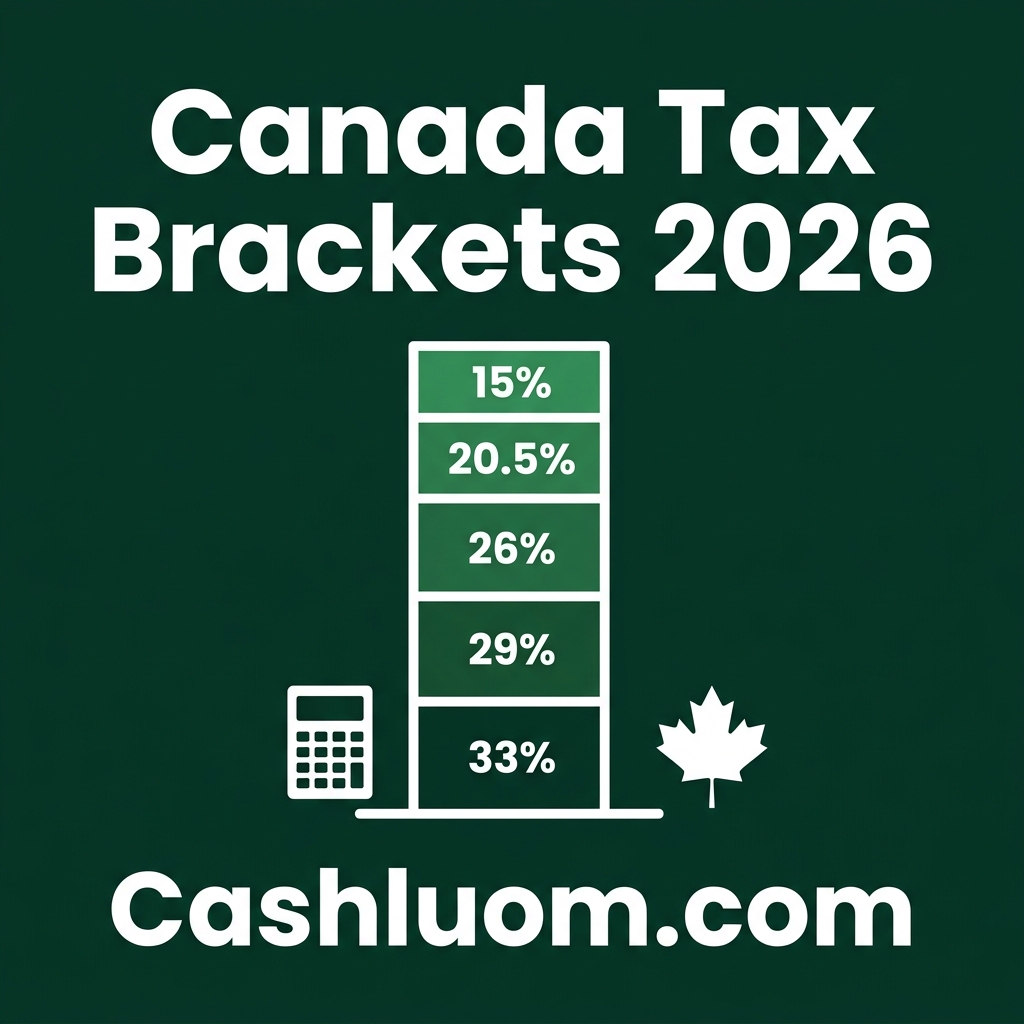
Canada uses a progressive tax system: the more you earn, the higher the rate on the top portion of your income, but not on all of it. The 2026 federal tax brackets have been indexed for inflation, meaning the thresholds shift slightly upward each year so that Canadians don't pay more tax simply because of inflation-driven wage increases. But with many provinces also raising their own brackets (or in some cases not adjusting fast enough), your combined federal + provincial marginal rate determines what you'll actually keep from every additional dollar you earn. This guide covers every federal and key provincial bracket for 2026.
Federal Tax Rates and Bracket Thresholds 2026
BPA: $16,129 | 15% | 20.5% | 26% | 29% | 33%
The Basic Personal Amount (BPA) generates a 15% non-refundable credit of ~$2,419: effectively making the first $16,129 of income tax-free for every Canadian. Federal brackets are indexed annually for inflation using the CPI adjustment.
2026 Federal Income Tax Brackets
| Bracket # | Federal Rate | Income Range (2026) | Tax on This Bracket |
|---|---|---|---|
| 1 | 15% | $0 – $57,375 | Max $8,606 |
| 2 | 20.5% | $57,376 – $114,750 | Max $11,762 |
| 3 | 26% | $114,751 – $158,519 | Max $11,380 |
| 4 | 29% | $158,520 – $220,000 | Max $17,829 |
| 5 | 33% | Over $220,000 | 33% on all above |
⚠️ 2026 federal brackets, inflation-indexed from 2025. Source: CRA. Income Tax Rates for Individuals. These apply to all provinces before provincial tax is added.
Combined Federal + Provincial Top Marginal Rates 2026
Federal rates are only half the picture. Your total marginal rate on the highest dollars of income depends on adding your province's top rate:
| Province | Top Provincial Rate | Income Threshold | Combined Top Marginal Rate |
|---|---|---|---|
| Quebec | 25.75% | Above $119,910 | ~53.31% |
| Ontario | 20.53% | Above $220,000 | ~53.53% |
| Nova Scotia | 21% | Above $150,000 | ~54% |
| BC | 20.5% | Above $240,716 | ~53.5% |
| Prince Edward Island | 18.75% | Above $140,000 | ~51.75% |
| Saskatchewan | 14.5% | Above $49,720 | ~47.5% |
| Manitoba | 17.4% | Above $74,416 | ~50.4% |
| New Brunswick | 19.5% | Above $185,064 | ~52.5% |
| Alberta | 15% | Above $341,708 | ~48% |
⚠️ Combined marginal rate = federal 33% + provincial rate. The highest dollar of income above $220,000 federally faces the maximum combined rate. Provincial rates and thresholds are approximate 2026 estimates; verify at each province's finance ministry. All provinces also add a small "surtax" in some cases (e.g., Ontario's surtax at certain income levels).
How Bracket Indexing Works, and Why It Matters
Canada indexes federal tax brackets annually by the inflation rate (CPI). This prevents "bracket creep": where inflation-driven wage increases push workers into higher brackets without any real increase in purchasing power. For 2026, brackets are approximately 2.7% higher than 2025 levels, reflecting the CPI adjustment. If inflation is 3% but your bracket only increases by 2.7%, you experience a tiny bit of fiscal drag, but far less than in countries where brackets are not indexed.
Some provinces are less consistent with indexing. Saskatchewan, for example, has indexed brackets, while some provinces have historically been slow to adjust, leading to provincial fiscal drag even when the federal system is properly adjusted.
Marginal Rate Worked Example: $120,000 Salary in Ontario
| Portion of Income | Federal Rate | Ontario Rate | Combined Rate | Tax Owed |
|---|---|---|---|---|
| $0 – $57,375 | 15% | 5.05% | 20.05% | $11,497.69 |
| $57,376 – $92,454 (ON bracket end) | 20.5% | 9.15% | 29.65% | $10,396.35 |
| $92,455 – $114,750 | 20.5% | 11.16% | 31.66% | $7,052.21 |
| $114,751 – $120,000 | 26% | 11.16% | 37.16% | $1,950.90 |
| Total before credits | ~$30,897 | |||
⚠️ Illustrative. Does not include BPA credits, Ontario basic personal amount credit, CPP/EI credits, or any other credits/deductions. Actual tax will be lower due to these credits. Use the Canada Tax Calculator for the exact figure.
Frequently Asked Questions
What are the federal income tax brackets in Canada for 2026?
Canada's 2026 federal brackets are: 15% on income $0–$57,375; 20.5% on $57,376–$114,750; 26% on $114,751–$158,519; 29% on $158,520–$220,000; 33% on income over $220,000. These apply before provincial tax is added. The Basic Personal Amount ($16,129) generates a 15% non-refundable credit of ~$2,419, effectively making the first $16,129 tax-free for all Canadians.
Does moving into a higher bracket mean I pay more tax on all my income?
No. Canada's tax system is marginal. Moving into a higher bracket means only the income within (and above) that bracket's threshold is taxed at the higher rate. All income below the threshold continues to be taxed at the lower rate. Example: earning $57,376 instead of $57,375 costs you 20.5% on just that additional $1, not 20.5% on the full $57,376. The lower bracket tax on the first $57,375 is unchanged.
What is the highest marginal tax rate in Canada in 2026?
The highest combined federal + provincial marginal rate in Canada in 2026 is approximately 54% in Nova Scotia for top earners. Ontario's top rate is about 53.53% on income above $220,000. Quebec's top rate is 53.31%. Alberta has the lowest top combined rate at about 48%. These rates apply only to the portion of income above each province's highest threshold, not to all income.
How are Canada's tax brackets indexed for inflation?
The CRA adjusts federal tax brackets annually using the Consumer Price Index (CPI): specifically the CPI for the 12-month period ending September 30 of the prior year. For 2026, this means brackets are approximately 2.7% higher than 2025 thresholds. Bracket indexing prevents "bracket creep": where inflation pushes workers into higher brackets even though their real purchasing power hasn't increased. Most provinces also index their brackets, though methods and timing vary.
What is the Basic Personal Amount in Canada for 2026?
The federal Basic Personal Amount (BPA) for 2026 is approximately $16,129. It's a non-refundable tax credit worth 15% of that amount = ~$2,419 off your federal tax bill. This means every Canadian taxpayer effectively pays zero federal income tax on the first $16,129 of income. Each province also has its own BPA (typically $8,000–$21,003 depending on province) generating a separate provincial credit. The federal BPA is reduced for very high earners (above ~$173,000).
Final Thoughts
Understanding Canada's federal income tax brackets is the foundation of any tax planning strategy. Once you know your marginal rate: the combined federal + provincial rate on your top dollars: you can accurately value RRSP contributions, income-splitting strategies, and other deductions in real dollar terms. Use the Canada Income Tax Calculator to see your exact bracket, effective rate, and how changes (salary increase, RRSP contribution, self-employment income) would affect your tax bill. And explore our income splitting guide for strategies that legally reduce the household's combined marginal rate.
Sources & Citations: Content verified against official guidelines from the IRS (US), HMRC (UK), and ATO (AU). Information is reviewed for accuracy prior to publication.
Free Calculator
Salary Calculator
Calculate your exact net take-home pay after all government deductions. Our salary tool handles UK PAYE/NI, US Federal/State taxes, Australian ATO rates, and more. Enter your gross annual pay to see your monthly, bi-weekly, and weekly cash in hand. Updated for the latest 2026 tax brackets and social security thresholds.
Comments are coming soon. Have feedback? Contact us.