

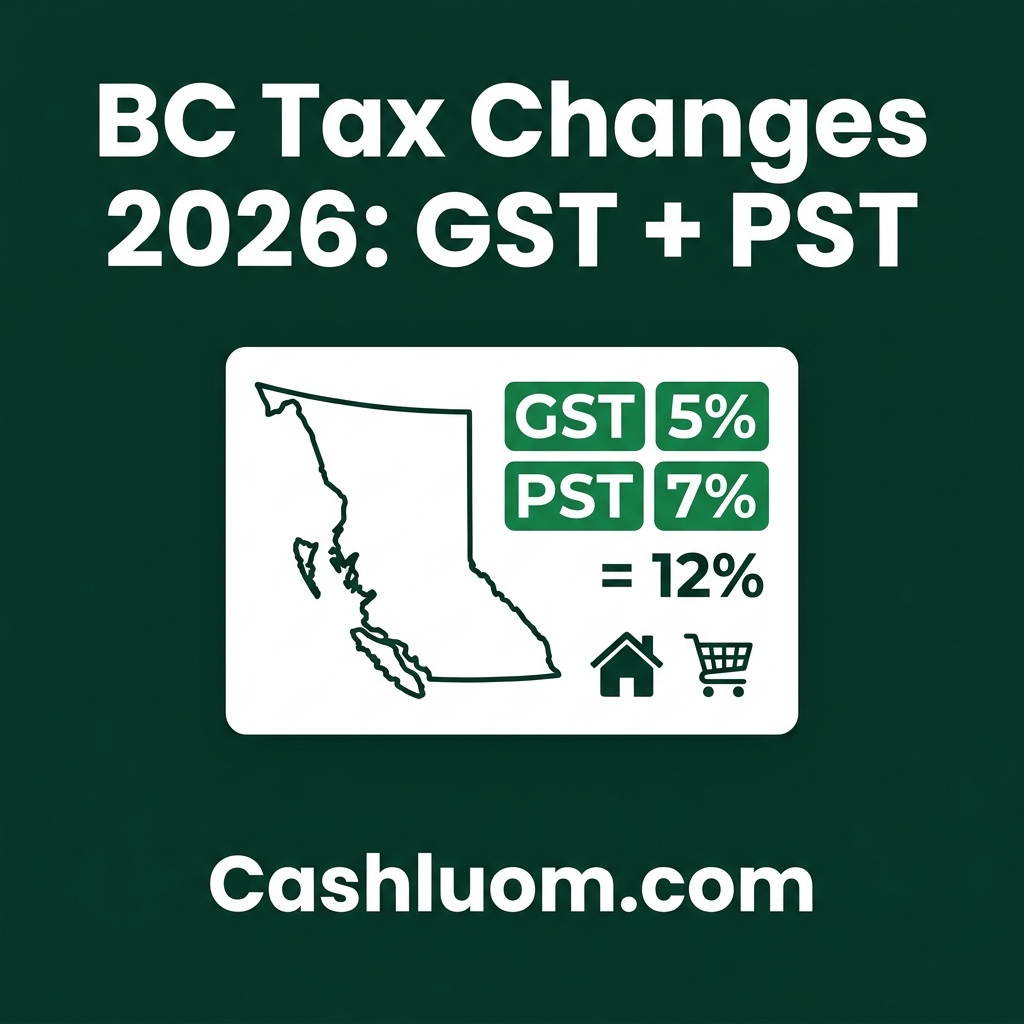
British Columbia is known for its breathtaking landscapes and equally breathtaking cost of living. For the 2026 tax year, the provincial government has introduced several measures to provide relief for middle-income families, including enhancements to the BC Family Benefit and the continuation of the $400 renter's tax credit. While BC boasts some of the lowest income tax rates in Canada for earners making under $100,000, its top marginal rates are among the highest. This guide provides a technical roadmap to help you navigate the 2026 BC tax landscape.
Total BC Tax = (Income × BC Brackets) - Credits + (5% GST + 7% PST)
BC is one of the few provinces that maintains a separate PST system rather than a unified HST, requiring careful tracking of taxable vs. exempt items.
The 7% PST Rule: Exemptions and Luxury Surcharges
British Columbia uses a multi-layered sales tax system. Unlike Ontario's 13% HST, BC charges a 5% federal GST and a 7% provincial PST. However, the PST is not applied to everything. In 2026, many essential items remain PST-exempt, which is a major win for household budgets.
- Exempt Items: Basic groceries, books, magazines, children's clothing, and most bicycles.
- Standard PST (7%): Applies to most retail goods and software.
- Luxury Surcharges: If you are purchasing a vehicle over $125,000, the PST rate can climb as high as 15% or even 20% for certain "passenger vehicles." This is designed to capture more revenue from high-end luxury consumption.
Understanding these exemptions can save a family hundreds of dollars a year. If you are calculating the cost of a major purchase, use our BC Sales Tax Calculator to see the exact breakout of the 5% and 7% portions.
BC's 2026 Income Tax Structure: A Tale of Two Tiers
For the 2026 tax year, BC's income tax brackets have been indexed to inflation. BC remains very competitive for middle-class workers. For example, the first $50,270 of your income is taxed at just 5.06%—the lowest entry-level rate in Canada. However, once you cross the $181,000 threshold, the rates jump significantly, peaking at 20.5% for income over $252,752.
| BC Taxable Income (2026) | Provincial Rate | Combined Rate (with Federal) |
|---|---|---|
| $0 to $50,270 | 5.06% | 20.06% |
| $50,271 to $100,540 | 7.7% | 28.2% |
| $100,541 to $115,420 | 10.5% | 31% – 36.5% |
| $115,421 to $181,355 | 12.29% – 14.7% | 38% – 43.7% |
| Over $252,752 | 20.5% | 53.5% |
Family Benefits and The Renter's Tax Credit
In 2026, BC continues to offer two primary credits that provide immediate relief. The BC Family Benefit is a tax-free monthly payment to families with children under 18. This amount is indexed to inflation and is tapered based on your adjusted family net income.
The $400 Renter's Tax Credit is a non-refundable credit for low-to-moderate income households. If you paid rent for at least six months in BC during the 2026 tax year and your family income is under $60,000, you are likely eligible for the full $400. Even families earning up to $80,000 may receive a partial amount.
Frequently Asked Questions
Is BC's MSP (Medical Services Plan) still free in 2026?
Yes. BC eliminated individual MSP premiums in 2020. However, the provincial government now funds healthcare through the Employer Health Tax (EHT), which is paid by businesses with a payroll over $1 million. As an individual, you no longer receive a monthly MSP bill.
What is the BC Carbon Tax rate for 2026?
The BC Carbon Tax is scheduled to increase in 2026 as part of the provincial climate plan. To offset this, the BC Climate Action Tax Credit is paid quarterly to low and middle-income residents. This credit is often combined with your federal GST/HST credit payment.
Does BC have a basic personal amount like the federal government?
Yes. For 2026, the BC basic personal amount is approximately $12,580. You pay $0 in provincial income tax on your first $12,580 of earnings, though you may still owe federal tax if your total income exceeds the federal BPA of $16,452.
Is software and digital media subject to PST in BC?
Yes. BC is one of the more aggressive provinces regarding digital taxes. Standard software (SaaS or downloaded) is generally subject to 7% PST if it is used in British Columbia.
When is the BC tax deadline for 2026?
The filing deadline is April 30, 2027. If you are self-employed, you have until June 15th to file, but any taxes owing must still be paid by April 30th to avoid interest charges.
BC's tax system is designed to be progressive, offering significant breaks for those starting out while asking more from those at the top. By utilizing the available credits and understanding the PST exemptions, you can navigate the high-cost environment of the West Coast with confidence.
Want to see how your BC taxes compare to other provinces? Use our Canada Salary Calculator to run your 2026 numbers instantly.
Sources & Citations: Content verified against official guidelines from the IRS (US), HMRC (UK), and ATO (AU). Information is reviewed for accuracy prior to publication.
Free Calculator
BC GST + PST Calculator
Calculate the combined impact of GST (5%) and PST (7%) on your British Columbia purchases. This tool handles both adding tax to a net price and removing it from a gross total. Stay on top of your BC sales tax calculations with 2026 verified rates. Essential for shoppers and small business accounting in BC.
Comments are coming soon. Have feedback? Contact us.