

UK Overtime Pay Calculator — 2026
Gross pay before income tax and National Insurance. NMW 2026: £12.21/hr (age 21+).
UK Overtime Rules 2026
- There is no statutory minimum overtime rate in the UK
- The National Living Wage (£12.21/hr for 21+) must be maintained across all hours when averaged
- Most employers pay 1.5× (time and a half) or 2× (double time) voluntarily
- Some employers use TOIL (Time Off In Lieu) instead of payment
- Overtime pay is subject to income tax and National Insurance at your normal rate
Unlike the US, the UK has no legal minimum overtime rate, but most employers pay time-and-a-half. Here's exactly how to calculate what you're owed.
In the US the FLSA forces 1.5× overtime by law. In the UK, your overtime rate is whatever your employment contract says it is, which means two colleagues doing the same job at the same company can be on different overtime rates. Most contracts settle on time-and-a-half as the industry standard, but nothing forces them to.
This guide covers the law, the three common rates, worked examples at £12–£25/hr, bank holiday rules, how overtime is taxed, and the free calculator.
UK Overtime Pay Calculator
Enter your hourly rate, overtime hours, and rate multiplier. See your exact overtime pay instantly.
Open Free Overtime Calculator →Time-and-a-half · Double time · Plain time · No signup
Does UK Law Require Overtime Pay?
UK law does NOT set a minimum overtime rate. The Working Time Regulations 1998 only set a 48-hour average weekly cap. Your right to overtime pay comes from your employment contract, not legislation.
Even without a statutory overtime rate, employers cannot let your effective hourly pay fall below NMW (£12.21/hr in 2026) after including overtime. If they pay plain time for overtime and that brings your average below NMW, they are breaking the law.
Without a contractual term, there is no enforceable right to overtime pay. Your employer could require you to work extra hours at your basic rate. Check your written contract, staff handbook, or any collective bargaining agreement: all three can create enforceable rights.
Common UK Overtime Rates
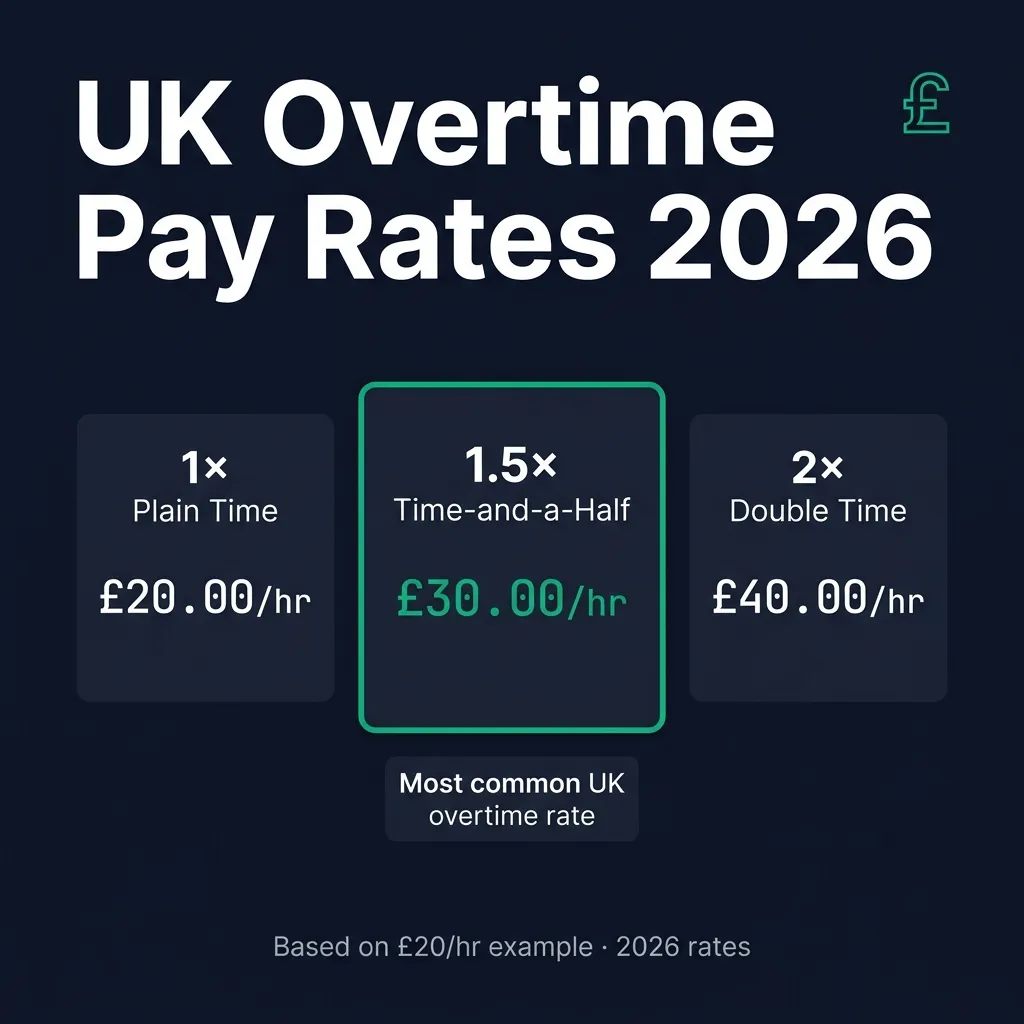
Plain Time (1×)
Rate: Your normal hourly rate. No premium.
When used: Minor overtime by agreement, salaried staff with flexible hours, some zero-hours contracts.
Example: £20/hr stays £20/hr for overtime hours.
Time-and-a-Half (1.5×)
Rate: Hourly rate × 1.5
When used: Standard overtime in most UK employment contracts, weekday evenings, Saturday mornings.
Example: £20/hr becomes £30/hr for overtime.
Double Time (2×)
Rate: Hourly rate × 2
When used: Bank holidays, Sundays, emergency call-outs, sectors like healthcare, retail, logistics.
Example: £20/hr becomes £40/hr for overtime.
Your contract may also specify enhanced rates for specific days (e.g. 1.25× for Saturdays, 1.75× for Sundays). Always refer to your specific employment contract: no single rate applies universally.
How to Calculate Time-and-a-Half in the UK
Example 1 — NMW worker, 5 hours overtime
Regular: 37.5 hrs × £12.21 = £457.88
Overtime: 5 hrs × £18.32 = £91.60 (£12.21 × 1.5)
Total: £549.48
Example 2. Office worker at £15/hr, 8 hours overtime
Overtime: 8 hrs × £22.50 = £180.00 (£15 × 1.5)
Total: £780.00
Example 3. Skilled tradesperson at £25/hr, 10 hours overtime
Overtime: 10 hrs × £37.50 = £375.00 (£25 × 1.5)
Total: £1,375.00
For any combination of hours and rates, use our UK overtime pay calculator.
How to Calculate Double Time in the UK
Double time calculation simply multiplies your hourly rate by 2.0 instead of 1.5.
£13 × 2.0 = £26/hr. 8 hrs × £26 = £208 overtime pay.
£22 × 2.0 = £44/hr. 12 hrs × £44 = £528 overtime pay.
Note: Double time for bank holidays is common in healthcare, logistics, hospitality, and retail, but it is still contractual, not a legal right. Confirm your rate with your contract or HR before assuming.
Hourly Rate Reference Table
| Hourly Rate | Plain Time (1×) | Time-and-a-Half (1.5×) | Double Time (2×) | 10 hrs OT at 1.5× |
|---|---|---|---|---|
| £12.21 (NMW) | £12.21 | £18.32 | £24.42 | £183.15 |
| £13.00 | £13.00 | £19.50 | £26.00 | £195.00 |
| £15.00 | £15.00 | £22.50 | £30.00 | £225.00 |
| £18.00 | £18.00 | £27.00 | £36.00 | £270.00 |
| £20.00 | £20.00 | £30.00 | £40.00 | £300.00 |
| £25.00 | £25.00 | £37.50 | £50.00 | £375.00 |
| £30.00 | £30.00 | £45.00 | £60.00 | £450.00 |
| £35.00 | £35.00 | £52.50 | £70.00 | £525.00 |
Bank Holiday Overtime. Are You Owed Extra Pay?
UK workers have NO automatic right to extra pay for working bank holidays. The statutory right to 5.6 weeks' paid holiday per year can include bank holidays, but whether you get extra PAY for working them is purely contractual.
Many employment contracts in retail, healthcare, hospitality, and logistics offer double time or a day in lieu for bank holiday working. Check your contract's bank holiday clause specifically: it is often a separate clause from the standard overtime rate.
Overtime and Tax. Does Overtime Push You into a Higher Band?
Overtime is taxed as employment income under PAYE: no special rate. But the annualisation effect can cause a temporary higher-rate tax deduction in months with heavy overtime.
HMRC tells payroll software to treat each month as if you earn that amount every month. A month where you earn £5,500 instead of your usual £3,000 gets treated as if your annual salary is £66,000: pushing the extra £2,500 into the 40% higher-rate band temporarily.
The good news is that if your actual annual income stays below £50,270, you will not end up paying 40% overall. The excess tax deducted in high-overtime months balances against lower-tax months across the year. You can also check your cumulative tax position via your payslip's "total tax to date" figure.
Overtime month: £5,500 gross → annualised £66,000 →
First £4,189 of month at 20%, remaining £1,311 at 40%
Extra tax deducted: ~£262 more than a normal month
If annual total stays below £50,270: tax is recalculated and you get the £262 back across subsequent months or as a year-end refund.
For a full take-home pay breakdown including overtime, use our UK salary calculator.
UK vs US Overtime Rules. What's Different?
UK 🇬🇧
- No statutory minimum overtime rate
- Rate set by employment contract
- 48-hour average weekly cap (opt-out available)
- NMW must be maintained across all hours
- Bank holiday pay: contractual only
- No automatic 1.5× for any hours worked
US 🇺🇸
- FLSA mandates 1.5× for all hours over 40/week
- Applies to most non-exempt employees
- No weekly hour cap for adults
- Federal minimum wage ($7.25/hr) must be met
- No federal bank holiday pay requirement
- State laws may add further protections
The practical result: US workers have a federal floor that guarantees time-and-a-half after 40 hours. UK workers depend entirely on what their contract says. Negotiating a 1.5× overtime clause before signing a UK contract is therefore far more important than it would be in the US.
See how UK and US income tax compares overall in our UK vs US tax system guide.
Frequently Asked Questions
What is the overtime rate in the UK?
There is no single statutory overtime rate in the UK. The most common contractual rate is time-and-a-half (1.5× your hourly rate), but some employers pay plain time (1×) or double time (2×) depending on the day and your contract terms. Unlike the US, UK law does not require any minimum overtime premium.
Is overtime compulsory in the UK?
It depends on your contract. If your contract includes a compulsory overtime clause, your employer can require you to work extra hours. If there is no such clause, you cannot generally be forced to work overtime. However, employees cannot average more than 48 hours per week without signing a written opt-out agreement.
How do I calculate time-and-a-half?
Multiply your hourly rate by 1.5. That is your overtime rate per hour. Then multiply by the number of overtime hours worked. Example: £20/hr × 1.5 = £30/hr overtime rate. 8 hours × £30 = £240 overtime pay. Use our free overtime calculator to do this instantly for any rate.
Do I pay more tax on overtime?
Overtime is taxed as regular employment income via PAYE: there is no special overtime tax rate. However, a large overtime payment in a single month can trigger higher-rate deductions due to HMRC's annualisation method. If your total annual income stays below £50,270, any over-deduction is automatically corrected across the rest of the year.
Can my employer refuse to pay overtime?
If your contract specifies an overtime rate, your employer must pay it: refusing is a breach of contract. If your contract is silent on overtime, there may be no enforceable right to any premium. However, your employer must always ensure your pay does not fall below the National Minimum Wage (£12.21/hr in 2026) when all hours are taken into account.
Once you know your contracted overtime rate, use our free UK overtime pay calculator to work out exactly what you're owed for any number of hours at any multiplier.
Sources & Citations: Content verified against official guidelines from the IRS (US), HMRC (UK), and ATO (AU). Information is reviewed for accuracy prior to publication.
Free Calculator
Salary Calculator
Calculate your exact net take-home pay after all government deductions. Our salary tool handles UK PAYE/NI, US Federal/State taxes, Australian ATO rates, and more. Enter your gross annual pay to see your monthly, bi-weekly, and weekly cash in hand. Updated for the latest 2026 tax brackets and social security thresholds.


Comments are coming soon. Have feedback? Contact us.